


- Products
- Catalogs
- News & Trends
- Exhibitions
T300
T300
Catalog excerpts

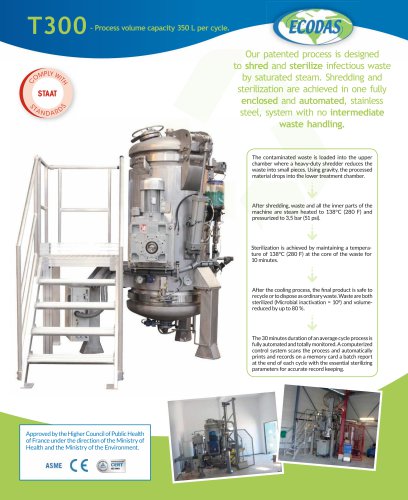
- Process volume capacity 350 L per cycle. STAAT NDARD Our patented process is designed to shred and sterilize infectious waste by saturated steam. Shredding and sterilization are achieved in one fully enclosed and automated, stainless steel, system with no intermediate waste handling. The contaminated waste is loaded into the upper chamber where a heavy-duty shredder reduces the waste into small pieces. Using gravity, the processed material drops into the lower treatment chamber. After shredding, waste and all the inner parts of the machine are steam heated to 138°C (280 F) and pressurized to 3,5 bar (51 psi). Sterilization is achieved by maintaining a temperature of 138°C (280 F) at the core of the waste for 10 minutes. After the cooling process, the final product is safe to recycle or to dispose as ordinary waste. Waste are both sterilized (Microbial inactivation = 108) and volumereduced by up to 80 %. The 30 minutes duration of an average cycle process is fully automated and totally monitored. A computerized control system scans the process and automatically prints and records on a memory card a batch report at the end of each cycle with the essential sterilizing parameters for accurate record keeping. Approved by the Higher Council of Public Health of France under the direction of the Ministry of Health and the Ministry of the Environmen
Open the catalog to page 1
- Process volume capacity 350 L per cycle. Technical specifications General Characteristics Dimensions (L x W x H) Shipping Weight Max weight when filled with water For a special hydraulic test Steam Pressure Operating Characteristics Average Cycle Time Process Volume Capacity Average Waste Density Average Process Weight Capacity Microbial Inactivation Waste Volume Reduction Consumption / cycle Steam 28 rue Sébastopol 59100 ROUBAIX - FRANCE [email protected] www.ecodas.com ENGINEERED SOLUTIONS FOR HEALTHCARE & THE ENVIRONM
Open the catalog to page 2All ECODAS catalogs and technical brochures
 ECODAS T100
2 Pages
 T150
T1502 Pages
 T700
T7002 Pages
 T1000
T10002 Pages
 T2000
T20002 Pages