
- Catalogs
- Edge BioSystems
- QuickStep™2 PCR Purification Kit

QuickStep™2 PCR Purification Kit
QuickStep™2 PCR Purification Kit
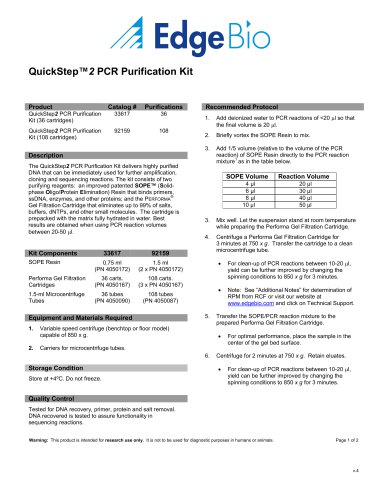
The QuickStep2 PCR Purification Kit is designed for research use to purify DNA for further amplification, cloning, and sequencing. It includes SOPE™ Resin and PERFORMA® Gel Filtration Cartridges to remove impurities such as primers, ssDNA, enzymes, proteins, salts, buffers, and dNTPs. The kit is available in two sizes: 36 and 108 cartridges.
- SOPE Resin: 0.75 ml for 36 cartridges, 1.5 ml for 108 cartridges.
- Performa Gel Filtration Cartridges: 36 or 108 cartridges.
- 1.5-ml Microcentrifuge Tubes: 36 or 108 tubes.
- Requires a variable speed centrifuge capable of 850 x g and carriers for microcentrifuge tubes.
- Store at +4ºC. Do not freeze.
The kit is tested for DNA recovery and removal of primers, proteins, and salts. Recovered DNA is verified for functionality in sequencing reactions.
- Adjust PCR reaction volume to 20 µl with deionized water if necessary.
- Mix SOPE Resin and add 1/5 volume to the PCR reaction.
- Prepare the Performa Gel Filtration Cartridge and centrifuge at 750 x g for 3 minutes.
- Transfer the SOPE/PCR mixture to the cartridge and centrifuge for 2 minutes at 750 x g.
Conversion of RCF to RPM is crucial for accurate centrifugation. Use the formula: RPM = sqrt((RCF * 1000) / (1.12 * r)), where r is the radius in millimeters.
Catalog excerpts

SOPE Volume Product Catalog # Purifications QuickStep2 PCR Purification 33617 36 Description The QuickStep2 PCR Purification Kit delivers highly purified DNA that can be immediately used for further amplification, cloning and sequencing reactions. The kit consists of two purifying reagents: an improved patented SOPE™ (Solid-phase Oligo/Protein Elimination) Resin that binds primers, ssDNA, enzymes, and other proteins; and the Performa® Gel Filtration Cartridge that eliminates up to 99% of salts, buffers, dNTPs, and other small molecules. The cartridge is prepacked with the matrix fully hydrated in water. Best results are obtained when using PCR reaction volumes between 20-50 pl. Kit Components SOPE Resin Performa Gel Filtration Cartridges 1.5-ml Microcentrifuge Tubes 1. Add deionized water to PCR reactions of <20 pl so that the final volume is 20 pl. 2. Briefly vortex the SOPE Resin to mix. 3. Add 1/5 volume (relative to the volume of the PCR reaction) of SOPE Resin directly to the PCR reaction mixture1 as in the table below. 3. Mix well. Let the suspension stand at room temperature while preparing the Performa Gel Filtration Cartridge. 4. Centrifuge a Performa Gel Filtration Cartridge for 3 minutes at 750 x g. Transfer the cartridge to a clean microcentrifuge tube. • For clean-up of PCR reactions between 10-20 pl, yield can be further improved by changing the spinning conditions to 850 x g for 3 minutes. • Note: See “Additional Notes” for determination of RPM from RCF or visit our website at www.edgebio.com and click on Technical Support. Equipment and Materials Required 1. Variable speed centrifuge (benchtop or floor model) capable of 850 x g. 2. Carriers for microcentrifuge tubes. Storage Condition Store at +4°C. Do not freeze. 5. T ransfer the SOPE/PCR reaction mixture to the prepared Performa Gel Filtration Cartridge. • For optimal performance, place the sample in the center of the gel bed surface. 6. Centrifuge for 2 minutes at 750 x g. Retain eluates. • For clean-up of PCR reactions between 10-20 pl, yield can be further improved by changing the spinning conditions to 850 x g for 3 minutes. Quality Control Tested for DNA recovery, primer, protein and salt removal. DNA recovered is tested to assure functionality in sequencing reactions. Warning: This product is intended for research use only. It is not to be used for diagnostic purposes in humans or animals.
Open the catalog to page 1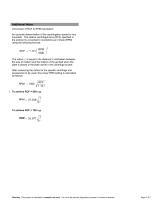
Additional Notes Conversion of RCF to RPM Calculation: An accurate determination of the centrifugation speed is very important. The relative centrifugal force (RCF) specified in the protocol is converted to revolutions per minute (RPM) using the following formula: The radius, r, is equal to the distance in millimeters between the axis of rotation and the bottom of the gel bed when the plate is placed in the plate carrier in the centrifuge bucket. After measuring the radius for the specific centrifuge and accessories to be used, the proper RPM setting is calculated as follows: Warning: This product...
Open the catalog to page 2All Edge BioSystems catalogs and technical brochures
 NimaPOP™
2 Pages


- Solvent reagent
- Molecular biology reagent
- Research reagent
- Laboratory reagent
- Enzyme reagent
- Buffer solution reagent
- Medium reagent
- Microtiter plate
- PCR reagent
- 96-well microplate
- Reagent for nucleic acids
- Laboratory microplate
- Next-generation sequencing reagent kit
- Enzymatic reagent
- Enzyme reagent
- DNA cleanup reagent
- Metal reagent
- Molecular biology microplate
- RNA purification reagent
- PCR microplate