
- Catalogs
- Edgecare Inc.
- EdgeFlow CW10

- Products
- Catalogs
- News & Trends
- Exhibitions
EdgeFlow CW10
EdgeFlow CW10
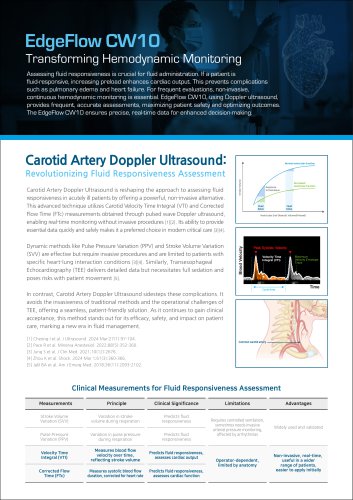
Carotid Artery Doppler Ultrasound is transforming fluid responsiveness assessment in critically ill patients by providing a non-invasive, real-time monitoring solution. This method uses Carotid Velocity Time Integral (VTI) and Corrected Flow Time (FTc) measurements, offering a safer alternative to traditional invasive techniques.
Traditional methods like Pulse Pressure Variation (PPV) and Stroke Volume Variation (SVV) require invasive procedures and are limited to specific conditions. Transesophageal Echocardiography (TEE) provides detailed data but involves sedation and risks with patient movement. In contrast, Carotid Artery Doppler Ultrasound avoids these complications, offering a seamless and patient-friendly solution.
The EdgeFlow CW10 device uses Doppler ultrasound for frequent and accurate assessments of fluid responsiveness, enhancing patient safety and optimizing outcomes. Key measurements include:
- Stroke Volume Variation (SVV): Predicts fluid responsiveness but requires controlled ventilation and may need invasive monitoring.
- Pulse Pressure Variation (PPV): Predicts fluid responsiveness but is operator-dependent and limited by anatomy.
- Velocity Time Integral (VTI): Measures blood flow velocity over time, predicting fluid responsiveness and assessing cardiac output.
- Corrected Flow Time (FTc): Measures systolic blood flow duration, predicting fluid responsiveness and assessing cardiac function.
The EdgeFlow CW10 features AngleFree™ technology, enhancing Doppler ultrasound accuracy by eliminating manual angle adjustments. This user-friendly feature supports continuous, hands-free monitoring, improving measurement reliability and patient outcomes. The device also includes clear B-mode imaging for real-time guidance.
The EdgeFlow CW10 uses patch-type probes for continuous, non-invasive monitoring, overcoming the challenges of TEE and manual Doppler ultrasounds. By attaching directly to the skin, it provides continuous monitoring without manual intervention, enhancing comfort and safety across diverse patient scenarios.
The EdgeFlow CW10 sets a new standard in hemodynamic monitoring, offering a reliable tool for accurate fluid management and improved clinical decisions, advancing patient care.
Catalog excerpts
Transforming Hemodynamic Monitoring Assessing fluid responsiveness is crucial for fluid administration. If a patient is fluid-responsive, increasing preload enhances cardiac output. This prevents complications such as pulmonary edema and heart failure. For frequent evaluations, non-invasive, continuous hemodynamic monitoring is essential. EdgeFlow CW10, using Doppler ultrasound, provides frequent, accurate assessments, maximizing patient safety and optimizing outcomes. The EdgeFlow CW10 ensures precise, real-time data for enhanced decision-making. Carotid Artery Doppler Ultrasound: Normal ventricular function Carotid Artery Doppler Ultrasound is reshaping the approach to assessing fluid responsiveness in acutely ill patients by offering a powerful, non-invasive alternative. This advanced technique utilizes Carotid Velocity Time Integral (VTI) and Corrected Flow Time (FTc) measurements obtained through pulsed wave Doppler ultrasound, enabling real-time monitoring without invasive procedures [1][2]. Its ability to provide Stroke Volume Revolutionizing Fluid Responsiveness Assessment Decreased ventricular function Response to fluid bolus Fluid bolus Fluid bolus Ventricular End-Diastolic Volume(Preload) Dynamic methods like Pulse Pressure Variation (PPV) and Stroke Volume Variation (SVV) are effective but require invasive procedures and are limited to patients with specific heart-lung interaction conditions [3][4]. Similarly, Transesophageal Echocardiography (TEE) delivers detailed data but necessitates full sedation and poses risks with patient movement [5]. Blood Velocity essential data quickly and safely makes it a preferred choice in modern critical care [3][4]. Peak Systolic Velocity Cycle time In contrast, Carotid Artery Doppler Ultrasound sidesteps these complications. It avoids the invasiveness of traditional methods and the operational challenges of TEE, offering a seamless, patient-friendly solution. As it continues to gain clinical acceptance, this method stands out for its efficacy, safety, and impact on patient care, marking a new era in fluid management. [1] Cheong I et al. J Ultrasound. 2024 Mar;27(1):97-104. Velocity Time Integral (VTI) Maximum Velocity Envelope Trace Common carotid artery [2] Pace R et al. Minerva Anestesiol. 2022;88(5):352-360. [3] Jung S et al. J Clin Med. 2021;10(12):2676. [4] Zhou K et al. Shock. 2024 Mar 1;61(3):360-366. [5] Jalil BA et al. Am J Emerg Med. 2018;36(11):2093-2102. Clinical Measurements for Fluid Responsiveness Assessment Measurements Clinical Significance Stroke Volume Variation (SVV) Variation in stroke volume during respiration Predicts fluid responsiveness Pulse Pressure Variation (PPV) Variation in pulse pressure during respiration Predicts fluid responsiveness Velocity Time Integral (VTI) Measures blood flow velocity over time, reflecting stroke volume Predicts fluid responsiveness, assesses cardiac output Corrected Flow Time (FTc) Measures systolic blood flow duration, corrected for heart rate Predicts fluid responsiveness, assesses cardiac function Requires controlled ventilation, sometimes needs invasive arterial pressure monitoring, affected by arrhythmias Widely used and validated Operator-dependent, limited by anatomy Non-invasive, real-time, useful in a wider range of patients, easier to apply initially
Open the catalog to page 1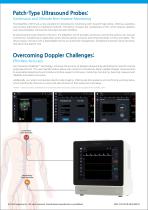
Patch-Type Ultrasound Probes: Continuous and Ultimate Non-Invasive Monitoring The EdgeFlow CW10 sets a new standard in hemodynamic monitoring with its patch-type probe, offering a seamless, zero-invasive alternative to traditional methods. This device conquers the complexities of TEE, which requires sedation, and manual Doppler ultrasounds that need constant handling. By attaching the probe directly to the skin, the EdgeFlow CW10 provides continuous monitoring without any manual intervention, broadening its application across diverse patient scenarios and enhancing both comfort and safety. This...
Open the catalog to page 2All Edgecare Inc. catalogs and technical brochures
 EdgeFlolw UW20
6 Pages
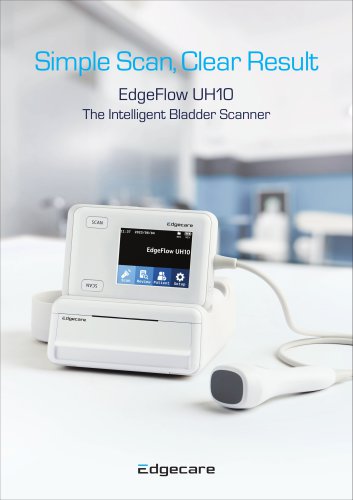 EdgeFlolw UH10
6 Pages