
- Catalogs
- EHD imaging
- EHD-NIRII-640B-U3 in Vivo NIR-II Camera

EHD-NIRII-640B-U3 in Vivo NIR-II Camera
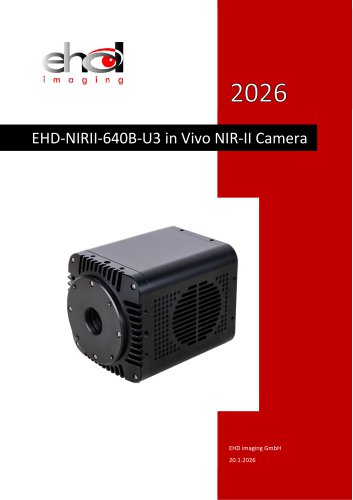
EHD-NIRII-640B-U3 in Vivo NIR-II Camera
The EHD-NIRII-640B-U3 is an advanced NIR-II imaging camera developed by EHD imaging GmbH, designed for in vivo applications. It features a ¾” InGaAs image sensor that operates within the 900–1700 nm spectral band, offering significant advantages in biomedical imaging.
Key Features
- InGaAs image sensor covering the 900–1700 nm NIR-II band.
- Resolution of 640×512 (0.33 MP) with a pixel size of 15 µm × 15 µm.
- Global shutter to eliminate motion distortion.
- Three conversion gain modes (HCG/MCG/LCG) for flexible application adaptation.
- TEC cooling system reducing dark current to 193.909 e⁻ in MCG mode.
- USB 3.2 Gen 2x1 interface for 10 Gbps high-speed data transmission.
- 512 MB onboard buffer for stable data transfer.
- Wide exposure time range from 16 µs to 5 s.
- Supports both 8-bit and 16-bit data output.
- Compatible with Windows and Linux platforms, with a complete SDK provided.
Specifications
- Sensor: InGaAs, monochrome, global shutter.
- Dynamic Range: 55.8 dB (HCG), 58.1 dB (MCG), 58.3 dB (LCG).
- Operating Temperature: -30 °C to +45 °C.
- Certifications: CE / FCC.
NIR-II Imaging
NIR-II imaging operates within the 900–1700 nm band, offering deeper tissue penetration and reduced autofluorescence compared to visible light and NIR-I. It is ideal for biomedical imaging, in vivo studies, and material defect detection.
Comparison with SWIR Imaging
- NIR-II covers 900–1700 nm, while SWIR spans 900–2500 nm.
- NIR-II uses InGaAs sensors; SWIR may use standard or extended InGaAs sensors.
- NIR-II is focused on biomedical imaging, whereas SWIR is used in industrial applications.
TEC Cooling
TEC cooling is essential for reducing dark current and thermal noise in InGaAs sensors, enhancing signal-to-noise ratio for long exposures and weak-signal detection.
Gain Modes
- HCG: Ideal for ultra-weak signals.
- MCG: Balances noise and dynamic range.
- LCG: Maximizes dynamic range for high-contrast scenes.
Applications
- In Vivo Vascular Imaging: Captures vascular networks up to 20 mm deep.
- Tumor Labeling and Detection: Provides superior contrast for tumor resections.
- Lymphatic Tracing: Enables real-time lymphatic mapping.
- Cerebral Vascular Imaging: Non-invasive monitoring of cerebral vasculature.
- Semiconductor Inspection: Inspects internal wafer defects.
- Quantum Dot Fluorescence Imaging: Offers long-term in vivo tracking.
Catalog excerpts

EHD-NIRII-640B-U3 in Vivo NIR-II Camera
Open the catalog to page 1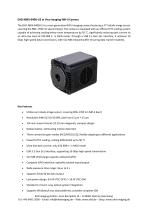
The EHD-NIRII-640B-U3 is a next-generation NIR-II imaging camera featuring a %" InGaAs image sensor covering the 900-1700 nm spectral band. The camera is equipped with an efficient TEC cooling system capable of achieving cooling below room temperature by 50 °C, significantly reducing dark current to an ultra-low level of 193.909 e" in MCG mode. Through a USB 3.2 Gen 2x1 interface, it achieves 10 Gbps high-speed data transmission, with 512 MB onboard buffer ensuring data transfer stability. • Utilizes an InGaAs image sensor, covering 900-1700 nm NIR-II band • Resolution 640x512 (0.33 MP), pixel...
Open the catalog to page 2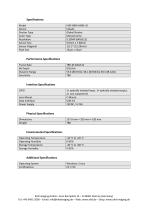
EHD imaging GmbH - Zum Rennplatz 15 - D-49401 Damme (Germany) Tel: +49-5491-2090 - Email: [email protected] - Web: www.ehd.de - Shop: www.ehd-imaging.de
Open the catalog to page 3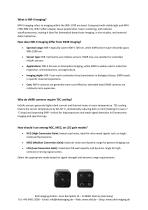
What is NIR-II imaging? NIR-II imaging refers to imaging within the 900–1700 nm band. Compared with visible light and NIR-I (700–900 nm), NIR-II offers deeper tissue penetration, lower scattering, and reduced autofluorescence, making it ideal for biomedical deep-tissue imaging, in vivo studies, and material defect detection. How does NIR-II imaging differ from SWIR imaging? Spectral range: NIR-II typically covers 900–1700 nm, while SWIR (short-wave infrared) spans 900–2500 nm. Sensor type: NIR-II primarily uses InGaAs sensors; SWIR may use standard or extended InGaAs sensors. Applications:...
Open the catalog to page 4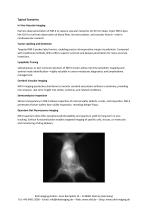
Typical Scenarios In Vivo Vascular Imaging Harness deep penetration of NIR-II to capture vascular networks 10–20 mm deep. Inject NIR-II dyes like ICG for real-time observation of blood flow, microcirculation, and vascular lesions—vital in cardiovascular research. Tumor Labeling and Detection Targeted NIR-II probes label tumors, enabling precise intraoperative margin visualization. Compared with traditional methods, NIR-II offers superior contrast and deeper penetration for more accurate resections. Lymphatic Tracing Subcutaneous or peri-tumoral injections of NIR-II tracers allow real-time lymphatic...
Open the catalog to page 5All EHD imaging catalogs and technical brochures
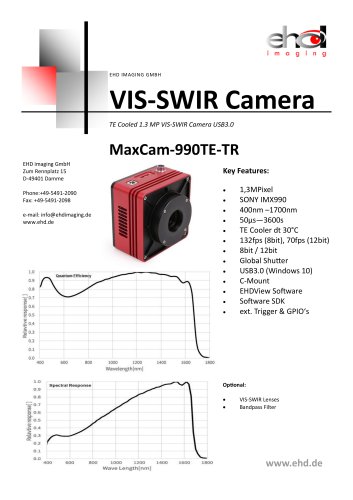 MaxCam‐990TE‐TR
2 Pages
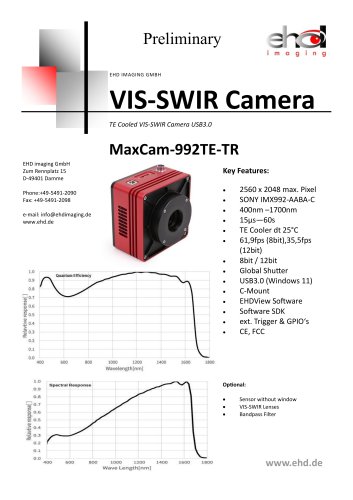 MaxCam-992TE-TR
2 Pages
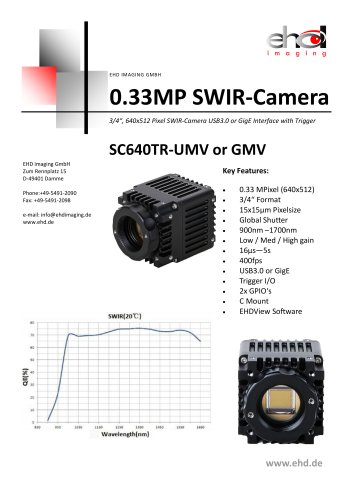 SC640TR-UMV or -GMV
2 Pages
 SC‐2020UV‐ITR
46 Pages
 EHD ICM-Series
51 Pages
 MaxCam‐400UV‐TE
38 Pages
 EHD SC-CTR Series Cooled Cameras
39 Pages
 EHD Vis-SWIR Series
172 Pages
 EHDView Software
137 Pages
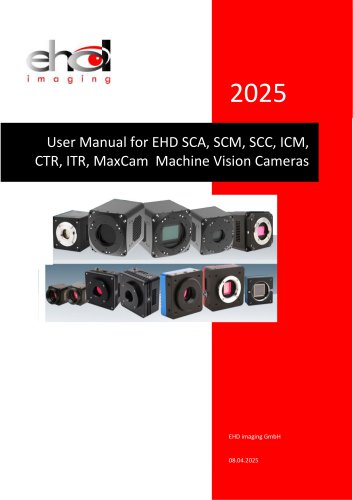 EHD SCM-SCA-SCC-TR series
308 Pages
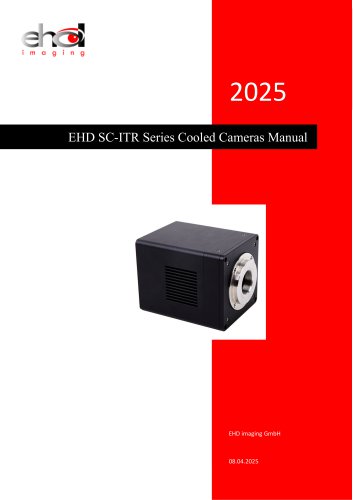 EHD SC-ITR Series
48 Pages
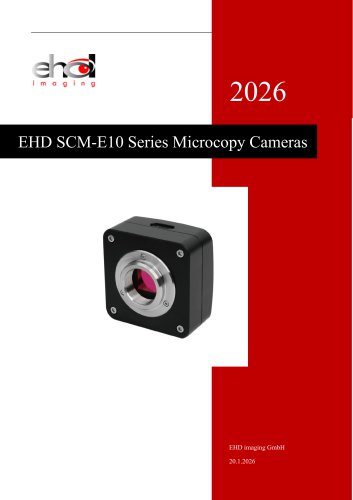 SCM-E10 Series Microcopy Cameras
4 Pages
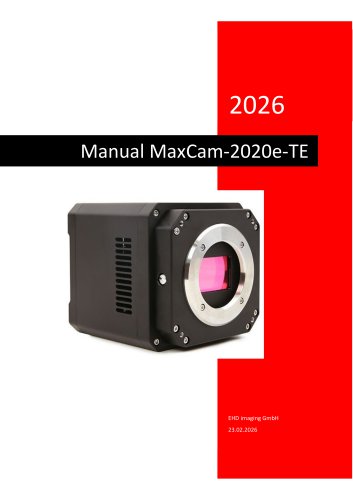 MaxCam‐2020e‐TE
39 Pages
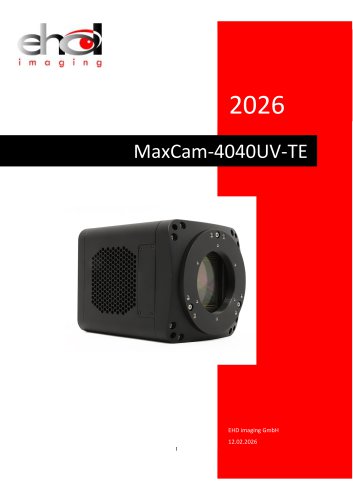 MaxCam‐4040UV‐TE
44 Pages
- Microscopy
- Compound microscope
- Laboratory microscope
- Desktop microscope
- CMOS camera
- Laboratory software
- Camera with USB port
- LED microscope
- Acquisition software
- Medical camera
- Measurement software
- Full HD camera
- HD camera
- Recording software
- Microscope camera
- Fluorescence microscope
- Real-time software
- Digital microscope
- Ultra-high resolution camera
- Monocular microscope