
- Catalogs
- EHD imaging
- MaxCam‐2020e‐TE

MaxCam‐2020e‐TE
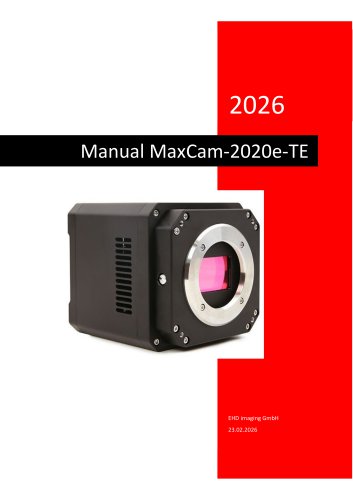
MaxCam‐2020e‐TE
The MaxCam2020e-TE camera is equipped with a GSENSE2020e 1.2-inch image sensor and features an efficient cooling module to minimize thermal noise. It includes an anti-fogging mechanism and utilizes a USB3 interface for rapid data transfer. Key features include a wide spectral response range (400nm - 1000nm), precise temperature control, 2048 x 2048 resolution, and ultra-low readout noise.
The camera supports various frame rates and resolutions, with a dynamic range of up to 81.6dB in HDR mode. Its cooling system can reduce the temperature by 30-35°C below ambient, ensuring low dark current levels.
The camera measures 110 x 110 x 121.5mm, weighs 1.7kg, and includes a C-mount lens. It is compatible with multiple operating systems, including Windows, OSx, and Linux.
The camera features opto-isolated input and output circuits, with additional non-isolated options. It supports various trigger functions, including software and external hardware triggers.
Multiple trigger modes are supported, such as single frame, multi-frame, and counter trigger modes. Advanced functions include plan and sequence triggers with configurable I/O signals and output modes.
The cooling system uses a TEC controlled by a PID algorithm for precise temperature management, ensuring efficient heat dissipation and low dark current levels.
The camera is compatible with EHDView software, offering a professional camera control panel and image processing functions. It supports a wide range of hardware and operating systems.
A comprehensive SDK is included for software development, supporting various platforms and third-party interfaces.
The document details performance parameters in various modes: HCG, LCG, and HDR, each with specific gain values, relative gain in dB, e-/ADU, read noise, full well capacity, and dynamic range.
The camera's dimensions are 100x100x121.5mm with a C mount. The interface includes USB 3.0/2.0, DC power port, and multiple LED indicators.
Standard packing includes the camera, power adapter, USB cable, I/O cable, and optional accessories like a micrometer.
Configurable parameters for input and output signals include trigger edge, debounce time, and trigger delay, with detailed instructions for setting these in the EHDView software.
The document discusses the exposure valid signal and the 'Frame Trigger Wait' signal, indicating when a trigger signal should be inputted to avoid being ignored.
'User Output' mode allows control of line outputs using a 'User Value'. Advanced trigger functions include 'Plan Trigger' and 'Sequence Trigger', supporting soft and external triggers.
The UART function enables communication with external devices via serial port, with configurable baud rates and GPIO settings for TX/RX communication.
EHDView software integrates camera control, image acquisition, and processing, supporting various operating systems and languages.
The SDK supports multiple platforms and APIs, providing resources for developing applications with MaxCam cameras.
The document provides technical details for using the nncam library across various platforms and programming languages.
Includes platform-specific files for Linux, Windows, macOS, Python, and Java, with example code and third-party software interfaces.
SDK usage documentation is available in Simplified Chinese and English.
Includes basic examples like 'demosimplest' and 'demoraw'.
Support for DirectShow, TWAIN, Labview, MatLab, and Micromanager.
EHD Imaging GmbH, Zum Rennplatz 15, D-49401 Damme, Germany. Tel: +49-5491-2090, Email: [email protected], Web: www.ehd.de
Catalog excerpts
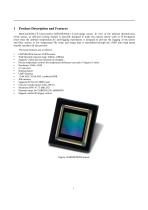
MaxCam2020e-TE is powered by GSENSE2020e 1.2-inch image sensor. In view of the inherent thermal noise of the sensor, an efficient cooling module is specially designed to make the camera sensor work at 35-40 degrees lower than the ambient temperature. An anti-fogging mechanism is designed to prevent the fogging of the sensor and filter surface at low temperature.The video and image data is transmitted through the USB3 ultra high speed transfer interface for fast preview. The basic features are as follows : • GSENSE2020e Science CMOS sensor • Wide Spectral response range: 400nm -1000nm • Supports...
Open the catalog to page 4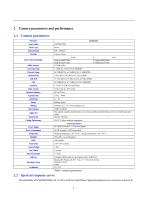
2 Camera parameters and performance 2.1 Camera parameters Table 1 camera parameters 2.2 Spectral response curve
Open the catalog to page 5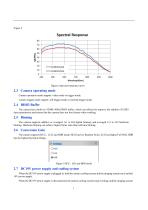
Figure 2 Spectral response curve Camera operation mode support: video mode or trigger mode. Camera trigger mode support: soft trigger mode or external trigger mode. The camera has a built-in 512MB (4Gb) DDR3 buffer, which can effectively improve the stability of USB3 data transmission and ensure that the camera does not lose frames when working. The camera supports additive or averaged 1x1 to 8x8 digital binning, and averaged 1x1 to 2x2 hardware binning. Hardware binning can achieve higher frame rates than software binning. The camera supports HCG^ LCG and HDR mode, HCG has low Readout Noise,...
Open the catalog to page 6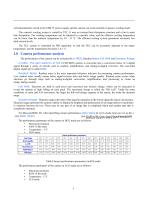
will automatically switch to the USB 5V power supply and the camera can work normally in passive cooling mode. The camera's cooling system is cooled by TEC. It uses an external heat dissipation structure and a fan to assist heat dissipation. The working temperature can be adjusted to a specific value, and the effective cooling temperature can be lower than the ambient temperature by 30 - 35 °C. The efficient cooling system guarantees extremely low dark current levels. The TEC system is controlled by PID algorithm, so that the TEC can be accurately adjusted to the target temperature, and the temperature...
Open the catalog to page 7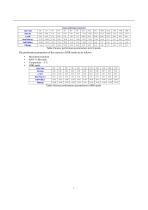
Table 4 Sensor performance parameters in HDR mode
Open the catalog to page 8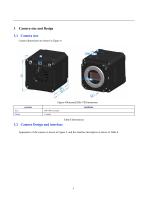
Camera size and Design 3.1 Camera size Camera dimensions are shown in Figure 4. Figure 4 Maxcam2020e-TE Dimensions parameter 3.2 Camera Design and interface Appearance of the camera is shown in Figure 5, and the interface description is shown in Table 6.
Open the catalog to page 9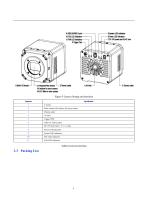
Figure 5 Camera Design and interface Sequence Filter window,AR window for mono camera Thermo outlet Table 6 Camera Interface
Open the catalog to page 10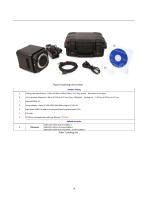
Figure 6 packing information Standard Packing A Packing case specifications L:50cm W:30cm H:30cm (20pcs, 12~17Kg/ carton),Not shown in the figure Power adapter : input: AC 100~240V 50Hz/60Hz,output: DC 19V 4A High‐speed USB3.0 A male to B male gold‐plated head data cable/1.5m CD (Driver and application software, Ø12cm) OPTIONAL Optional accessories
Open the catalog to page 11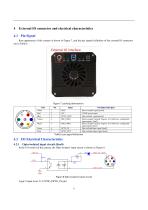
Rear appearance of the camera is shown in Figure 7, and the pin signals definition of the external IO connector are in Table 8. Table 8 pin signal definition In the I/O control of the camera, the Opto-isolated input circuit is shown in Figure 8. Logic 0 input level: 0~2.2VDC (OPTO_IN pin)
Open the catalog to page 12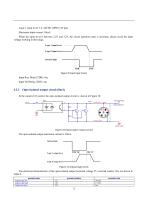
Logic 1 input level: 3.3~24VDC (OPTO_IN pin) Maximum input current: 30mA When the input level is between 2.2V and 3.2V, the circuit operation state is uncertain, please avoid the input voltage working in this range. Logic 1 input level Logic 0 input level Internal logic Figure 9 Input logic levels Input Rise Delay (TDR): 6us Input Fall Delay (TDF): 6us The opto-isolated output maximum current is 30mA. Internal logic Logic 0 output level The electrical characteristics of the opto-isolated output (external voltage 5V, external resistor 1K) are shown in Table 9.
Open the catalog to page 13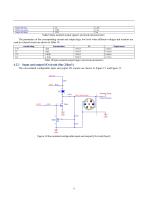
output fall time Output rise delay Output fall delay Table 9 Opto-isolated output signal's electrical characteristics The parameters of the corresponding current and output logic low level when different voltages and resistors are used in external circuit are shown in Table 10. external voltage 3.3V 5V 12V 24V External resistor Table 10 Opto-isolated output logic's low level parameters Input and output I/O circuit (line 2/line3 ) The non-isolated configurable input and output I/O circuits are shown in Figure 12 and Figure 13. Figure 12 Non-isolated configurable input and output I/O circuit (line2)...
Open the catalog to page 14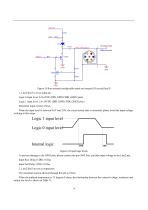
Figure 13 Non-isolated configurable input and output I/O circuit (line3) 1. Line2/line3 is set as input pin Logic 0 input level: 0~0.6VDC (DIR_GPIO1/DIR_GPIO2 pins) Logic 1 input level: 2.0~24VDC (DIR_GPIO1/DIR_GPIO2 pins) Maximum input current: 25mA When the input level is between 0.6V and 2.0V, the circuit action state is uncertain, please avoid the input voltage working in this range. Figure 14 Input logic levels To prevent damage to the GPIO pins, please connect the pin GND first, and then input voltage to the Line2 pin. Input Rise Delay (TDR): 0.02us Input Fall Delay (TDF): 0.02us 2. Line2/line3...
Open the catalog to page 15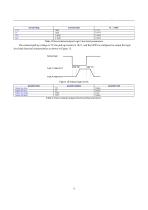
Table 12 Non-isolated output electrical characteristics
Open the catalog to page 16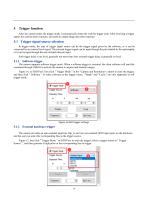
Trigger function After the camera enters the trigger mode, it automatically enters the wait-for-trigger state. After receiving a trigger signal, the camera starts exposure, and starts to output image data after exposure. 5.1 Trigger signal source selection In trigger mode, the type of trigger signal source can be the trigger signal given by the software, or it can be connected by an external level signal. The external trigger signal can be input through the pin isolated by the optocoupler, or it can be input through the non-isolated tube pin input. Soft trigger delay is ms level, generally not...
Open the catalog to page 17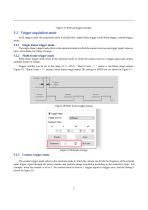
Figure 17 External trigger settings In the trigger mode, the acquisition mode is divided into: single-frame trigger, multi-frame trigger, counter trigger mode. The single-frame trigger mode refers to the operation mode in which the camera receives one trigger signal, exposes once, and outputs one frame of image. Multi-frame trigger mode refers to the operation mode in which the camera receives a trigger signal and outputs multiple frames of images. Trigger number can be set in the range of 1~ 65535. "Burst Count = 1” means a one-frame image output, Figure 18, "Burst Count = 3” means a three-frame...
Open the catalog to page 18All EHD imaging catalogs and technical brochures
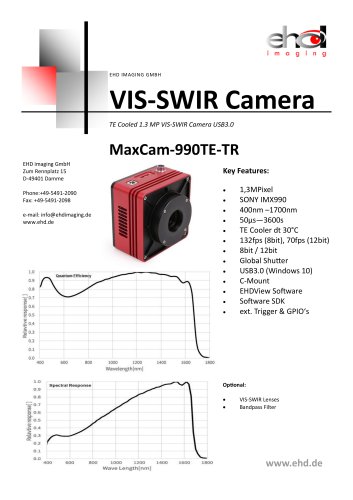 MaxCam‐990TE‐TR
2 Pages
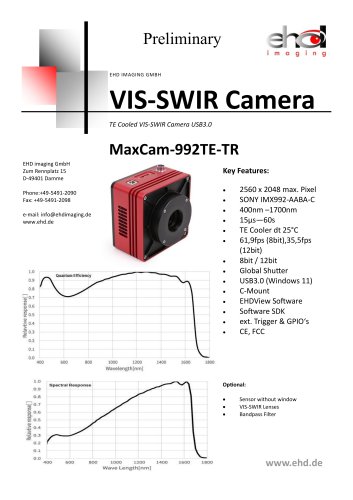 MaxCam-992TE-TR
2 Pages
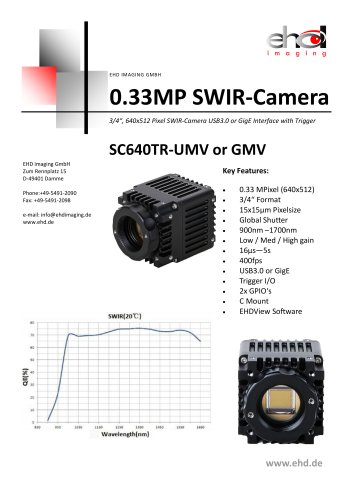 SC640TR-UMV or -GMV
2 Pages
 SC‐2020UV‐ITR
46 Pages
 EHD ICM-Series
51 Pages
 MaxCam‐400UV‐TE
38 Pages
 EHD SC-CTR Series Cooled Cameras
39 Pages
 EHD Vis-SWIR Series
172 Pages
 EHDView Software
137 Pages
 EHD SCM-SCA-SCC-TR series
308 Pages
 EHD SC-ITR Series
48 Pages
 SCM-E10 Series Microcopy Cameras
4 Pages
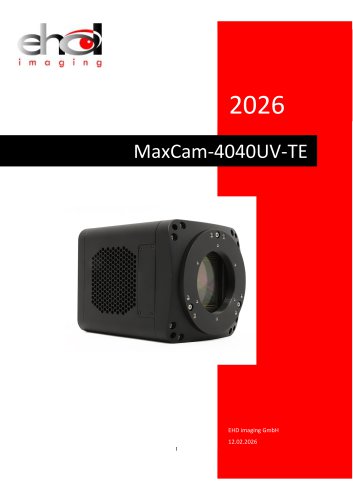 MaxCam‐4040UV‐TE
44 Pages
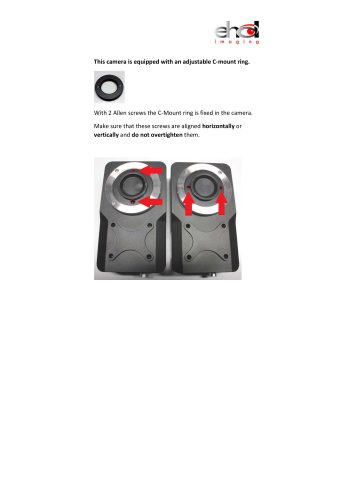
- Microscopy
- Compound microscope
- Laboratory microscope
- Desktop microscope
- Laboratory software
- CMOS camera
- Camera with USB port
- LED microscope
- Acquisition software
- Medical camera
- Measurement software
- Full HD camera
- HD camera
- Recording software
- Microscope camera
- Fluorescence microscope
- Real-time software
- Digital microscope
- Ultra-high resolution camera
- Monocular microscope