
- Catalogs
- Elabscience Biotechnology Inc.
- Elabscience®Hydrogen Peroxide (H2O2) Fluorometric Assay Kit

Elabscience®Hydrogen Peroxide (H2O2) Fluorometric Assay Kit
Elabscience®Hydrogen Peroxide (H2O2) Fluorometric Assay Kit
Catalog excerpts
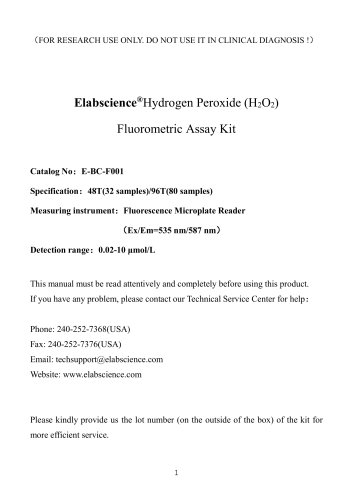
(FOR RESEARCH USE ONLY. DO NOT USE IT IN CLINICAL DIAGNOSIS !) Elabscience®Hydrogen Peroxide (H2O2) Fluorometric Assay Kit Catalog No:E-BC-F001 Specification:48T(32 samples)/96T(80 samples) Measuring instrument:Fluorescence Microplate Reader (Ex/Em=535 nm/587 nm) Detection range:0.02-10 μmol/L This manual must be read attentively and completely before using this product. If you have any problem, please contact our Technical Service Center for help: Phone: 240-252-7368(USA) Fax: 240-252-7376(USA) Email: [email protected] Website: www.elabscience.com Please kindly provide us the lot number (on the outside of the box) of the kit for more effi
Open the catalog to page 1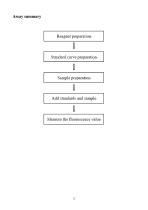
Assay summary
Open the catalog to page 3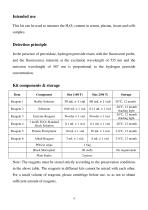
This kit can be used to measure the H2O2 content in serum, plasma, tissue and cells samples. Detection principle In the presence of peroxidase, hydrogen peroxide reacts with the fluorescent probe, and the fluorescence intensity at the excitation wavelength of 535 nm and the emission wavelength of 587 nm is proportional to the hydrogen peroxide concentration. Note: The reagents must be stored strictly according to the preservation conditions in the above table. The reagents in different kits cannot be mixed with each other. For a small volume of reagents, please centrifuge before use, so as not...
Open the catalog to page 4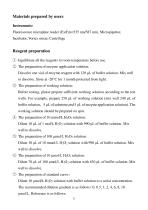
Materials prepared by users Instruments: Fluorescence microplate reader (Ex/Em=535 nm/587 nm), Micropipettor, Incubator, Vortex mixer, Centrifuge Reagent preparation ① Equilibrate all the reagents to room temperature before use. ② The preparation of enzyme application solution: Dissolve one vial of enzyme reagent with 120 μL of buffer solution. Mix well to dissolve. Store at -20° for 1 month protected from light. C ③ The preparation of working solution: Before testing, please prepare sufficient working solution according to the test wells. For example, prepare 250 μL of working solution (mix...
Open the catalog to page 5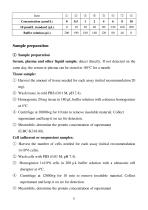
Sample preparation © Sample preparation Serum, plasma and other liquid sample: detect directly. If not detected on the same day, the serum or plasma can be stored at -80°C for a month. Tissue sample: © Harvest the amount of tissue needed for each assay (initial recommendation 20 mg). © Wash tissue in cold PBS (0.01 M, pH 7.4). © Homogenize 20 mg tissue in 180 pL buffer solution with a dounce homogenizer at 4°C. © Centrifuge at 10000*g for 10 min to remove insoluble material. Collect supernatant and keep it on ice for detection. © Meanwhile, determine the protein concentration of supernatant (E-BC-K318-M)....
Open the catalog to page 6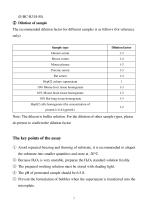
(E-BC-K318-M). @ Dilution of sample The recommended dilution factor for different samples is as follows (for reference only): Note: The diluent is buffer solution. For the dilution of other sample types, please do pretest to confirm the dilution factor The key points of the assay ® Avoid repeated freezing and thawing of substrate, it is recommended to aliquot the substrate into smaller quantities and store at -20°C. © Because H2O2 is very unstable, preparae the H2O2 standard solution freshly. © The prepared working solution must be stored with shading light. © The pH of pretreated sample should...
Open the catalog to page 7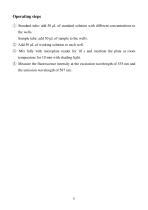
Operating steps ① Standard tube: add 50 μL of standard solution with different concentrations to the wells. Sample tube: add 50 μL of sample to the wells. ② Add 50 μL of working solution to each well. ③ Mix fully with microplate reader for 10 s and incubate the plate at room temperature for 10 min with shading light. ④ Measure the fluorescence intensity at the excitation wavelength of 535 nm and the emission wavelength of 58
Open the catalog to page 8
Calculation The standard curve: 1. Average the duplicate reading for each standard. 2. Subtract the mean fluorescence value of the blank (Standard # ① ) from all standard readings. This is the absoluted fluorescence value. 3. Plot the standard curve by using absoluted fluorescence value of standard and correspondent concentration as y-axis and x-axis respectively. Create the standard curve (y = ax + b) with graph software (or EXCEL). The sample: 1. Serum, plasma and other liquid samples: V1 + V2 H2O2 content = (∆F − b) ÷ a × 2 × ( )×f (μmol/L) V1 2. Tissue and cell samples: V1 + V2 H2O2 content...
Open the catalog to page 9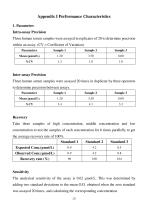
1. Parameter: Intra-assay Precision Three human serum samples were assayed in replicates of 20 to determine precision within an assay. (CV = Coefficient of Variation) Sensitivity The analytical sensitivity of the assay is 0.02 pmol/L. This was determined by adding two standard deviations to the mean O.D. obtained when the zero standard was assayed 20 times, and calculating the corresponding concentration.
Open the catalog to page 10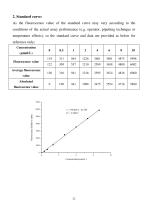
2. Standard curve: As the fluorescence value of the standard curve may vary according to the conditions of the actual assay performance (e.g. operator, pipetting technique or temperature effects), so the standard curve and data are provided as below for reference only:
Open the catalog to page 11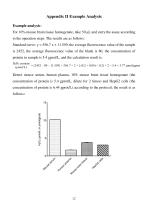
Appendix П Example Analysis Example analysis: For 10% mouse brain tissue homogenate, take 50 μL and carry the assay according to the operation steps. The results are as follows: Standard curve: y = 556.7 x + 11.559, the average fluorescence value of the sample is 2452, the average fluorescence value of the blank is 80, the concentration of protein in sample is 5.4 gprot/L, and the calculation result is: H2O2 content = (2452 – 80 – 11.559) ÷ 556.7 × 2 × ( (0.2 + 0.04) ÷ 0.2) × 2 ÷ 5.4 = 3.77 μmol/gprot (μmol/L) Detect mouse serum, human plasma, 10% mouse brain tissue homogenate (the concentration...
Open the catalog to page 12
Statement 1. This assay kit is for Research Use Only. We will not response for any arising problems or legal responsibilities causing by using the kit for clinical diagnosis or other purpose. 2. Please read the instructions carefully and adjust the instruments before the experiments. Please follow the instructions strictly during the experiments. 3. Protection methods must be taken by wearing lab coat and latex gloves. 4. If the concentration of substance is not within the detection range exactly, an extra dilution or concentration should be taken for the sample. 5. It is recommended to take...
Open the catalog to page 13All Elabscience Biotechnology Inc. catalogs and technical brochures
- Detection kit
- Solvent reagent
- Blood detection kit
- Molecular biology reagent
- Serum detection kit
- Immunoassay detection kit
- Plasma detection kit
- Protein reagent
- Optical test kit
- Cytology reagent
- Fluorescence detection kit
- Antibody
- ELISA detection kit
- Virus reagent
- Research detection kit
- ELISA reagent kit
- Monoclonal antibody
- Liver disease test kit
- Western blot reagent
- Coronavirus reagent