
- Catalogs
- Elcam Medical Italy
- SafeT™ Stopcocks Lipid and drug Compatibility evaluation

SafeT™ Stopcocks Lipid and drug Compatibility evaluation
SafeT™ Stopcocks Lipid and drug Compatibility evaluation
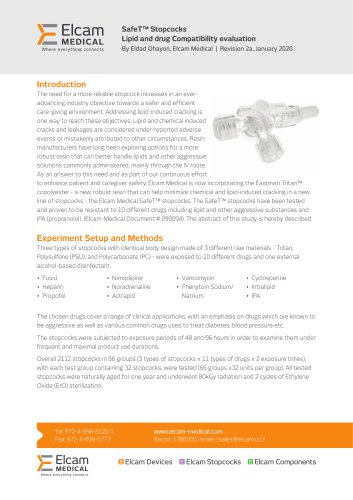
The document discusses the development of a more reliable stopcock to enhance safety and efficiency in medical environments. It addresses the issue of lipid-induced cracking in stopcocks, which is often under-reported. Elcam Medical introduces the SafeT™ stopcocks made from Eastman Tritan™ copolyester, designed to resist chemical and lipid-induced cracking.
Experiment Setup and Methods
The study tested three types of stopcocks made from Tritan, Polysulfone (PSU), and Polycarbonate (PC) against 10 drugs and one disinfectant. The drugs included Fusid, Heparin, Propofol, Nimodipine, Noradrenaline, Actrapid, Vancomycin, Phenytoin Sodium, Cyclosporine, Intralipid, and IPA. The stopcocks were exposed for 48 and 96 hours, with a total of 2112 stopcocks tested. They were naturally aged for a year and underwent sterilization.
Results
The Tritan stopcocks showed no leakage and resisted all drugs for 48 and 96 hours, with some non-leaking cracks observed. Polycarbonate stopcocks resisted 8 out of 11 drugs, with breakages after 48 hours for some drugs. Polysulfone stopcocks resisted 10 out of 11 drugs, with breakages observed with Cyclosporine.
Conclusions
The Tritan stopcocks are suitable for use up to 96 hours with various drugs, including lipid-based solutions. Polycarbonate and Polysulfone stopcocks have limitations with certain drugs. The SafeT™ stopcocks are recommended for safe and effective use in clinical settings.
For further information, contact Eldad Ohayon at [email protected].
Catalog excerpts
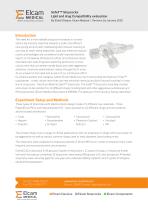
MEDICAL Where everything connects SafeT™ Stopcocks Lipid and drug Compatibility evaluation By Eldad Ohayon, Elcam Medical | Revision 2a, January 2020 Introduction The need for a more reliable stopcock increases in an ever-advancing industry objective towards a safer and efficient care-giving environment. Addressing lipid-induced cracking is one way to reach these objectives. Lipid and chemical induced cracks and leakages are considered under-reported adverse wan* • jj v\ \ - events or mistakenly attributed to other circumstances. Resin manufacturers have long been exploring options for a more robust resin that can better handle lipids and other aggressive solutions commonly administered, mainly through the IV route. As an answer to this need and as part of our continuous effort to enhance patient and caregiver safety, Elcam Medical is now incorporating the Eastman Tritan™ copolyester - a new, robust resin that can help minimize chemical and lipid-induced cracking in a new line of stopcocks - the Elcam Medical SafeT™ stopcocks. The SafeT™ stopcocks have been tested and proven to be resistant to 10 different drugs including lipid and other aggressive substances and IPA (propranolol). (Elcam-Medical Document # 099094). The abstract of this study is hereby described. Experiment Setup and Methods Three types of stopcocks with identical body design made of 3 different raw materials - Tritan, Polysulfone (PSU), and Polycarbonate (PC) - were exposed to 10 different drugs and one external alcohol-based disinfectant. • Fusid • Nimodipine • Vancomycin • Cyclosporine • Heparin • Noradrenaline • Phenytoin Sodium/ • Intralipid • Propofol • Actrapid Natrium • IPA The chosen drugs cover a range of clinical applications, with an emphasis on drugs which are known to be aggressive as well as various common drugs used to treat diabetes, blood pressure etc. The stopcocks were subjected to exposure periods of 48 and 96 hours in order to examine them under frequent and maximal product use durations. Overall 2112 stopcocks in 66 groups (3 types of stopcocks x 11 types of drugs x 2 exposure times), with each test group containing 32 stopcocks, were tested (66 groups x32 units per group). All tested stopcocks were naturally aged for one year and underwent 80kGy radiation and 2 cycles of Ethylene Oxide (EtO) sterilization. Fax: 972-4-698-0777 Baram 1386000, Israel | [email protected] 'Z Elcam MEDICAL Where everything connects 0 Elcam Devices § Elcam Stopcocks S Elcam Compo
Open the catalog to page 1
" Elcam SafeT™ Stopcocks Lipid and drug Compatibility evaluation The tested stopcocks were assembled together in a chain formation and fastened with an applied torque of 20 In^Oz. Exposure testing was conducted by filling the chain of stopcocks with the tested solution/drug. Stopcock handles were adjusted in such a manner that the liquid reached all the passes including the side port. A visual test using a magnifier and a leakage test were conducted once the exposure times to the drugs (after 48 and 96 hours) were completed. 4 of the Tritan groups (2 from each time frame) were also tested after...
Open the catalog to page 2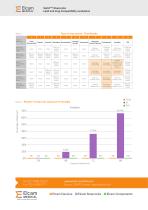
Figure 1 Results of stopcocks exposure to Intralipid Intralipid 4 70%_ Table 1 Type of drug tested - Test Results Fax: 972-4-698-0777 Baram 1386000, Israel | [email protected] 'Z Elcam MEDICAL Where everything connects □ Elcam Devices El Elcam Stopcocks El Elcam Components
Open the catalog to page 3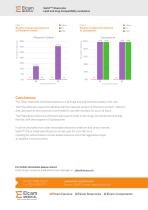
SafeT™ Stopcocks Lipid and drug Compatibility evaluation Results of stopcocks exposure to Phenytoin sodium Percentage of failed parts Percentage of failed parts Results of stopcocks exposure to Cyclosporine Exposure time (hours) 96 Exposure time (hours) Conclusions The Tritan stopcocks withstood exposure to all drugs and disinfectants tested in this trial. The Polycarbonate stopcocks withstood all the materials except for Phenytoin Sodium / Natrium and Cyclosporine, and continue to be limited for use with Intralipid for up to 24 hours. The Polysulfone stopcocks withstood exposure to most of the...
Open the catalog to page 4All Elcam Medical Italy catalogs and technical brochures
 Patient Monitoring
4 Pages
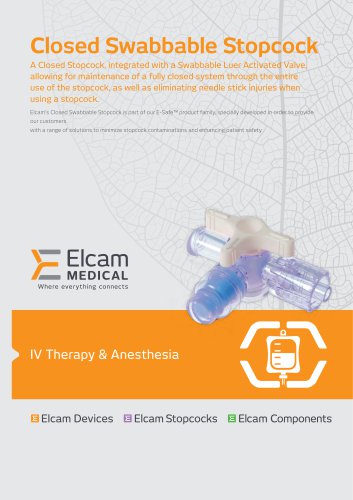 Closed Swabbable Stopcock
2 Pages
 Stopcocks with Tube
2 Pages
 Standard Manifolds
2 Pages
 High Pressure Manifold
4 Pages
 SafePort™ Manifold
2 Pages
 High Pressure Product Line
4 Pages
 MarvelousTM Stopcock (MRVLS)
2 Pages
 HIGH FLOW STOPCOCKS
2 Pages
 STANDARD STOPCOCKS
2 Pages

- Valve
- Medical valve
- Infusion connector
- Straight infusion connector
- LUER®-lock infusion connector
- Pressure transducer
- Infusion manifold
- Y infusion connector
- Infusion connector with stopcock
- T infusion connector
- Intensive care infusion manifold
- 3-way infusion manifold
- Disposable transducer
- 2-way infusion manifold
- 4-way infusion manifold
- Blood sampling system