

pelvic floor muscle exerciser / Elvie / Elvie Trainer sales letter

pelvic floor muscle exerciser / Elvie / Elvie Trainer sales letter
Elvie Trainer is a device designed to enhance pelvic floor muscle training, improving compliance, technique, and outcomes. It addresses the high prevalence of pelvic floor dysfunction, which affects a significant percentage of women, particularly during and after pregnancy.
Specifications and Features
The Elvie Trainer is an over-the-counter pelvic floor muscle training guide and tracker for single-patient use. It includes an accelerometer to detect incorrect techniques, such as the Valsalva maneuver, which can be harmful. The device is recommended by over 1000 health professionals globally and has won multiple design and innovation awards.
Effectiveness and User Engagement
Elvie Trainer users show significant improvement in pelvic floor muscle training compliance and outcomes. Before using the device, many users rarely exercised their pelvic floor muscles, but after using Elvie Trainer, a majority exercised regularly. The device also shows high user satisfaction, with most users recommending it to others.
Design and Technology
Elvie Trainer is small, comfortable, discreet, and portable, designed with input from over 150 women. It uses biofeedback technology to measure force, detect incorrect contractions, and correct technique. The device is made with medical-grade silicone, is waterproof, and has passed rigorous testing.
App and Training Resources
The Elvie Trainer app provides five-minute workouts and six unique exercises targeting different muscle fibers. It offers four levels of difficulty and allows users to track their progress over time. The app is secure, regularly updated, and available in multiple languages.
Conclusion
Elvie Trainer is a cutting-edge solution for pelvic floor muscle training, offering a combination of innovative technology, user-friendly design, and effective training resources to improve women's health outcomes.
Catalog excerpts
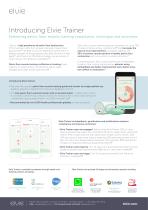
Introducing Elvie Trainer Enhancing pelvic floor muscle training compliance, technique and outcomes There’s a high prevalence of pelvic floor dysfunction: 37% of women suffer from at least one type of pelvic floor dysfunction[1]; 50-80% of women experience some form of bladder problem during pregnancy and after the birth of their baby[2]; and, there’s an 11% lifetime surgery risk as a result of stress urinary incontinence or prolapse.[3] Pelvic floor muscle training is effective in treating stress, urgency or mixed urinary incontinence, pelvic organ prolapse and lower bowel dysfunction[4]. Pelvic floor muscle training improves symptoms in up to 70% of cases of stress urinary incontinence[5] and increases the chance of an improvement in prolapse stage by 17%. 30% of women cannot perform a healthy pelvic floor contraction with only written or verbal instruction[7]. Comparing pelvic floor muscle training with biofeedback to pelvic floor muscle training alone, patients using biofeedback see better improvement and a better longterm effect on motivation.[7] Introducing Elvie Trainer: • The over-the-counter pelvic floor muscle training guide and tracker for single-patient use, enabling patients to benefit from clinical biofeedback at home • The only pelvic floor exercise tracker with an accelerometer, to detect and correct if a woman is performing a Valsalva maneuver instead of the correct cranioventral lift – potentially causing herself harm – as 30% of women do[8] • Recommended by over 1000 health professionals globally, private and public Elvie Trainer’s biofeedback, gamification and notifications enhance compliance and improve outcomes: • Elvie Trainer users are engaged: Before using Elvie Trainer, 22% of users never exercised their pelvic floor and 43% only did so rarely; when using Elvie Trainer, 87% of users exercise their pelvic floor at least once a month, with 53% exercising at least three times a week and 15% exercising at least once a day. For users who already performed pelvic floor exercise, 69% reported an increase in frequency after purchasing Elvie Trainer[9] • Elvie Trainer users improve: 8 in 10 users who purchase Elvie Trainer to treat bladder problems feel improvements (98% do so in less than 6 weeks)[10] • Elvie Trainer users are happy: 9 in 10 would recommend Elvie Trainer to a friend or colleague[10] Elvie Trainer is available to patients through health and medical partners including: Elvie Trainer has received 12 design and innovation awards including: Princeton Medical Group US Award Winner AXA PPP Health Tech and You 2015 Clínica Dexeus Spain Product Design Red Dot Design Award 2016 63-66 Hatton Garden - London, EC1N 8LE - United Kingdom | +44 (0)203 745 5201 USA: [email protected] | UK, Europe & Rest of World: [email protected] Award Winner Hardware The Europas 2017 Award Winner HealthTechX Eu
Open the catalog to page 1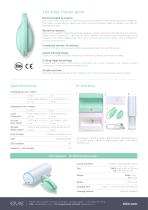
The Elvie Trainer pitch Recommended by experts Over 1000 health and medical professionals around the world recommend Elvie Trainer with confidence, Elvie Trainer's unique ability to detect and correct incorrect technique, means that patients won't get into bad habits at home. Backed by research Adding to the wealth of supporting secondary literature, research presented at the International Continence Society annual conference (IT, 2017) and the Pelvic, Obstetric and Gynaecological Physiotherapy annual conference (UK, 2016) validates that Elvie Trainer enhances pelvic floor muscle training compliance, technique...
Open the catalog to page 2
Professionals frequently report issues regarding patient compliance with pelvic floor muscle training, outside of clinic time. Elvie Trainer enhances pelvic floor muscle training compliance, technique and outcomes. It makes pelvic floor muscle training fun and easy for patients, for between clinic visits and thereafter. The workouts were created with the support of women's health physiotherapist, Dr Kay Crotty (Physiolink), and urogynaecologist, Dr Rufus Cartwright (Oxford University Hospitals Trust). The workouts incorporate clinical recommendations on the need for targeting fast-twitch and...
Open the catalog to page 3
References: 1. Lawrence, J. M., Lukacz, E. S., Nager, C. W., Hsu, J.-W. Y., & Luber, K. M. (2008). Prevalence and co-occurrence of pelvic floor disorders in community-dwelling women. Obstetrics and Gynecology, 111(3), 678–85. http://doi.org/10.1097/AOG.0b013e3181660c1b 2. Netmums (2014) Netmums survey. Available from www.netmums.co.uk (accessed 29/03/17) 3. Olsen, A. L., Smith, V. J., Bergstrom, J. O., Colling, J. C., & Clark, A. L. (1997). Epidemiology of surgically managed pelvic organ prolapse and urinary incontinence. Obstetrics and Gynecology, 89(4), 501–506. http://doi.org/10.1016/S0029-7844(97)00058-6...
Open the catalog to page 4