- Catalogs
- encee GmbH Stratasys medical
- 3D printing

- Products
- Catalogs
- News & Trends
- Exhibitions
3D printing
1 /4Pages
3D printing
1 /4Pages
Catalog excerpts
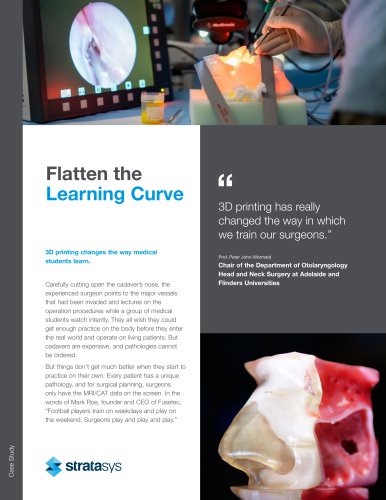
Case Study Flatten the Learning Curve 3D printing changes the way medical students learn. Carefully cutting open the cadaver’s nose, the experienced surgeon points to the major vessels that had been invaded and lectures on the operation procedures while a group of medical students watch intently. They all wish they could get enough practice on the body before they enter the real world and operate on living patients. But cadavers are expensive, and pathologies cannot be ordered. But things don’t get much better when they start to practice on their own. Every patient has a unique pathology, and for surgical planning, surgeons only have the MRI/CAT data on the screen. In the words of Mark Roe, founder and CEO of Fusetec, “Football players train on weekdays and play on the weekend. Surgeons play and play and play.” x stratasys Prof. Peter John-Wormald Chair of the Department of Otolaryngology Head and Neck Surgery at Adelaide and Flinders Universities
Open the catalog to page 1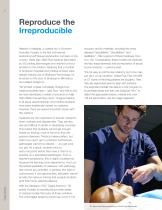
Reproduce the Irreproducible Nestled in Adelaide, a coastal city in Southern Australia, Fusetec is the first commercial anatomical soft tissue reproduction company in the country. Years ago, Mark Roe became fascinated by 3D printing technologies and wanted to find a problem to the solution. Realizing that a number of American hospitals and medical schools were already making use of Stratasys® technology, he knocked on the door of Stratasys in Minnesota and walked straight in. Document Case StudyTitle Here “3D printed models completely change how medical students learn,” said Roe, “and this is...
Open the catalog to page 2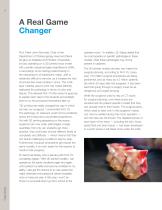
A Real Game Changer Prof. Peter John-Wormald, Chair of the Department of Otolaryngology Head and Neck Surgery at Adelaide and Flinders Universities, is busy operating on a 3D printed sinus model with juvenile nasopharyngeal angiofibroma (JNA), a rare benign tumor arising predominantly in the nasopharynx of adolescent males. JNA is extremely difficult to remove, as it invades the vital structures like nasal cavities in sinus. The multilayer material used to print this model faithfully replicated the pathology in terms of color and texture. This allowed Prof. PJ (the name he goes by) to explain...
Open the catalog to page 3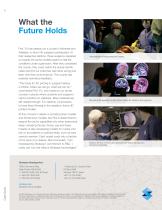
What the Future Holds Prof. PJ has already run a course in Montreal and Adelaide, in which 40 surgeons participated. At their respective stations, those surgeons operated on exactly the same models based on real-life conditions under supervision. After they completed the course, they could watch the actual real-life video and find out what they had done wrong and learn how they could improve. This course has received marvelous feedback. “The future for 3D printing in surgical training is infinite: where we can go, what we can do,” commented Prof. PJ, who hopes to run similar courses in places...
Open the catalog to page 4All Encee GmbH Stratasys medical catalogs and technical brochures
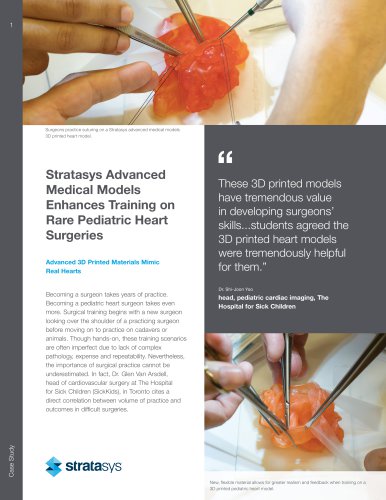 Children 3D Printing Case
3 Pages
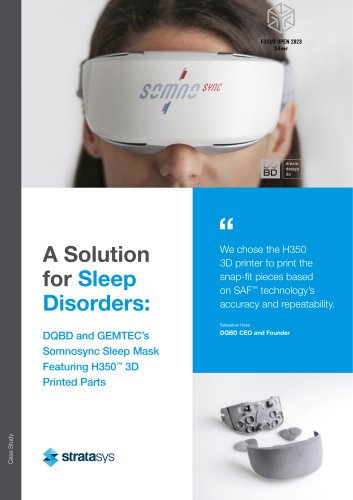 Somnosync Sleep Mask
6 Pages
 Syqe Medical
4 Pages