- Catalogs
- encee GmbH Stratasys medical
- Children 3D Printing Case

- Products
- Catalogs
- News & Trends
- Exhibitions
Children 3D Printing Case
1 /3Pages
Children 3D Printing Case
1 /3Pages
Catalog excerpts
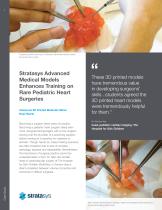
Surgeons practice suturing on a Stratasys advanced medical models 3D printed heart model. Stratasys Advanced Medical Models Enhances Training on Rare Pediatric Heart Surgeries Advanced 3D Printed Materials Mimic Real Hearts head, pediatric cardiac imaging, The Hospital for Sick Children Case Study Becoming a surgeon takes years of practice. Becoming a pediatric heart surgeon takes even more. Surgical training begins with a new surgeon looking over the shoulder of a practicing surgeon before moving on to practice on cadavers or animals. Though hands-on, these training scenarios are often imperfect due to lack of complex pathology, expense and repeatability. Nevertheless, the importance of surgical practice cannot be underestimated. In fact, Dr. Glen Van Arsdell, head of cardiovascular surgery at The Hospital for Sick Children (SickKids), in Toronto cites a direct correlation between volume of practice and outcomes in difficult surgeries. These 3D printed models have tremendous value in developing surgeons’ skills...students agreed the 3D printed heart models were tremendously helpful for them.” New, flexible material allows for greater realism and feedback when training on a 3D printed pediatric heart model
Open the catalog to page 1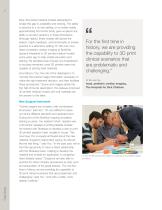
2 2 Early 3D printed medical models attempted to bridge this gap in availability and training. The ability to practice in a no-risk setting, on a model closely approximating the human body, gave surgeons the ability to envision anatomy in three-dimensions. Although helpful, these models still lacked the realism, haptic feedback, and functionality to enable practice in a laboratory setting. Dr. Shi-Joon Yoo, head of pediatric cardiac imaging at SickKids, became interested in 3D printed medical models some years ago to help enable education and training. He persisted even though one impediment...
Open the catalog to page 2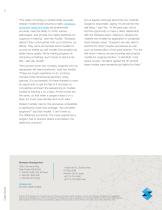
3 “The reality of training on anatomically accurate, realistic models finally became a reality. Stratasys advanced medical models are anatomically accurate, have the ability to mimic various pathologies, and provide true haptic feedback for surgeons in-training,” said Van Arsdell. “Stratasys asked if they could partner with us to advance our efforts. They came and printed some models for us and we ended up with models that actually had better tissue quality. We’re making progress on mimicking something much closer to real human feel,” said Van Arsdell. “We practice some very complex surgeries...
Open the catalog to page 3All Encee GmbH Stratasys medical catalogs and technical brochures
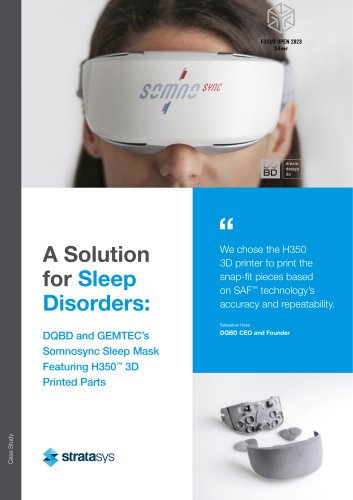 Somnosync Sleep Mask
6 Pages
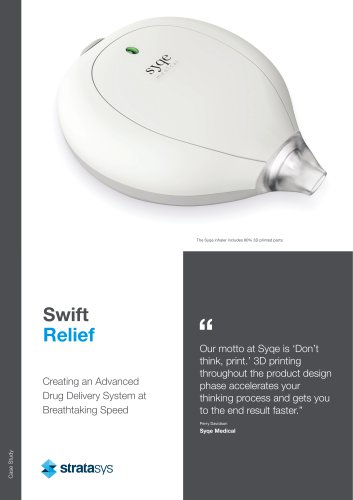 Syqe Medical
4 Pages
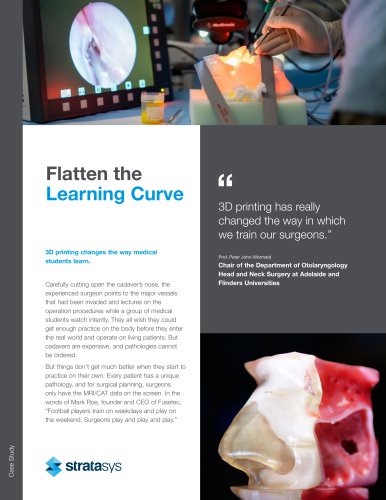 3D printing
4 Pages