
- Catalogs
- Erbe Elektromedizin
- En Bloc Resection of Bladder Tumors

En Bloc Resection of Bladder Tumors

En Bloc Resection of Bladder Tumors
The document discusses the en bloc resection of bladder tumors using the HybridKnife, a technique adapted from gastrointestinal tract procedures. This method aims to improve the accuracy and safety of tumor resections.
Procedure Overview
The en bloc resection using HybridKnife involves four main steps:
- Marking: The tumor is circled with coagulation points, maintaining a 5-7 mm safety margin.
- Elevation: The tumor is elevated using a waterjet, creating a submucosal safety margin to reduce perforation risk.
- Incision/Dissection: The tumor is resected using DRY CUT® or ENDO CUT® Q modes for optimal hemostasis.
- Post-coagulation: Any bleeding is managed with FORCED COAG®.
Advantages of ESD with HybridKnife
Endoscopic submucosal dissection (ESD) with HybridKnife is noted for its simplicity and safety, allowing for en bloc resection of non-muscle-invasive tumors with a safe R0 resection border. Key benefits include reduced recurrence rates, improved histological assessment, and minimized perforation risk.
Application in Urology
The technique's success in gastrointestinal procedures suggests potential benefits for bladder tumor resections. Initial reports from hospitals indicate promising results, prompting a multicenter study to compare this method with traditional snare resection.
Comparison with Traditional Methods
Traditional transurethral snare resection often requires tumor fractionation, which can complicate pathological assessments and increase recurrence risk. The en bloc method with HybridKnife aims to address these issues by allowing complete tumor removal in one piece.
Study and Equipment
A multicenter study in Germany is underway to evaluate the HybridKnife method's effectiveness. The study will focus on pathological assessment improvements, tumor invasion evaluation, and recurrence rates. Recommended equipment includes the VIO® 300 D, APC® 2, and ERBEJET® 2.
Conclusion
The HybridKnife offers a promising alternative for bladder tumor resection, potentially improving outcomes and reducing recurrence rates. Further studies will confirm its advantages over traditional methods.
Catalog excerpts
power your performance.
Open the catalog to page 1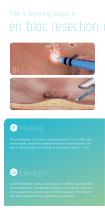
Prior to elevation, the tumor is marked around in a circle with coagulation points, which also represent the later line of resection. The lateral safety margin to the border of the tumor is about 5–7 mm. Using the waterjet function, the tumor is elevated by injecting within the marked points. The separation medium accumulates in the submucosa and forms a safety margin to the muscularis. This reduces the risk of perforation during the following resection.
Open the catalog to page 2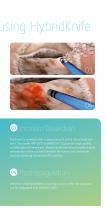
The tumor is resected after cutting around it at the raised resection level. The modes DRY CUT® or ENDO CUT® Q provide a high-quality cut with optimal hemostasis. Repeating the elevation provides a good presentation of the cut level (beneath the tumor) and contributes towards achieving the desired R0 resection. Vessels or seeping bleeding occurring during or after the resection can be coagulated with FORCED COAG®.
Open the catalog to page 3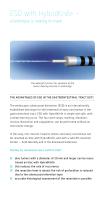
ESD with HybridKnife – a technique is making its mark The waterjet function for elevation of the lesion-bearing mucosa in endoscopy THE ADVANTAGES OF ESD IN THE GASTROINTESTINAL TRACT (GIT) The endoscopic submucosal dissection (ESD) is an internationally established technique for the treatment of early carcinomas in the gastrointestinal tract. ESD with HybridKnife is simple and safe, with a steep learning curve. The four work steps, marking, elevation, incision/dissection and coagulation, can be performed without an instrument change. In this way, non-muscle-invasive tumors and early carcinomas...
Open the catalog to page 4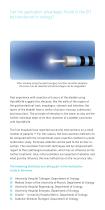
Can the application advantages found in the GIT be transferred to urology? After marking using the electrosurgery function and after elevation, the tumor can be resected and hemorrhages can be coagulated Past experience with resection of tumors of the bladder using HybridKnife suggest this. Because, like the walls of the organs of the gastrointestinal tract, esophagus, stomach and intestine, the layers of the bladder have a similar structure: mucosa, submucosa and muscularis. The principle of elevation is the same, as also are the further individual steps of en bloc resection of a bladder carcinoma...
Open the catalog to page 5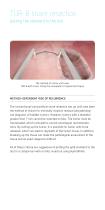
TUR-B snare resection putting the standard to the test The method of choice until now: TUR-B with snare. Using the monopolar or bipolar technique. METHOD-DEPENDENT RISK OF RECURRENCE The conventional transurethral snare resection has up until now been the method of choice for minimally invasive removal and pathological diagnosis of bladder tumors. However, tumors with a diameter greater than 7 mm cannot be resected en bloc. The tumor must be fractionated, which contradicts current oncological recommendations. By cutting up the tumor, it is possible for tumor cells to be released, which can lead...
Open the catalog to page 6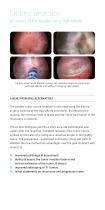
En bloc resection of tumors of the bladder using HybridKnife En bloc resection of bladder tumors. All individual steps are performed with HybridKnife and without changing instruments. A NEW, PROMISING ALTERNATIVE? The bladder tumor can be resected in one piece using the electrosurgery function of the HybridKnife instrument. By elevating the mucosa, the resection level is raised and the risk of perforation of the muscularis is reduced. The en bloc technique permits a more accurate pathological evaluation after the resection. Complete removal of the tumor can be verified on the basis of a contiguous...
Open the catalog to page 7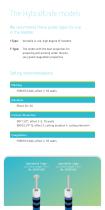
The HybridKnife models We recommend these probe types for use in the bladder: I-Type: Versatile in use, high degree of freedom T-Type: The model with the best properties for preparing and working under tension, very good coagulation properties Setting recommendations Marking FORCED COAG, effect 2, 50 watts Elevation Effect 20–30 Incision/Dissection DRY CUT®, effect 3-5, 70 watts ENDO CUT® Q, effect 2, cutting duration 4, cutting interval 4 Coagulation FORCED COAG, effect 2, 50 watts HybridKnife T-type ø 2.3 mm; length 1.9 m No. 20150-060 HybridKnife I-type ø 2.3 mm; length 1.9 m No. 20150-
Open the catalog to page 8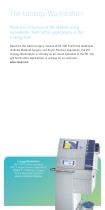
The Urology Workstation Resection of tumors of the bladder using HybridKnife. And further applications in the urology tract. Based on the electrosurgery module VIO® 300 D with the additional modules Waterjet Surgery and Argon Plasma Coagulation, the VIO Urology Workstation is virtually an all-round specialist in the OR. You will find further applications in urology on our web site: erbe-med.com Urology Workstation VIO® 300 D (Electrosurgery) APC® 2 (Argon Plasma Coagulation) ERBEJET® 2 (Waterjet Surgery) ESM 2 (Aspiration System) Bipolar Resection Adapte
Open the catalog to page 9
References * Repici A. et al, High efficacy of endoscopic submucosal dissection for rectal laterally spreading tumors larger than 3 cm, Gastrointest Endosc 2013; 77: 96-101. Schumacher B. et al, Endoscopic submucosal dissection of early gastric neoplasia with a water-jet assisted Hybrid-Knife: A Western single centers’s experience, Gastrointest Endosc 2012, 75:1166-74. Schumacher B. et al, Water-jet assisted endoscopic submucosal dissection (ESDH) in comparison to conventional ESD technique for treatment of early gastric cancer, Gastrointest Endosc 2012, DDW abstract accepted. Neuhaus H. et al,...
Open the catalog to page 10All Erbe Elektromedizin catalogs and technical brochures
 ENDO CUT® I
16 Pages
 Units and modules
16 Pages
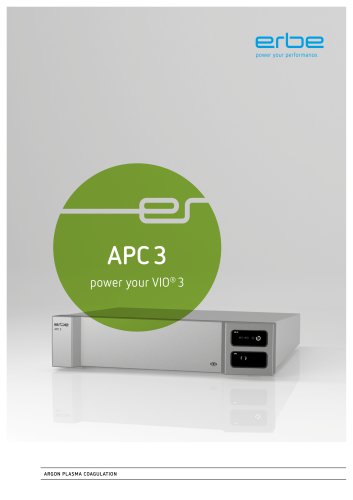 APC3
6 Pages
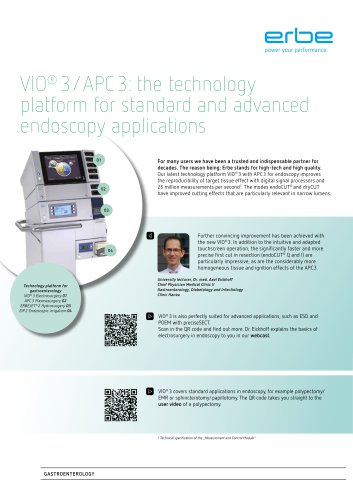 VIO® 3/APC 3
2 Pages
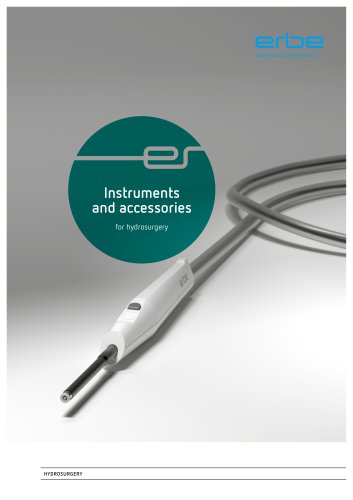 Instruments and accessories
12 Pages
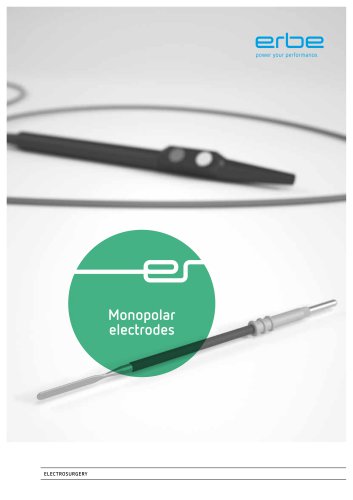 Monopolar electrodes
204 Pages
 Ablation of Barrett‘s esophagus
6 Pages
 ERBEJET 2
8 Pages
 Hybrid technology
20 Pages

Archived catalogs
 VIO product family
6 Pages
 APC 2
8 Pages
 ERBECRYO 2
8 Pages
 HybridKnife
6 Pages
 Product catalog
232 Pages
- Erbe surgery forceps
- Erbe grasping forceps
- Erbe surgery electrode
- Erbe electrosurgical electrode
- Human scissors
- Erbe medical endoscope
- Erbe straight forceps
- Erbe electrosurgical unit
- Reusable forceps
- Erbe reusable electrode
- Surgical scissors
- Erbe high-frequency electrode
- Erbe cutting electrosurgical unit
- Erbe coagulation electrosurgical unit
- Erbe monopolar electrode
- Endoscopy forceps
- Erbe electrosurgical forceps
- Erbe needle holder
- Erbe surgical needle holder
- Erbe straight electrode