
- Catalogs
- ERKODENT Erich Kopp
- 2021 Thermoforming

2021 Thermoforming
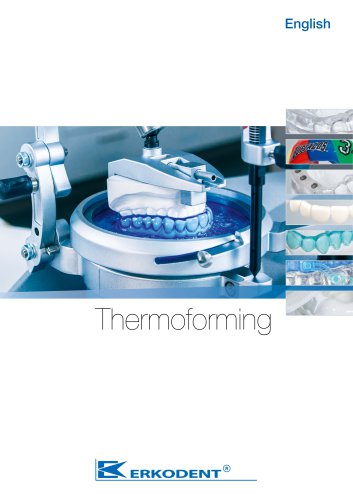
2021 Thermoforming
This document provides guidelines from the Erkodent Development Team on the thermoforming technique, emphasizing that the instructions are suggestions and may vary. Users are encouraged to contact the team for suggestions and access instructional videos.
- Models should be made of hard plaster (class 3) and must not be wet, though residual moisture is acceptable.
- Air permeability is crucial for good adaptation; impermeable models can lead to incomplete adaptation.
- 3D print models should be centrally placed on the model plate for a complete fit.
- Thermoforming on a duplicated model is recommended to avoid breakage.
- Models should be embedded in high-grade steel granules, exposing only the necessary area plus 3 mm.
- All Erkodent materials are biocompatible and CE marked, though allergic reactions cannot be entirely ruled out.
- Operational safety regulations must be followed.
- Remove obstructive areas and sharp edges from models.
- Use Erkogum to fill narrow gaps and blocking out wax for defects.
- Various materials are recommended for different applications, such as Erkoplast PLA-R for base plates and Erkodur for occlusal splints.
- The Occluform-3 is compatible with Erkoform units series 3, allowing direct imprinting of the opposing bite during thermoforming.
- It features plaster-free model fixation and a hydraulic system for articulation.
- The device is based on a Bonwill triangle, allowing median bite elevation.
- Different types of splints (hard, hard/soft, semi-soft, tough-hard) are fabricated using specific materials like Erkodur and Erkoloc-pro.
- Model preparation involves marking prosthetic equators and using materials like Erkogum and Erkoskin for adjustments.
- Finishing involves cutting, grinding, and polishing using specific tools and techniques.
- Instructions cover general fabrication, with specific adjustments for various splint types.
- Transparent splints require alginate insulation, and tension cracks can be avoided with proper resin application.
The document outlines the procedures for fabricating various types of dental splints and appliances using thermoforming materials such as Erkodur, Erkoloc-pro, and Erkoflex. The materials vary in thickness and hardness, suitable for different applications like occlusal splints, temporary appliances, cosmetic splints, and radiation protection splints.
- Fabrication of Occlusal Splints: The process involves curing in a polymerization pot, finishing with tools like Liskosil, and using materials like Erkodur and Erkoloc-pro. Adjustments are made by addition and grinding.
- Temporary Appliances: Made using Erkolen and Erkodur, with options for bonding to acrylics. The process includes embedding models in steel granules, thermoforming, and finishing with tools like HSS twist drills and tungsten carbide burs.
- Cosmetic Splints: Made from Erkodur, designed for aesthetic purposes, with interdental spaces accentuated using flexible grinding discs.
- Radiation Protection Splints: Fabricated using Erkoflex, these splints reduce radiation exposure by maintaining a distance between high-density materials and soft tissues.
- Cleaning and Maintenance: Instructions emphasize the importance of maintaining the splints.
- Model Preparation: Use of Erkogum and high-fusing wax for blocking out and filling bubbles in plaster models is recommended.
- Finishing Techniques: Various tools and techniques are suggested for smoothing and polishing, including Liskosil and polishing sets.
The document includes specifications for thermoforming materials, detailing their thickness and hardness. It also provides step-by-step instructions for each type of appliance, highlighting critical steps like embedding models, thermoforming, and finishing.
- Material Selection: The choice of material depends on the application, with specific recommendations for each type of splint.
- Thermoforming Process: The document emphasizes the importance of precise thermoforming and finishing to ensure the functionality and durability of the appliances.
- Safety and Efficacy: Radiation protection splints are designed to minimize radiation exposure, adhering to safety standards.
This document provides detailed procedures and specifications for the fabrication of various dental appliances using thermoforming techniques. It covers materials, model preparation, and finishing processes for bleaching trays, fluoride trays, individual impression trays, denture bases, and more.
- Materials: Erkoflex-bleach, 1.0 mm, and Erkoloc-pro 1.0 mm.
- Procedure: Thermoform the material over a model embedded in steel granules, cut along the gingival margin, and smooth edges with Liskosil tools.
- Key Points: Ensure proper cooling and follow cleaning instructions to avoid deformations.
- Materials: Erkoplast PLA-W and PLA-T for upper and lower jaws.
- Procedure: Block out residual teeth with Erkogum, use Erkopor black as a spacer, and thermoform.
- Finishing: Use fissure burs and Liskosil tools for edge smoothing.
- Materials: Erkocryl rose and transparent options.
- Procedure: Thermoform Erkocryl, ensuring model areas that obstruct the process are removed.
- Finishing: Use tungsten carbide burs and Liskosil tools for polishing.
- Materials: Erkoflex, 3.0 - 5.0 mm.
- Procedure: Use high-fusing wax for model preparation and thermoform over a vibrating slab.
- Note: This method is cost-effective but less precise than duplicating compounds.
- Materials: Erkodur, 1.5 - 2.0 mm.
- Procedure: Thermoform over models with embedded balls for X-ray templates, ensuring proper alignment and sealing with Erkogum.
- Finishing: Follow standard procedures for cutting and polishing.
- Always use insulating foils to prevent shrinkage and deformation.
- Ensure proper model preparation by removing obstructive areas and using appropriate spacers.
- Follow detailed finishing instructions to achieve optimal appliance fit and function.
- Bracket transfer splints involve gluing brackets with water-soluble adhesive onto a model. The model can be placed onto a model disc if it has a flat base.
- Thermoforming involves embedding the model into granules so that tooth alignment plus approximately 7 mm are visible. The Erkoflex foil should not be removed from the model.
- Cut the plate vestibularly and palatally/lingually about 3-4 mm below the teeth. Use scissors to push underneath the material due to its flexibility.
- After thermoforming, separate and shorten the Erkodur foil up to the middle of the brackets. Remove adhesive residues with water if necessary.
- Bracket transfer/etching masks require cutting out the bracket base with a scalpel and watering the model for at least 30 minutes before removing the brackets.
- Erkoflex (transparent, 1.5 or 2.0 mm) and Erkodur (clear, 1.0 mm) are used for bracket transfer splints.
- Erkolen (0.8 - 1.0 mm) is recommended for bracket transfer/etching masks when using a pressure forming unit.
- High-fusing wax is used for filling bubbles in the plaster.
- Retainers are marked for dimensions and cut using an HSS twist drill without pressure. Finished retainers should not affect occlusion.
- Correction splints involve blocking out teeth that need movement and thermoforming with Erkodur/Erkodur-al 1.0 mm.
- Aligners are thermoformed using Erkodur/Erkodur-al 1.0 mm, with borders smoothed using Liskosil-m or -s.
- Materials include Erkodur-al, Erkoloc-pro, and Erkodur in various thicknesses for different applications.
- Finishing tools include take-off pliers, HSS twist drill, special scissors XL, and Liskosil for smoothing edges.
- Fabrication involves using Erkocryl and autopolymerizing resin for clasps.
- Model preparation includes using Erkogum and high-fusing wax for filling bubbles and insulation.
- Finishing involves using a fissure bur, tungsten carbide bur, and HSS twist drill for cutting and smoothing.
- Fabrication uses Erkoflex in various thicknesses and involves embedding the model in granules for thermoforming.
- Finishing includes using special scissors, FG-sheets, and a hot-air burner for smoothing and polishing.
- Fabrication uses Erkoflex and Erkodur-S for different types of mouthguards.
- Model preparation involves filling plaster bubbles and blocking out undercuts with Erkogum.
- Playsafe mouthguards are fabricated for the upper jaw and cover the first molar with an occlusion increase of 4-5 mm.
This document provides detailed instructions for the fabrication of Playsafe sports mouthguards, focusing on different types such as light, medium, light-pro, and heavy-pro. It also covers the fabrication of the Playsafe triple sports-mouthguard and the Silensor-sl lower jaw protrusion splint.
The document outlines the materials used, including Erkoflex, Erkodur-S, and Erkogum, and provides specific measurements for each type of mouthguard. The Playsafe triple is noted for its three-layered structure, offering a balance of protection and comfort.
The step-by-step process includes thermoforming, cutting, smoothing, and imprinting techniques. Special attention is given to the positioning of layers, degreasing for reliable bonding, and handling of air pockets. The document also describes the use of Occluform-3 for imprinting the opposing bite during thermoforming.
For optimal results, the document recommends using specific tools such as special scissors, tungsten carbide burs, and hot-air burners. It also suggests maintaining a duplicate of the initial situation to counteract potential tooth migration when using the Silensor-sl splint.
A comprehensive list of materials and accessories is provided, including model preparation tools, finishing sets, and specific foils for different mouthguard types.
The document emphasizes the importance of proper model preparation, alignment, and the use of insulating foils. It also highlights the need for careful handling of the mouthguard during the finishing process to ensure comfort and effectiveness.
The document concludes with a reminder to follow cleaning and maintenance instructions and offers customization options through Playsafe 4 u for personalized designs.
Catalog excerpts
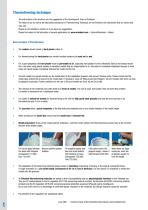
Thermoforming technique The instructions in this brochure are the suggestions of the Development Team of Erkodent. The fields of use as well as the fabrication procedures in Thermoforming Technique are not limited to the instructions that are shown and may vary. Please do not hesitate to contact us if you have any suggestions. Please find videos to the fabrication of several applications at: www.erkodent.com > Service/Download > Videos Basic principles of thermoforming: • The models should consist of hard plaster (class 3). For thermoforming the hard plaster can contain residual moisture but...
Open the catalog to page 2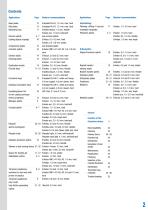
Implantology Planning- drilling- X-ray and orientation templates Protection splints Orthodontics Aligner/Correction splints Bracket transfer/ etching masks Bracket transfer splints Extension plates Orthodontic plates Positioners Retainers Retention plates 19 Erkodur, 0.5 - 1.0 mm, hard Erkodur-al, 0.6 - 1.0 mm, hard Erkoloc-pro, 1.0 and 1.3 mm, hard/soft 18 Erkolen, 0.8 and 1.0 mm, elastic 18 Erkoflex, 1.5 and 2.0 mm, flexible 20 - 21 Erkocryl, 2.0 and 2.5 mm, hard 20 - 21 Erkocryl, 2.0 and 2.5 mm, hard 21 - 22 Erkoflex, 3.0 - 5.0 mm, flexible 19 Erkodur, 0.6 - 1.5 mm, hard Erkodur-al, 0.6 -...
Open the catalog to page 3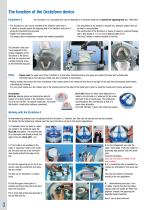
The function of the Occluform device Occluform-3 The Occluform is an occludator that can be integrated in a thermoforming unit to imprint the opposing bite (pat. 19915567). • The Occluform-3 can only be installed at the Erkoform units serie 3. • It allows to directly imprint the opposing bite in the Erkoform units serie 3 during the thermoforming process! • Plaster-free model fixation. • The single column construction enables best model accessibility. • The articulation of the models is ensured by a hydraulic system that can be fixed in every position. • The construction of the Occluform-3 device...
Open the catalog to page 4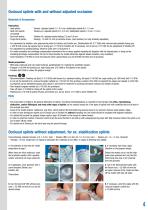
Occlusal splints with and without adjusted occlusion Materials & Accessories Fabrication: • Hard splints: • Hard / soft splints: (2-layered) • Semi-soft splints: • Tough-hard splints: Erkodur, adjusted splints 1.5 - 5.0 mm, stabilization splints 0.8 - 1.5 mm Erkoloc-pro, adjusted splints 2.0 - 5.0 mm, stabilization splints 1.0 mm / 1.3 mm Erkoflex-95, adjusted splints (biting) 2.5 and 4.0 mm Erkolign, 1.0 and 2.0 mm (at extreme stress, most resistant, but only limitedly adjustable) • For adjustment by addition: auto-polymerizing resin for Erkodur and Erkoloc-pro, Erkoflexsticks-95 (177 006) with...
Open the catalog to page 5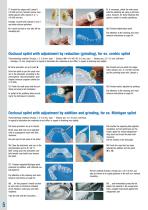
7. Smooth the edges with Liskosil-l (10 000 rev/min). Smooth narrow interdental spaces with Liskosil-m or -s (10 000 rev/min). 8. If necessary, polish the matt areas with the polishing set using a lab handpiece, however, for these relatively thin splints a polish is mostly superfluous. Erkolign: smooth with Liskosil-m and -l and white silicone polishers. 9. It would be best to now take off the insulating foil. 10. Finished stabilization splint. Pay attention to the cleaning and maintenance instructions on page 34. Occlusal splint with adjustment by reduction (grinding), for ex. centric splint...
Open the catalog to page 6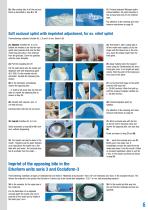
20. After cooling take it off the unit and finish as described in step 9 to 12. 21. Finished adjusted Michigan splint without addition, the splint consists in the occlusal area only of one material type. Pay attention to the cleaning and maintenance instructions on page 34. Soft occlusal splint with imprinted adjustment, for ex. relief splint Thermoforming material: Erkoflex-95, 2.5 and 4.0 mm, Shore A 95 22. Addition: Erkoflex-95, 2.5 mm Embed the models so far into the high grade steel granules that only the thermoforming area plus 5 mm protrude from the granules. Cover the granules with the...
Open the catalog to page 7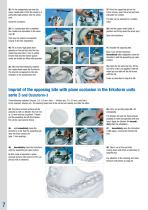
36. Fix the antagonistic jaw onto the upper model plate. Prefix the model in a preferably high position with the arrest joint. Close the Occluform. 38. If a construction bite is available the models are articulated in the same way (3). 37. Point the supporting pin on the 0-line (arrow), open the arrest joint and articulate the models. The bite can be elevated to a median value. 39. Hold the upper model plate in position and firmly close the arrest joint. Open the Occluform. That way the imprint corresponds exactly to the bite registration. 40. Fill as many high grade steel granules in the pot...
Open the catalog to page 8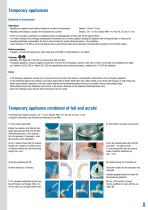
Temporary appliances Materials & Accessories Fabrication: • Moulding as negative mould without bonding to acrylics for temporaries: • Moulding with bonding to acrylics for temporaries by a primer: • Primer for a durable combination of cartridge acrylics and liquid powder acrylics with the foil types Erkodur. / • or model insulation and shrinkage compensation thermoform the ex works applied insulating foil together with the desired plate, in doing so the F insulating shrinkage compensation foil has to show towards the model (otherwise primer, only insulation). / • over templates (110 900) to...
Open the catalog to page 9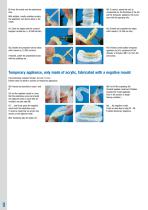
9. Press the mould onto the edentulous area. With suitable, mostly cartridge acrylics, the adaptation can also be done in the mouth. 10. To avoid a raised bite and to compensate for the thickness of the foil, put the temporary appliance into occlusion with the opposing bite. 11. Grind the edges with the crosscut tungsten carbide bur (> 20 000 rev/min). 12. Smooth and prepolish the edges with Liskosil-l (10 000 rev /min). 13. Smooth and prepolish narrow areas with Liskosil-m (10 000 rev /min). 14. Finished, break-stable temporary appliance out of a compound of foil (Erkodur or Erkodur-0M1/-A1/-A2/-A3)...
Open the catalog to page 10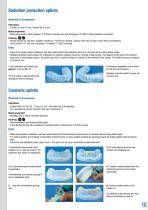
Radiation protection splints Materials & Accessories Fabrication: • Erkoflex, 4.0 and 5.0 mm, Erkoflex-95, 4.0 mm Model preparation: • When using plaster models: Erkogum (110 844) for blocking out, high-fusing wax (725 080) for filling bubbles in the plaster. Finishing: • Special scissors XL (220 301), tungsten carbide bur (110 837) for grinding, Liskosil-l (223 240) or Lisko-S (223 200) for prepolishing, hot air burner (177 540) and if necessary, FG-sheets (177 400) for shining Hints • Areas of the model (exterior vestibulum, oral floor) which obstruct the adaptation have to be removed. Remove...
Open the catalog to page 11All ERKODENT Erich Kopp catalogs and technical brochures
 Program
28 Pages
 silensor-sl
2 Pages
 Thermoforming material EN
10 Pages
 Thermoforming
40 Pages
 Blocking out wax --
10 Pages
 Playsafe comparison
6 Pages
 New products 2015
12 Pages
 tztG_EN
12 Pages
 Playsafe Flyer
2 Pages
 Machines (Unit)
4 Pages
 New products 2013
12 Pages
 Erkoform-3
1 Page


Archived catalogs
 Erkoform-3d
2 Pages
- Dental material
- Dental restoration material
- Dental surgery instrument kit
- Dental burr
- Human scissors
- Resin dental material
- Heating oven
- Modeling dental material
- Biocompatible dental material
- Cutting burr
- Dental laboratory dental material
- Metal burr
- Wax dental material
- Impression tray dental material
- Opaque dental material
- Casting dental material
- Orthodontic material
- Silicone dental material
- White dental material
- Temporary dental material