

- Products
- Catalogs
- News & Trends
- Exhibitions
Gynecare TVT

Gynecare TVT
This document provides comprehensive information on Stress Urinary Incontinence (SUI) and its treatment options, with a focus on the Gynecare TVT system. It aims to educate women about SUI, its causes, symptoms, and available treatments, and encourages consultation with healthcare professionals.
Urinary incontinence involves the accidental leakage of urine, with SUI being the most prevalent type. It occurs during activities that increase abdominal pressure, such as coughing or sneezing. Other types include urge incontinence, mixed incontinence, and overflow incontinence.
SUI can affect women of any age and is not a normal part of aging. Causes include pregnancy, childbirth, menopause, obesity, and smoking. Symptoms involve urine leakage during activities like coughing, sneezing, or exercising.
Diagnosis typically involves a pelvic exam and possibly urodynamic tests to assess bladder and urethral function, helping to determine the type of incontinence and guide treatment recommendations.
Treatment varies based on individual needs and may include:
- Behavioral/Muscle Therapy: Kegel exercises to strengthen pelvic muscles.
- Biofeedback: Electrical sensing devices to improve muscle control.
- Electrical Stimulation: Mild electric currents to pelvic muscles.
- Bulking Agents: Injectable therapy to thicken the urethral wall.
- Surgical Options: Minimally invasive sling procedures using synthetic mesh, such as the Gynecare TVT system.
The Gynecare TVT system provides tension-free support for the urethra using a mesh sling. It is a well-studied and effective treatment for SUI, supported by extensive clinical data. The procedure is typically outpatient, with quick recovery and immediate results.
Potential risks include anesthesia complications, infection, pain, and mesh-related issues such as exposure or erosion. Patients should discuss these risks with their surgeon and consider factors like smoking cessation before surgery.
Women experiencing SUI should consult with a specialist to explore treatment options, including the Gynecare TVT system. This procedure is covered by most insurance plans, but patients should verify coverage with their provider.
Potential adverse reactions include mesh extrusion, exposure, or erosion, risk of infection, acute and/or chronic pain, voiding dysfunction, pain during intercourse, neuromuscular problems, recurrence of incontinence, bleeding, and the potential need for revision surgeries. In severe cases, death may occur.
Patients are advised to consult their doctors to discuss the benefits and risks of treatment options, including the appropriateness of PROLENE Mesh.
Patients are encouraged to ask their doctors specific questions about their type of incontinence, treatment options, candidacy for GYNECARE TVT™, and the safety and effectiveness of procedures.
Ethicon is committed to improving women's quality of life by providing innovative solutions for pelvic health conditions.
For more information, patients can visit www.smarterpatient.com or call 1-877-ETHICON.
Catalog excerpts

Stop coping. Start living.* know about Stress Urinary MRTOFTHE^efMUDH-l^efnHini FAMILY OF COMPANIES
Open the catalog to page 1
What is Urinary Incontinence? Urinary incontinence occurs when you experience accidental urine leakage. Many women suffer from some type of urinary incontinence. There are 4 major types. Have you ever leaked urine when you laughed, coughed or sneezed? You are not alone. Many women suffer from a common condition called stress urinary incontinence, or SUI. Stress Urinary Incontinence Unintentional urine leakage during exertion, activity, or movements, such as coughing, sneezing, laughing and exercising. This is also referred to as stress incontinence. SUI is the most common type of urinary incontinence...
Open the catalog to page 2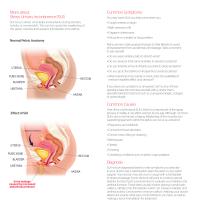
More about Stress Urinary Incontinence (SUI) Common Symptoms SUI occurs when urine leaks involuntarily during exertion, activity, or movements. This can be caused by weakening of the pelvic muscles that support the bladder and urethra. • Cough, sneeze or laugh You may have SUI if you leak urine when you: • Walk, exercise or lift • Engage in intercourse • Get up from a seated or lying position Normal Pelvic Anatomy Many women make gradual changes to their lifestyle to avoid embarrassment from accidental urine leakage. Take a moment to ask yourself: • Do you wear sanitary pads to absorb urine?...
Open the catalog to page 3
Minimally Invasive Surgical Sling Procedure: Typically an outpatient procedure in which the surgeon places a thin piece of flexible, permanent surgical mesh under the urethra, like a sling, to prevent involuntary urine leakage. In some patients, an inpatient procedure may be required. The most common surgical techniques used to treat SUI are: Retropubic Approach Mesh is inserted through a small incision in the vagina and exits through two small incisions in the abdomen. SKIN INCISIONS PUBIC BONE VAGINA UTERUS PUBIC BONE URETHRA VAGINA Treatments Stress urinary incontinence is treatable at any...
Open the catalog to page 4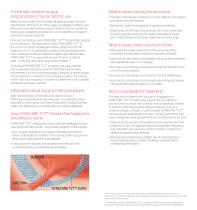
A minimally invasive surgical sling procedure may be right for you What to expect during the procedure • Typically a 30-minute procedure; in some patients, an inpatient procedure may be required Many women suffer from SUI without getting treated. Women should know that SUI is, in many cases, a treatable condition, and there are minimally invasive surgical options that can usually be done as an outpatient procedure. In some patients, an inpatient procedure may be required. • Performed under local, regional or general anesthesia • Depending on the type of procedure, the mesh is inserted through...
Open the catalog to page 5
What are the risks? Risks Common to All Pelvic Surgeries: Risks for all pelvic surgeries include anesthesia risks, infection, inflammation, tissue contraction, vaginal scarring, pain (temporary or chronic), pain with intercourse, pelvic pain, development of urge urinary incontinence or voiding difficulties (such as urinary retention or frequency), bleeding, including hemorrhage, hematoma (collections of blood in the pelvis), seroma, injury to vessels, nerves, and organs including the bladder, urethra or bowel, wound healing problems, urinary tract infection, fistula (holes between bladder or...
Open the catalog to page 6
Stress urinary incontinence (SUI) is common, and treatment may help you get back to doing the things you enjoy most. Speak with your doctor or surgeon to discuss the best options for you. Questions for your doctor about Stress Urinary Incontinence • What type of incontinence do I have? • What are the least invasive treatment options you would recommend for me? • Am I a candidate for treatment with GYNECARE TVT™ Tension-free Support for Incontinence? • Will treatment affect my ability to have children? • What are the risks for my situation that are associated with the GYNECARE TVT™ procedure?...
Open the catalog to page 7All Ethicon catalogs and technical brochures
 Ethicon Product Catalog 2024
105 Pages


Archived catalogs
 EVARRESt
6 Pages
 GYNECARE VERSAPOINT™
2 Pages
 EVICEL® Fibrin Sealant (Human)
22 Pages
 HARMONIC® HD 1000i Shears:
9 Pages
 PROXIMATE® Skin Staplers
2 Pages
 2017 Ethicon Product Catalog
72 Pages
 ENDOPATH® Probe Plus II
7 Pages
 Surgicel
69 Pages
 Surgicel JME reprint
63 Pages
 Ethicon Product Catalog
90 Pages
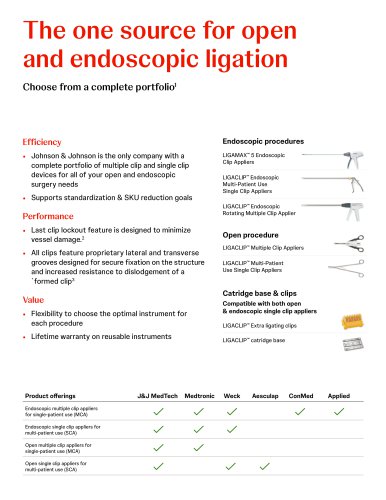
 LIGACLIP®
3 Pages
 SURGICEL® FIBRILLAR™
7 Pages
 ENSEAL® G2
4 Pages
 GEN11
GEN112 Pages
 HARMONIC FOCUS®+
2 Pages
 Product Catalog
103 Pages
 ECHELON CONTOUR™
4 Pages
 MEGADYNE™ MEGA SOFT™
4 Pages
 HARMONIC ACE®+7 Shears
3 Pages
 Harmonic®
2 Pages
 SAGB VC
8 Pages
 Echelon Flex
6 Pages
 2016 Ethicon Product Catalog
52 Pages
 PROXIMATE ® Skin Staplers
2 Pages
 BASX? BLADELESS TROCAR
2 Pages
 TROCAR PORTFOLIO
2 Pages
 2015 Ethicon Product Catalog
81 Pages
 2014 Ethicon Product Catalog
81 Pages


