
- Catalogs
- ETS Lindgren
- Acoustic Shielding Solutions for MRI Installations


- Products
- Catalogs
- News & Trends
- Exhibitions
Acoustic Shielding Solutions for MRI Installations

Acoustic Shielding Solutions for MRI Installations
Modern MRI installations face challenges with high noise levels due to powerful gradient coils, reaching 100 to 110 dBA, with peaks at 120 dB. This affects patient comfort and staff efficiency, necessitating acoustic shielding, especially in facilities not originally designed for MRI.
Noise Sources and Transmission
Noise in MRI environments can be airborne or structure-borne, requiring effective sound abatement strategies due to their ability to travel significant distances.
Sound Transmission Loss (STL) and Sound Transmission Class (STC)
STL measures the sound-blocking capability of a barrier, influenced by weight and frequency, while STC ratings guide the selection of acoustic barriers.
Designing Acoustically Enhanced Rooms
Noise abatement involves materials like fiberglass panels and sealants. Considerations include building structure, MRI equipment type, noise paths, room usage, and equipment frequency.
Suggested Design Guidelines
Use proven construction methods, such as sound-absorbing materials in the Magnet Room, and ensure proper sealing in interspatial areas. Wall construction should involve multiple layers of gypsum wallboard with acoustical caulking.
Additional Considerations
Ventilation ducts should be lined with absorbent material, and RF windows should have appropriate STC ratings. Proper sealing of RF doors is essential to prevent sound leaks.
Lead Shielding
Lead is effective for sound abatement, offering a thinner wall section and preventing easy vibration.
Structure-borne Noise Isolation
MRI equipment should ideally be placed on the ground floor with an isolated slab to minimize vibration transmission.
Acoustically Rated RF Doors and Windows
ETS-Lindgren offers RF doors and windows with high STC ratings, enhancing acoustic performance.
RF Shield Decoupling
RF shields should be independent of parent room walls to enhance sound abatement.
Acoustic Wall and Floor Systems
ETS-Lindgren's systems achieve high STC ratings using layered construction and insulating materials. Various floor systems are available to dampen sound and vibration.
Acoustic Absorption Kits
These kits can be applied to RF shield walls and ceilings, though primary noise reduction relies on building structures.
Glossary and Standards
The document includes definitions and standards related to sound transmission, such as STC, NIC, and NRC ratings.
Standards
Includes standards like C 634, C 919, E 90, E 336, and E 413, relating to environmental acoustics and sound insulation.
Company Overview
ETS-Lindgren is a leading supplier of shielding solutions for EMI/RFI, with extensive experience in MRI Shielding Systems and over 25,000 shielded enclosures installed globally.
Technical Expertise
ETS-Lindgren is renowned for its expertise in shielding principles and commitment to controlling electromagnetic energy.
Contact Information
ETS-Lindgren has offices worldwide, providing global support and services.
Catalog excerpts
coustic Shielding Solutions for §] PSffl Installations An ESCO Technologies Company
Open the catalog to page 1
The Issue: Increasing Noise Levels in MRI Environments With the introduction of more powerful gradient coils on today’s high field MRI scanners, MRI equipment is producing increasingly high noise levels. During a typical scan sequence, many newer MRI systems will produce average sound pressure levels (SPL) as high as 100 to 110 dBA, with peak levels of 120 dB. These high scanner noise levels can interfere with patient comfort, patienttechnician communication, and staff working efficiency. noise suppression specifications often exist During a scanning procedure, the patient is located at the epicenter...
Open the catalog to page 2
Understanding Sound Transmission Following are descriptions of Sound Transmission Loss (STL) and Sound Transmission Class (STC) ratings. Sound Transmission Loss (STL) Airborne sound is transmitted through a barrier in much the same manner as is a radio frequency signal. When a sound wave traveling through the air strikes a barrier surface, most of the sound energy is either reflected back into the source room or absorbed in the barrier, but some of the sound energy penetrates the barrier and is detectable in the receiving room. As sound penetration occurs, the sound wave exerts a fluctuating...
Open the catalog to page 3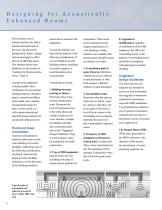
Designing for Acoustically Enhanced Rooms Most acoustic noise is airborne and not only affects patients and technicians in the room, but also travels through walls, floors, ceilings, and structural gaps to affect persons in adjoining spaces. (For structure-borne noise problems, see the section on “Isolation for Structure-borne Noise,” Page 8). ensure that no issues are left unattended. Acoustic noise abatement is made possible with a combination of conventional building materials, fiberglass panels, mineral board fillers, mass loaded vinyl, sealants, and absorbent linings for ducts. In this section,...
Open the catalog to page 4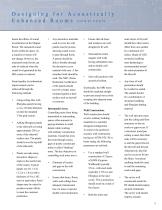
Designing for Acoustically E n h a n c e d R o o m s CONTINUED lessen the effects of sound reverberation in the Magnet Room. The measured sound levels within the space via a sound level meter will not change. However, the measured sound levels can only be reduced when the sound level generated by the MR system is reduced. Sound quality (reverberation) improvements can be achieved through the following methods: • Using ceiling tiles with fiberglass panels having a 2-in. (51mm) thickness set into the standard T-bar grid system. Adding fiberglass panels to the sidewalls covering approximately 20%...
Open the catalog to page 5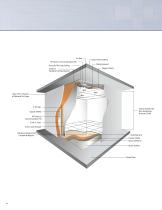
Air Gap RF Panel w/ Sound Insulation Fill Acoustic Tile Drop Ceiling Studs or Resilient Furring Channel Deck, Parent Ceiling Ceiling Support Copper Shield Layer 5/8 in. Drywall w/Optional 2cd Layer Seams Sealed with Non-Hardening Acoustic Chalk Copper Shield RF Panel w/ Sound Insulation Fill 3 5/8 in. Stud 5/8 in. layer Drywall Vibration Isolation Pad Located at Magnet Underlayment Copper Shield Epoxy Adhesive Epoxy Isolator Parent Floor
Open the catalog to page 6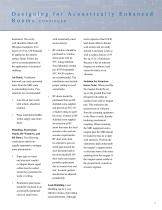
Designing for Acoustically Enhanced R o o m s CONTINUED treatments. The cavity wall should be filled with fiberglass insulation. Two layers of 5/8 in. GWB should be applied as the interior surface finish. Follow the above recommendations for the application of acoustical caulking. Air Ducts. Ventilation ductwork can carry unwanted noise from the MRI room to surrounding rooms. Two solutions are recommended: • Line the air duct walls with a thick, absorbent material. Place intermittent baffles within supply and return ducts. Plumbing, Penetration Panels, RF Windows, and RF Doors. The following...
Open the catalog to page 7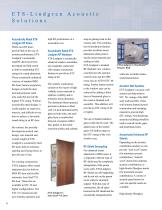
Acoustically Rated ETSLindgren RF Doors While most RF doors provide little in the way of acoustic performance, ETSLindgren’s acoustically rated RF doors have been developed and fully tested to deliver outstanding STC ratings for sound abatement. These acoustically enhanced versions of standard MRI RF doors feature proprietary designs on both the door leaf and perimeter jamb area seals that provide the highest STC rating. Without acoustically rated designs, it would require an expensive, massive, and difficult-to-use door to achieve a favorable sound rating in an RF door. By contrast, the specially...
Open the catalog to page 8
acoustic inserts may be placed in all wall and ceiling surfaces. When used with STC 50+ rated parent wall assemblies, without penetrations, the RF shield wall and ceiling assemblies are capable of contributing additional STC rating points between 10 and 30, depending on the type of interior wall preparations provided by the customer and the type of shielding material. This contribution would be made to the entire acoustic assembly, consisting of parent walls/ceiling, RF shield acoustic modification, and finished interior walls. Acoustic Floor Systems While the thickness and construction of MRI...
Open the catalog to page 9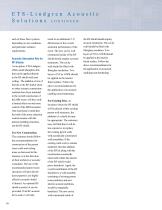
each of these floor systems depending on site conditions and particular isolation requirements. Acoustic Absorption Kits for RF Shields As an option, ETS-Lindgren offers sound absorption kits that can be applied directly to the RF shield walls and ceiling. The addition of one of the kits to the RF shield, when no other acoustic construction methods have been instituted to the overall construction of the MRI room, will have only a limited effect on total noise control of the MRI resonator. One must keep in mind that the bulk of the noise reduction control remains with the primary building structures,...
Open the catalog to page 10
Airborne Sound- Sound transmitted through air as a medium rather than through solids or the structure of a building. differentials are measured in one-third octave bands and compared with standard contours as per ASTM E 413. Attenuation, Sound- Reducing the intensity of a sound signal. Noise Reduction (NR)- The difference in sound pressure level between any two points along the path of sound propagation. As an example, noise reduction is the term used to describe the difference in sound pressure levels between the inside and outside of an enclosure. Noise reduction is usually expressed as a function...
Open the catalog to page 11All ETS Lindgren catalogs and technical brochures
 Test Cell
2 Pages
 DEI
DEI8 Pages
 LRW-Series
2 Pages
 Filters Capabilities
4 Pages
 Chamber
52 Pages
 Corp
Corp24 Pages
 AudiometricFullLine
32 Pages
 Antenna Capabilities
26 Pages
 MRI SOLUTIONS
1 Page
 MED-VIZION LIGHTING
2 Pages
 MRI ACCESSORIES AND SERVICES
2 Pages
 SAFESCAN®
12 Pages
 Full Line Product Brochure
40 Pages
 MRI Full Line Brochure
12 Pages
 ASDII
ASDII4 Pages
 Sliding Shielded Door (SSD)
2 Pages
 MRDS Door
2 Pages


Archived catalogs
 MRI SHIELDING
34 Pages
 MRI RF Doors.
8 Pages


- Hospital door
- Sliding door
- Protection door
- LED lighting
- Ceiling-mounted lighting
- Hospital lighting
- Double door
- Radiation protection door
- Medical monitoring system
- Shielded door
- Service door
- Radiology service door
- Temperature monitoring system
- Medical gas monitoring system
- Built-in lighting
- Door control panel
- MRI metal detector
- Humidity monitoring system
- Sliding window
- MRI door