


Anterior Approach Patient Education

Anterior Approach Patient Education
This brochure provides an overview of the Direct Anterior Approach to total hip arthroplasty, emphasizing that it is for educational purposes and not a substitute for professional medical advice.
Severe hip pain can result from conditions like osteoarthritis, rheumatoid arthritis, avascular necrosis, developmental dysplasia, or hip fractures. Osteoarthritis is a leading cause, characterized by the wearing away of joint surfaces, leading to painful bone-on-bone contact.
Treatment begins with conservative methods such as rest, physical therapy, and medication. If ineffective, total hip replacement surgery may be considered. The surgery involves risks, and the surgeon will discuss these with the patient.
The procedure involves removing diseased bone and cartilage, replacing them with orthopedic implants. The femoral head is replaced with an artificial ball on a stem, and the acetabulum is fitted with a titanium shell and liner to form the new joint.
The Direct Anterior Approach accesses the hip joint from the front, preserving muscles and potentially allowing faster recovery and less pain. It requires specific implants and instruments, and not all surgeries use this approach.
The lifespan of a hip replacement depends on factors like patient age, weight, activity level, and implant materials. Friction wear is a concern, and minimizing it is crucial for implant longevity.
Post-surgery involves pain management and physical therapy, with patients often walking within 24 hours. Recovery includes learning daily activities and requires support from family or friends. Exercise and adherence to medical advice are vital for recovery.
Patients can typically return to activities like walking, golfing, and biking within weeks. Recovery speed depends on pre-surgery condition and adherence to post-operative guidelines.
Total hip replacement can significantly improve lifestyle, but it involves risks and is not suitable for everyone. Consultation with a physician is essential to determine candidacy for surgery.
Catalog excerpts

pyflffpffr Find out why the Anterior Surgeon focused. Patient driven.™ Approach may be right for you.
Open the catalog to page 1
UNDERSTANDING TOTAL HIP REPLACEMENT This brochure offers a brief overview of the Direct Anterior Approach to total hip arthroplasty. This information is for educational purposes only and is not intended to replace the expert guidance of your physician. Please direct any questions or concerns you may have to your doctor.
Open the catalog to page 2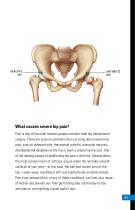
What causes severe hip pain? Pain is one of the main reasons people consider total hip replacement surgery. There are several conditions that can bring about severe hip pain, such as osteoarthritis, rheumatoid arthritis, avascular necrosis, developmental dysplasia of the hip or even a simple hip fracture. One of the leading causes of debilitating hip pain is arthritis. Osteoarthritis, the most common form of arthritis, occurs when the normally smooth surfaces of your joint—in this case, the ball-and-socket joint of the hip—wear away, resulting in stiff and painful bone-on-bone contact. Pain from...
Open the catalog to page 3
Your doctor will evaluate your condition and determine if surgery is right for you. TREATMENT OPTIONS? Your doctor will consider many factors in determining an appropriate treatment method to relieve your hip pain. Treatment may begin with conservative methods such as rest, physical therapy, medication or analgesics. If these methods fail to provide long-term relief, then it may be time to consider a surgical treatment such as total hip replacement. Joint replacement surgery is a major operation. As with any major operation, there are possible complications. Some of these are related to the anesthesia,...
Open the catalog to page 4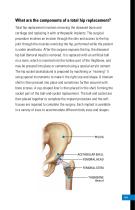
What are the components of a total hip replacement? Total hip replacement involves removing the diseased bone and cartilage and replacing it with orthopaedic implants. The surgical procedure involves an incision through the skin and access to the hip joint through the muscles overlying the hip, performed while the patient is under anesthesia. After the surgeon exposes the hip, the diseased hip ball (femoral head) is removed. It is replaced with an artificial ball on a stem, which is inserted into the hollow part of the thighbone, and may be pressed into place or cemented using a special acrylic...
Open the catalog to page 5
WHAT IS THE ANTERIOR SURGICAL APPROACH? Hip replacement can be performed through a variety of surgical approaches. Anterolateral (from the side of the hip) and posterolateral (from the back of the hip) have been traditionally used in the U.S. The Direct Anterior Approach is different because it allows the surgeon to access the diseased hip joint through the front of the hip. A major advantage of this approach is that it allows your surgeon to work through natural intervals between the muscles around your hip, without having to cut through the muscles or detach them from the pelvis or thighbone. Another...
Open the catalog to page 6
Why aren’t all hip replacements performed through the Direct Anterior Approach? Direct Anterior Approach hip surgery requires implants and surgical instruments that are compatible with the approach. Specialized surgical tables may facilitate the Direct Anterior Approach by allowing precise positioning of the patient during surgery. Your doctor will consider a wide variety of factors in determining the best course of treatment. Please talk to your doctor and ask whether hip replacement through the Direct Anterior Approach is right for you. DIRECT ANTERIOR APPROACH INCISION
Open the catalog to page 7
HOW LONG WILL MY TOTAL HIP REPLACEMENT LAST? There are numerous factors that affect the longevity of a total hip replacement including patient indications (age, weight and activity level), implant design and materials used during surgery. Just like your natural hip, the components of a hip implant are subject to wear from friction caused by bending, straightening and supporting your body weight. In the design of hip implant components—particularly the bearing surfaces that slide against one another—it is very important to ensure the least amount of friction possible.
Open the catalog to page 9
EXPECT AFTER SURGERY? After surgery you will receive pain medication and begin physical therapy. You may be out of bed and walking on crutches or a walker within 24 hours of your surgery. You will be shown how to perform activities of daily living such as how to safely climb and descend stairs and how to care for your hip once you return home. It is a good idea to enlist the support of family or friends to help you once you return home. Exercise will be a necessary part of proper healing. Therapy will begin in the hospital and continue after discharge on your own or with a therapist. Therapy,...
Open the catalog to page 10
When can I return to my regular activities? After successful surgery, you will be eager to return to many of the activities you enjoy. Your recovery is partially based upon your condition prior to your surgery. Going for walks, golfing, boating, biking and playing with children or grandchildren are usually realistic expectations, and many patients who have a hip replaced through the Direct Anterior Approach are able to return to normal activities more quickly (within a few weeks rather than a few months). Many patients report little or no pain in a month or two after surgery, but the decision...
Open the catalog to page 11
SUMMARY This brochure is not intended to replace the experience and counsel of your orthopaedic surgeon. Surgery is one of the most important decisions you will make. Total hip replacement has allowed millions of people to return to more active lifestyles. Your surgeon will help you decide if it’s the right choice for you. With any surgery, there are potential risks, and results will vary depending on the patient. Joint replacement surgery is not for everyone. Check with your physician to determine if you are a candidate for joint replacement surgery. Your physician will consider the risks and...
Open the catalog to page 12All Exactech catalogs and technical brochures
 AcuMatch
7 Pages
 Hip Family Brochure
9 Pages
 Corporate Product Brochure
5 Pages
 Biologics
9 Pages
 Corporate brochure
11 Pages
 Cemex_Main_
12 Pages
 LBS II
12 Pages
 Calcium Phosphate Cement
5 Pages
 EXACTECH HIP
8 Pages
 Bipolar/Unipolar Heads
2 Pages
 Novation
16 Pages
 Equinoxe Fx Plate
2 Pages
 Equinoxe Product
2 Pages
 Equinoxe Reverse
8 Pages
 Equinoxe System
7 Pages
 Novation CFS
2 Pages
 AcuMatch_Family
20 Pages
 knee replacement
5 Pages
 Spacer
4 Pages
 accelerate
3 Pages
 Element
16 Pages
 EXACTECH HIP Design Rationale
12 Pages
 EXACTECH HIP Operative Technique
16 Pages


- Bone plate
- Compression plate
- Metallic compression plate
- Locking compression plate
- Analysis software
- Orthopedic surgery instrument kit
- Tablet computer software
- Tablet PC software
- Windows software
- Proximal compression plate
- Bone substitute
- Data management software
- Surgery software
- Femoral stem
- Humerus compression plate
- Arthrodesis plate
- Orthopedic surgery bone substitute
- Knee prosthesis
- Metallic arthrodesis plate
- Acetabular prosthesis