


EXACTECH HIP Design Rationale

EXACTECH HIP Design Rationale
The Alteon® Tapered Wedge is a modern femoral stem designed to improve surgical outcomes and patient experiences. It focuses on immediate mechanical stability through advanced geometry, titanium plasma coating, and a range of sizes.
Design History and Evolution of Wedge Stems
Wedge stems have evolved from early designs like the cemented Mueller stem to more sophisticated versions. These advancements include shorter lengths and reduced distal geometry to better fit anatomical variations.
Summary of Success
Research indicates high implant survivorship for both first- and second-generation wedge stems, with material and design improvements enhancing their success.
Unmet Clinical Needs
Challenges such as distal potting, delayed osseointegration, periprosthetic fractures, and thigh pain persist, often due to limitations in earlier stem designs.
Exactech Implant Design Philosophy for Tapered Wedge
The design philosophy aims for fixation across all femur types without sacrificing implant features, addressing kinematic issues without modular necks, and ensuring immediate stability.
Design Goals
1. Achieve fixation in all primary femur types.
2. Solve kinematic issues without modular necks.
3. Limit growth to avoid large size jumps.
4. Ensure axial and rotational stability.
5. Maintain compatibility with all surgical approaches.
Incremental Sizing
The Tapered Wedge offers four neck length groups and two offsets, allowing adjustments without affecting leg length, accommodating various femur sizes.
Platform Instrumentation
Part of the Alteon hip system, the Tapered Wedge uses common femoral instruments for multiple stems, enhancing surgical efficiency.
Conclusion
The Alteon Tapered Wedge Femoral Stem marks a significant advancement, improving surgical experiences and patient outcomes.
This document outlines guidelines for using medical devices by Exactech, Inc., emphasizing that Exactech does not practice medicine or recommend surgical techniques. Surgeons must assess these guidelines based on their expertise.
Product Information
Surgeons should refer to the product package insert for warnings, precautions, indications, contraindications, and adverse effects. Products may have different trademarks in various countries.
Usage Restrictions
This material is for the Exactech sales force and physicians only and should not be redistributed without Exactech's consent.
References
The document references studies and data on femoral stems and hip arthroplasty, focusing on cobalt-chrome and titanium trilock femoral stems, cementless components, and implant stability.
Contact Information
Exactech's global headquarters is in Gainesville, Florida, USA, with contact details provided for further product information.
Catalog excerpts

Tapered Wedge Femoral Stem Surgeon focused. Patient driven.TM
Open the catalog to page 1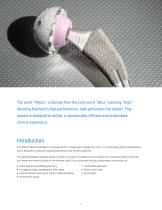
The word “Alteon” is derived from the Latin word “altus” meaning “high,” denoting Exactech’s high performance, next-generation hip system. This system is designed to deliver a reproducible, efficient and predictable clinical experience. Introduction The Alteon® Tapered Wedge is a next-generation, single-taper, wedge-style stem. It incorporates specific philosophies, and is designed to improve surgical experiences and clinical outcomes. The Tapered Wedge collarless design intends to achieve immediate axial and rotational mechanical stability between the medial and lateral cortices of the femoral...
Open the catalog to page 3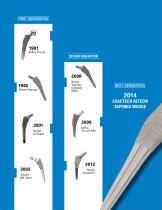
FIRST GENERATION DePuy Tri-Lock SECOND GENERATION Biomet TaperLoc Biomet TaperLoc Complete (RDD) NEXT GENERATION EXACTECH ALTEON TAPERED WEDGE
Open the catalog to page 4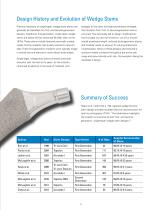
Design History and Evolution of Wedge Stems Previous iterations of single-taper, wedge-style stems can changes to the stem and head prostheses emerged, generally be classified into first- and second-generation the transition from first- to second-generation stems designs. Traditional, first-generation, single-taper wedge occurred. This eventually led to design modifications stems are based off the cemented Mueller stem of the that included, but are not limited to: cut off or shorter 1970s. These stems initially featured proximally coated, overall prosthesis length, reduced distal geometry stems,...
Open the catalog to page 5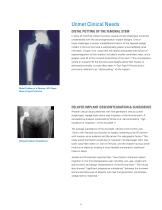
Unmet Clinical Needs DISTAL POTTING OF THE FEMORAL STEM In spite of historical implant success, several clinical challenges remained unaddressed with the second-generation implant designs. One of these challenges is proper medial/lateral fixation of the tapered wedge implant in femurs that have a substantially greater proximal/distal canal mismatch. Cooper et al. noted that risk factors associated with failure of osseointegration (of the implant) included a smaller canal-flare index, and a greater canal fill at the mid-and distal-thirds of the stem.10 This complication, where an implant fills...
Open the catalog to page 6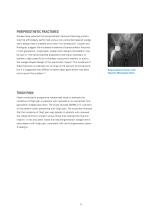
PERIPROSTHETIC FRACTURES Studies have reported that periprosthetic fractures following primary total hip arthroplasty performed using a non-cemented tapered wedge stem design have increased since their first introduction. Cooper and Rodriguez suggest the increased incidence of periprosthetic fractures in first-generation, single-taper wedge stem designs (Accolade I) may be due to “the hand broached preparation technique necessary to achieve a tight press-fit for immediate component stability, or due to the wedge-shaped design of this (particular) implant. The incidence of ” these fractures is...
Open the catalog to page 7
Exactech Implant Design Philosophy for Tapered Wedge Since its founding in 1985, Exactech has operated with a primary goal of providing implants and services that seek to improve patient outcomes. The Tapered Wedge Surgeon Design team, Jeff Pierson, MD, (Franciscan St. Francis Health, Carmel, Indiana) and Micahel Kang, MD, (Insall Scott Kelly Institute, New York , New York), alongside our engineering team, set out with several design goals in mind to address the clinical challenges previously mentioned. DESIGN GOALS 1) The proximal/distal stem ratio should allow the implant 3) The stem should...
Open the catalog to page 8
Standard Base Neck Length INCREMENTAL SIZING In order to satisfy design goal number two, solving common kinematic issues without the was taken when designing the neck grouping scheme for the Tapered Wedge stem. Some first- and second-generation competitive designs feature base neck lengths that are too large, have too large of a jump between need for modular necks, careful consideration stem sizes, or require modularity in order to solve kinematic issues during the surgical The Tapered Wedge stem has four base neck Alteon Tapered Wedge length groups. The system was intentionally First-Generation...
Open the catalog to page 9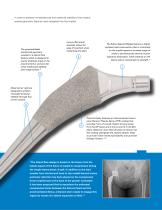
In order to achieve immediate axial and rotational stability of the implant, several geometric features were designed into the implant. The proximal/distal transitional geometry resulted in a lateral flare feature which is designed to evenly distribute loads in the proximal femur and provide initial mechanical stability (see image below).14 Low profile lateral shoulder allows for ease of insertion when implanting the stem. The Alteon Tapered Wedge features a highly polished neck cross-section that is minimized on the medial aspect to increase range of motion, decreasing the chance of postoperative...
Open the catalog to page 10
PLATFORM INSTRUMENTATION The Tapered Wedge is part of the Alteon family of hip stems. This platform hip system features a set of common femoral instruments that can be used across multiple stems. Alteon Common Femoral Instruments (Upper Level Tray) Alteon Common Femoral Instruments (Lower Level Tray) Alteon Tapered Wedge Instruments – Anterior Approach or all other approaches BROACH DESIGN • The system uses rasping-style broaches. • hen the Tapered Wedge prostheses is impacted to an W axial stopping point, the proximal border of the TPS will be approximately 1.5mm above the final broach. • he...
Open the catalog to page 11
GLOBAL HEADQUARTERS References 1. Healy W, Tilzey J, Lorio R, Specht L, Sharma S. Prospective, Randomized Comparison of CobaltChrome and Titanium Trilock Femoral Stems. J Arthroplasty. 2009;24:831-6. 6. hite C, Carsen S, Rasuli K, Feibel R, Kim P, W Beaulé P. High Incidence of Migration with Poor Initial Fixation of the Accolade® Stem. Clin Orthop Relat Res. 2012 Feb;470(2):410-7. 11. acobs C, Christensen C. Progressive subsidence J of a tapered, proximally coated femoral stem in total hip arthroplasty. Int Orthop. 2009 Aug;33(4):917-22. 2. urt C, Garvin K, Otterberg E, Jardon O. A Femoral B...
Open the catalog to page 12All Exactech catalogs and technical brochures
 AcuMatch
7 Pages
 Hip Family Brochure
9 Pages
 Corporate Product Brochure
5 Pages
 Biologics
9 Pages
 Corporate brochure
11 Pages
 Cemex_Main_
12 Pages
 LBS II
12 Pages
 Calcium Phosphate Cement
5 Pages
 EXACTECH HIP
8 Pages
 Bipolar/Unipolar Heads
2 Pages
 Novation
16 Pages
 Equinoxe Fx Plate
2 Pages
 Equinoxe Product
2 Pages
 Equinoxe Reverse
8 Pages
 Equinoxe System
7 Pages
 Novation CFS
2 Pages
 AcuMatch_Family
20 Pages
 knee replacement
5 Pages
 Spacer
4 Pages
 accelerate
3 Pages
 Element
16 Pages
 EXACTECH HIP Operative Technique
16 Pages


- Bone plate
- Compression plate
- Metallic compression plate
- Locking compression plate
- Analysis software
- Orthopedic surgery instrument kit
- Tablet computer software
- Tablet PC software
- Windows software
- Proximal compression plate
- Bone substitute
- Data management software
- Humerus compression plate
- Surgery software
- Arthrodesis plate
- Orthopedic surgery bone substitute
- Knee prosthesis
- Metallic arthrodesis plate
- Acetabular prosthesis