
- Catalogs
- EZDIATECH INC.
- VEUPLEXTM

VEUPLEXTM
VEUPLEXTM
VEUPLEX™ is a diagnostic solution developed by Ezdiatech for neurological brain disorders. It utilizes a multiplexed immunoassay system to diagnose brain diseases early and accurately using blood biomarkers, overcoming the limitations of traditional imaging methods like CT and MRI.
The document discusses the rising prevalence of brain diseases due to an aging population, forecasting significant healthcare costs by 2030. Traditional diagnostic methods detect diseases only after significant progression. VEUPLEX™ aims to facilitate early diagnosis through biomarkers, potentially enhancing treatment outcomes.
The document identifies various biomarkers linked to neurological conditions such as Alzheimer's, Parkinson's, and multiple sclerosis. It highlights the significance of biomarkers like GFAP, UCH-L1, and NfL in diagnosing and monitoring these diseases.
VEUS is an automated diagnostic system employing magnetic particles and AI technology for rapid and accurate testing. It offers high sensitivity and the capability to test multiple biomarkers simultaneously, reducing time and cost.
The document details specifications for various assays, including storage conditions, assay time, sample volume, and shelf life. It also provides ordering information for different VEUPLEX™ kits.
1. Magnetic Particle Technology: Enhances diagnostic accuracy and efficiency.
2. AI Imaging Analysis: Improves detection accuracy through advanced image processing.
3. Fluorescence Analysis: Offers ultra-sensitive detection capabilities.
The VEUDx Analyzer, part of the VEUS system, is CE IVDR and MFDS approved, ensuring compliance with international medical device standards.
VEUPLEX™ represents a significant advancement in the early diagnosis and management of neurological disorders, offering a comprehensive, efficient, and user-friendly diagnostic solution.
- Principle: Fluorescence coding/analysis
- Dimensions: 530 mm (L) x 485 mm (D) x 465 mm (H)
- Weight: 33.8 kg
- Cartridge Slots: Up to 6 cartridges
- Power Supply: AC 100-120V, 50/60Hz or AC 200-240V, 50/60Hz
- Display: 7 inch Touch LCD, 1024 x 600 resolution
The VEUS system offers hypersensitive and high-accuracy diagnosis with rapid results. It requires no warming time, reaching 37°C within 4-5 minutes, thus reducing test preparation time. The system uses a magnetic particle size-based coding system for multiplexed diagnostics and integrates reaction and optical modules for easy operation. Its efficient mixing and washing technology minimizes waste and device size, promoting economical and eco-friendly use.
- VEUDx Analyzer (Model No. V1-01A-2)
- Spin down Centrifuge with Rotor (Model No. CF01010)
- IVD and RUO kits for various assays, including TBI, Neuro assays, and quality control kits.
The VEUS system is applicable in research institutes, pharmaceutical companies, universities, and bio ventures.
- Address: fl 4, ACE-Air, 12-30, Simin-daero 327 beon-gil, Dongan-gu, Anyang-si, Gyeonggi-do (14055)
- Phone: +82-31-385-5455
- Website: www.ezdiatech.com
- Fax: +82-31-423-6455
- Email: [email protected]
Catalog excerpts
Neurological brain disorders Immunoassay kits Ezdiatech's fast and accurate solution for neurological brain disorders
Open the catalog to page 1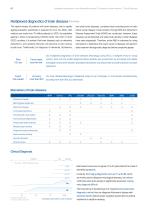
Multiplexed diagnostics of brain diseased(Neurology) | Biomarkers of brain diseases | Clinical Diagnosis The rapid increase of patients with brain diseases, due to rapidly ageing population worldwide, is expected to incur two trillion USD medical care costs from 75 million patients by 2030. As population ageing in Korea is progressing 4.5times faster than that of other OECD countries, it is evident that brain diseases such as dementia, Alzheimer's, and cerebral infarction will become a more serious social issue. Traditionally, for diagnosis of dementia, Alzheimer's and other brain diseases, combined...
Open the catalog to page 2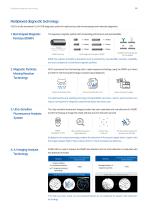
Multiplexed diagnostic technology Multiplexed diagnostic technology VEUS is a fully automated ALL-IN-ONE diagnostic system for rapid and accurate immunoassays and molecular diagnostics. 1. Rod Shaped Magnetic Particles (RSMP) The ingenious magnetic particle with outstanding performance and reproducibility. RSMP structure Multiple 'functional groups' can be applied Multi-diagnosis principle of RSMP RSMP has superior strengths in all aspects such as productivity, reproducibility, precision, availability and cost compared to conventional magnetic particles. 2. Magnetic Particles Moving Reaction...
Open the catalog to page 3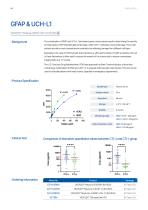
GFAP & UCH-L1 VEUPLEX™ TBI assay (GFAP, UCH-L1) (for IVD) · The combination of GFAP and UCH-L1 biomarkers gives a more precise result in determining the severity of head injuries. GFAP indicates glial cell damage, while UCH-L1 indicates neuronal damage. Thus, both proteins provide a more comprehensive evaluation by reflecting damage from different cell types. · Especially in the case of mild traumatic brain injuries (e.g. after sports injuries or traffic accidents), the use of these biomarkers is often used to assess the severity of the trauma and to reduce unnecessary imaging tests (e.g. CT...
Open the catalog to page 4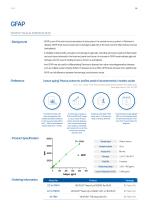
GFAP VEUPLEX™ Neuro 1p-B (GFAP) (for RUO) · GFAP is one of the main structural proteins of astrocytes in the central nervous system. In Parkinson's disease, GFAP levels may increase due to damage to glial cells in the brain and the inflammatory process (astrogliosis). · In Multiple Sclerosis (MS), activation and damage to glial cells, including astrocytes, leads to inflammation and scar tissue (sclerosis) in the brain and spinal cord tissue. An increase in GFAP levels indicates glial cell damage, and this wound healing process is known as astrogliosis. · And GFAP may be useful in differentiating...
Open the catalog to page 5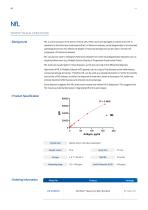
| Background • NfL is a structural part of the axons of nerve cells. When axons are damaged or broken down, NfL is released into the blood and cerebrospinal fluid. In Parkinson's disease, axonal degeneration is an important pathological process. NfL reflects the degree of neuronal damage and can be used to monitor the progression of Parkinson's disease. • NfL can also be used to distinguish Parkinson's disease from other neurodegenerative diseases such as atypical parkinsonism (e.g. Multiple System Atrophy or Progressive Supranuclear Palsy). • NfL levels are usually higher in these diseases,...
Open the catalog to page 6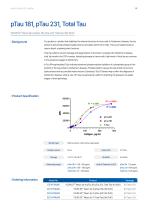
pTau 181, pTau 231, Total Tau • Tau protein is a protein that stabilizes the internal structure of nerve cells. In Alzheimer's disease, the tau protein is abnormally phosphorylated and accumulates within nerve cells. This accumulation leads to neuron death, impairing brain functions. ■ Total Tau reflects neuron damage and degeneration in the brain. In people with Alzheimer's disease, total tau levels in the CSF increase, indicating damage to nerve cells. High levels of total tau are common in the advanced stages of Alzheimer's. ■ p-Tau (Phosphorylated Tau) indicates abnormal phosphorylation (addition...
Open the catalog to page 7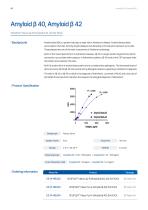
Amyloid p 40, Amyloid p 42 VEUPLEX™ Neuro 2p-B (Amyloid p 40, 42) (for RUO) | Background • Amyloid beta (Ap) is a protein that plays a major role in Alzheimer's disease. Amyloid beta proteins accumulate in the brain, forming amyloid plaques and disrupting communication between nerve cells. These plaques are one of the main components of Alzheimer's pathology. • Ap 42 is the most important form in Alzheimer's disease. Ap 42 is a longer protein fragment than Ap 40 and tends to accumulate within plaques. In Alzheimer's patients, Ap 42 levels in the CSF decrease while the protein accumulates in the...
Open the catalog to page 8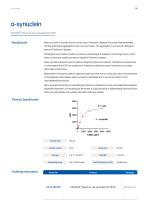
| Background ■ Alpha-synuclein is a protein found in nerve cells. In Parkinson’s disease, this protein folds abnormally, forming pathological aggregation known as Lewy bodies. This aggregation is an important biological feature of Parkinson’s disease. ■ Pathological accumulation of alpha-synuclein causes damage to dopamine-producing neurons, which leads to motor and cognitive symptoms typical of Parkinson’s disease. ■ Alpha-synuclein biomarkers can be helpful in diagnosing Parkinson's disease. Total alpha-synuclein levels in cerebrospinal fluid (CSF) are usually low in Parkinson’s patients because...
Open the catalog to page 9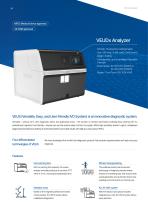
VEUDx Analyzer MFDS Medical Device approved CE IVDR approved VEUDx Analyzer · Principle : Fluorescence coding/analysis · Size : 530 mm(L) X 485 mm(D) X 465 mm(H) · Weight : 33.8 kg · Cartridge slots: up to 6 cartridges Desorption Tray type · Power Supply : AC 100-120V, 50/60Hz or AC 200-240V, 50/60Hz · Display : 7 inch Touch LCD, 1024 X 600 VEUS (Versatile, Easy, and User-friendly IVD System) is an innovative diagnostic system: Versatile – almost all in vitro diagnostic items are applicable; Easy – the system is entirely automated enabling easy testing with no pretreatment required; User-friendly...
Open the catalog to page 10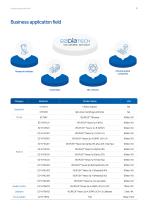
Business application field Business application field Pharmaceutical companies Research institutes Product Name VEUDx analyzer Spin down Centrifuge with Rotor VEUPLEX™ Neuro 1p-B (GFAP) VEUPLEX™ Neuro 2p-A (GFAP, UCH-L1) VEUPLEX™ Neuro 3p-A(pTau 181, pTau 231, Total Tau) VEUPLEX™ Neuro 1p-G (Amyloid β 40) VEUPLEX™ Neuro 1p-H (Amyloid β 42) VEUPLEX™ Neuro 1p-I (α-synuclein) Quality Control VEUPLEX™ Neuro 2p-A (GFAP, UCH-L1) QC VEUPLEX™ Neuro 2p-A (GFAP, UCH-L1) Calibrator
Open the catalog to page 11- Detection kit
- Blood detection kit
- Serum detection kit
- Clinical detection kit
- Immunoassay analyzer
- Clinical diagnostic immunoassay analyzer
- Automated immunoassay analyzer
- Benchtop immunoassay analyzer
- Continuous access immunoassay analyzer
- Chemiluminescence immunoassay analyzer
- Fluorescence immunoassay analyzer
- Fully automated immunoassay analyzer
- POC immunoassay analyzer
- Biomarqueurs test kit
- ELISA immunoassay analyzer
- Neurological disease test kit