

UPSEE

UPSEE
The Upsee is a mobility device designed for children with movement delays, enabling them to stand and move with adult assistance. Created by Debby Elnatan, it was inspired by her son with cerebral palsy. The Upsee Therapy Programme aims to enhance mobility, ability, and participation skills in children using the device.
The programme focuses on three key areas: Mobility, Ability, and Participation (MAP). It includes the MAP Mobility Assessment and the MAP Activity Programme, based on the WHO’s ICF-CY framework, to track and enhance these areas.
The MAP Mobility Assessment helps parents determine their child’s current mobility stage, focusing on head control, weight bearing, and walking. Each goal has stages that serve as building blocks for progress.
After identifying the mobility starting point, parents can select activities from the MAP Activities Programme to improve specific mobility goals, mixing and matching for ability and participation.
Progress should be reviewed regularly using the MAP Mobility Assessment. Parents are encouraged to document changes and share progress with Firefly to contribute to a broader understanding of the Upsee’s benefits.
Sessions should be scheduled when the child is well-rested. Parents should practice putting on and taking off the Upsee and ensure the child is comfortable during use.
It is recommended to wait at least 30 minutes before using the Upsee and avoid using it before bedtime. Start with standing for about 2 minutes, gradually increasing time based on the child's comfort. Use a mirror for proper fitting and monitor posture and control.
Observe the child's confidence and enjoyment before and after sessions. Document motivation levels and take photos or videos for review.
The ICF-CY framework records child development and environmental influences, emphasizing health and functioning, viewing disabilities as part of the health spectrum.
Firefly by Leckey aims to enhance children's play and participation through innovative products, focusing on mobility, ability, and participation, considering environmental and personal factors.
Definitions of gross and fine motor skills, visual-motor skills, body awareness, confidence, initiation, engagement, motivation, communication, tracking, everyday activities, and sensory skills are provided.
Guidelines for assessing head control, weight bearing, and walking patterns are detailed, with stages for each goal to track progress.
Activities are suggested to improve physical, cognitive, and social development, focusing on head control, weight bearing, and participation, including using mirrors, playing games, and engaging in everyday tasks.
The document provides a comprehensive guide for using the Upsee, assessing mobility goals, and engaging in activities to support child development.
- Walking Patterns: Different stages of walking patterns are outlined, including walking with full help, some help, and without sandals, with specific activities to encourage movement and independence.
- Mobility Activities: Suggestions include waiting for the child to initiate steps, using rhymes for rhythm, and guiding foot placement for normal walking patterns.
- Ability Activities: Designed to improve gross and fine motor skills, bilateral hand function, visual motor skills, communication, and sensory skills, with examples like playing football with a balloon and playing mini-golf.
- Activities aim to provide diverse experiences, including cooking, gardening, walking on the beach, and playing hide and seek, enhancing the child's engagement and enjoyment in various settings.
- An Ability Assessment section tracks progress in areas such as hand function, floor play, communication, attention, exploration, and fun, encouraging sharing progress through photos and videos.
- Encourage active involvement from the child and avoid rushing them. Adapt activities to suit the child's pace and ensure they are not overexerted.
- Use the Upsee in various environments to enhance sensory experiences, such as bright/dark areas or with different music tempos.
The document cites studies and guidelines from reputable sources, including the World Health Organization and various academic journals, to support the effectiveness of early intervention and therapy programmes.
Catalog excerpts

Therapy Programme A parent’s guide to choosing activities for improving Mobility, Ability & Participation (MAP)
Open the catalog to page 1
Upsee Therapy Programme Upsee Therapy Programme INTRODUCTION TO THE UPSEE • hat is the Upsee? W • hree starting essentials T • utting on and taking off your Upsee P THE UPSEE THERAPY PROGRAMME • What is the Upsee Therapy Programme? • Overview • inding your child’s mobility starting point F • hoosing Ability and Participation activities C • ow to review your progress H • haring your progress with us at Firefly S • Top tips • ICF-CY and MAP • Therapy terms explained • AP Mobility Assessment Sheet (and guidance notes) M • AP Activity Programme Worksheets M • dditional Ability and Participation activity...
Open the catalog to page 2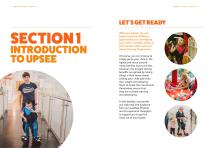
Upsee Therapy Programme Upsee Therapy Programme With your Upsee, you can begin to provide different opportunities for developing your child’s mobility, ability & participation skills using our Upsee Therapy Programme. Of course, you can choose to simply place your child in the Upsee and move around – many families love to do this. However, the longest lasting benefits are gained by taking things a little more slowly. Letting your child take their own weight and allowing them to make the movements themselves means that they are actively learning and developing. In this booklet, we provide you...
Open the catalog to page 3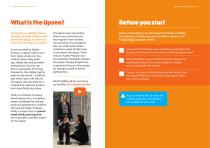
Upsee Therapy Programme Upsee Therapy Programme The Upsee is a mobility device designed to allow children with movement delays to stand and move with the help of an adult. Before attempting to use the Upsee for therapy or family participation activities, you must be able to answer ‘yes’ to ALL THREE questions below: It was invented by Debby Elnatan, a special needs mum from Israel, whose son has cerebral palsy. Many years ago, Debby was told by health professionals that her son had no awareness of his legs. Shocked by this, Debby tried to walk him by herself - a difficult task which led to her...
Open the catalog to page 4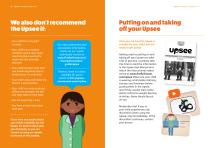
Upsee Therapy Programme Upsee Therapy Programme We also don't recommend the Upsee if: Putting on and taking off your Upsee • our child has very tight Y muscles Once you are sure the Upsee is suitable for your child, you are ready to get going! • our child has a medical Y condition where they might need laid down quickly for treatment (for example, seizures) • our child has had more than Y one broken leg bone (due to brittle bones, for example) • our child’s hips and knees are Y fixed in a bent position • our child has major postural Y differences between the left and right sides of their body...
Open the catalog to page 5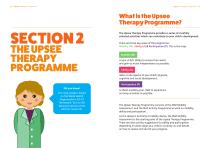
10 Upsee Therapy Programme Upsee Therapy Programme 11 What is the Upsee Therapy Programme? SECTION 2 THE UPSEE THERAPY PROGRAMME The Upsee Therapy Programme provides a series of carefully selected activities which can contribute to your child’s development. There are three key areas of the programme: Mobility (M), Ability (A) & Participation (P). This is the map: Mobility (M) is your child’s ability to access their world and gain as much independence as possible; Ability (A) refers to all aspects of your child’s physical, cognitive and social development; Participation (P) Did you know? The map...
Open the catalog to page 6
12 Upsee Therapy Programme Upsee Therapy Programme 13 Overview of the Upsee Therapy Programme Finding your child's mobility starting point Using the MAP Mobility Assessment Your Upsee arrives! Repeat at regular intervals, for example once per month Find your child’s mobility starting point using the map mobility assessment Choose mobility, ability & participation activities to work on using the map activities worksheet Record progress using the map mobility assessment and optional map abilities assessment Read the instructions and practice using the Upsee Remember to record your child’s stage...
Open the catalog to page 7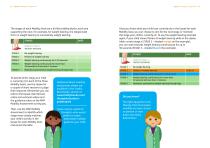
14 Upsee Therapy Programme Upsee Therapy Programme 15 The stages of each Mobility Goal are a bit like building blocks, each one supporting the next. For example, for weight bearing, the stages build from no weight bearing to consistently weight bearing: STAGES MOBILITY GOAL 2: WEIGHT BEARING Flickers of weight bearing Weight bearing continuously for 5-30 seconds Weight bearing continuously for more than 30 seconds but less than 2 minutes Maintains symmetrical weight bearing through legs Once you know what your child can currently do in the Upsee for each Mobility Goal, you can choose to aim for...
Open the catalog to page 8
16 Upsee Therapy Programme Upsee Therapy Programme 17 Choosing ability and participation activities using the MAP Activities Programme Now that you have found your child’s Mobility starting point for each of the three Mobility Goals, find the worksheet for that goal in the resources section. There are five worksheets in total, but you will probably never work on more than three at any one time, depending on the stage your child is at. The mobility suggestions on each worksheet are designed specifically to work on that goal, so if you are working on weight bearing, the mobility suggestions will...
Open the catalog to page 9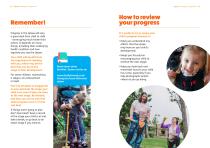
18 Upsee Therapy Programme Upsee Therapy Programme 19 How to review your progress It’s useful to try to review your child’s progress because it: Progress in the Upsee will vary a great deal from child to child – some going much faster than others. It depends on many things, including their underlying health condition and how regularly you use the Upsee. • elps you understand any H effects that the Upsee may have on your child’s development; • eeps you focused on K encouraging your child to achieve the next stage; Your child will benefit from the experience of standing with you, which may be the...
Open the catalog to page 10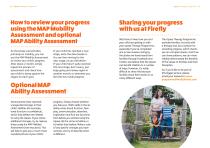
20 Upsee Therapy Programme Upsee Therapy Programme 21 How to review your progress using the MAP Mobility Assessment and optional MAP Ability Assessment As the Upsee concentrates primarily on mobility, you can use the MAP Mobility Assessment to review your child’s progress. After about a month, simply repeat the process of assessment and check how your child is doing against the stages for each goal. If your child has reached a new stage, write the date beside it. You are then aiming for the next stage, as you did before. If your child hasn’t quite reached the next stage, don’t worry, just keep...
Open the catalog to page 11


