- Catalogs
- Flores medical
- BA-TUBE


BA-TUBE

BA-TUBE
Specifications: The BA-TUBE features a blue cap that allows users to adjust resistance levels from 0 (highest resistance) to 7 (lowest resistance). This adjustability helps tailor the device to individual patient needs.
Usage Instructions:
- Use the BA-TUBE as instructed by a physiotherapist.
- Set the resistance level by turning the blue top anti-clockwise.
- If prescribed, take any bronchodilator medication 15 minutes before exercises.
- Practice for about 10 minutes, repeating exercises throughout the day.
- Breathe in through the nose and out through the tube, maintaining a regular and calm pace.
- Rest after 5-10 breaths and cough up secretions using the instructed technique.
- Continue breathing with the tube for a total of 10 minutes.
Cleaning Instructions: Disassemble the BA-TUBE by removing the blue top with the black plunger. Clean the parts in boiling water or disinfect at a maximum of 100°C. Reassemble by aligning the arrow on the blue top with the number scale.
Recommendations: Regular check-ups with a physiotherapist are advised to ensure correct technique and resistance settings. If discomfort occurs, it may indicate incorrect technique or inappropriate resistance settings.
Contact Information: Flores Medical GmbH, Auwiesen 12, D-07330 Probstzella, Germany. Phone: +49 036735 463-0, Fax: +49 36735 463-44, Email: [email protected], Website: www.multisonic.de
Catalog excerpts

BA-TUBE Respiratory therapy with the BA-TUBEThe BA-TUBE has been specially developed for use by patients with chronic bronchitis, asthma, pulmonary emphysema and cystic fibrosis. In postoperative or immobilized patients the BA-TUBE is used for prophylaxis of atelectasis. Patients with asthma and chronic obstructive pulmonary disease (COPD) learn to use the "lip brake" when they have acute breathing difficulties. This technique is intended to keep the airways open when exhaling. However, in an acute situation it is not always easy to practice the technique correctly. This was the impetus for de-similarly to a lip brake and can be used at any time. The patient selects the resistance against which he has to breathe out on the blue cap. The resistance to exhaling leads to the build-up of positive expiratory pressure (PEP) within the mouth that extends back to the bronchia. PEP acts as an invisible splint and prevents bronchial collapse. BATUBE is of benefit to other patients too - not just those with asthma and COPD. Your own exercise can be done as follows – after instruction from your Physiotherapist. The following method is recommended: § Use the BA-TUBE with the blue top, its resistance has no steps and can be adjusted Between 0 – 7. 0 = biggest resistance 7 = least resistance. § Turn the blue top anti-clockwise. § Set the resistance tested for you. If your Doctor has prescribed a medicine for stretching the bronchitis, it is very important, that you take your dose at least 15 minutes before the breathing exercises. 1. In all you practise for about 10 minutes. Repeat the exercises at different times during the day, as often as possible. Take advantage of any opportunity during the day, like when watching TV, or when reading newspaper etc. 2. Take the time, for instance, by setting an egg timer for 10 minutes. 3. Breathe through your nose and blow out through the tube, in the way that your Physiotherapist has instructed you. Blow out regularly and calmly but not to slowly. 4. The number of breaths in one session is very individual and depends on your daily condition. Rest after 5 – 10 breaths. 5. Cough up the secretion in between. The Physiotherapist will instruct you in the right coughtechnique. First of all, draw a deep breath. After that you use the same technique to force out the air, in the same way, as you would “huff” onto a mirror or glasses before cleaning. 6. Rest. 7. Continue to breath with the tube, as described in paragraph 3, for a total of 10 minutes. If something feels disagreeable, this might depend on the fact, that you use wrong technique when exercising, or, that the resistance on the out-breathing is too heavy. Regular controls with your Physiotherapist are necessary to keep such problems under c
Open the catalog to page 1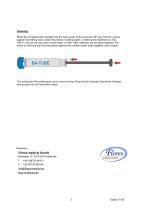
Cleaning: Place the enclosed black plunger into the tube, press of the blue top with your thumb or press against something hard. Clean the pieces in boiling water, or alternative disinfection’s max. 100°C, (do not use any acid or acid bases >0.5M). After cleaning, put the parts together, the arrow on the blue top must be placed against the number-scale, push together until it snaps. The authorized Physiotherapist Jane Lackorn at the Royal Karolin Hospital Stockholm Sweden has worked out this instruction sheet. Flores medical GmbH Auwiesen 12, D-07330 Probstzella [email protected] www.multisonic.de...
Open the catalog to page 2All Flores medical catalogs and technical brochures
 Lella Flaem Lella F700
2 Pages
 Flaem Masterneb F 400
4 Pages
 InfraControl
4 Pages
 DP 100 plus
4 Pages
 LS 290
2 Pages
 aerosonic mobil
4 Pages
 aerosonic combineb
4 Pages
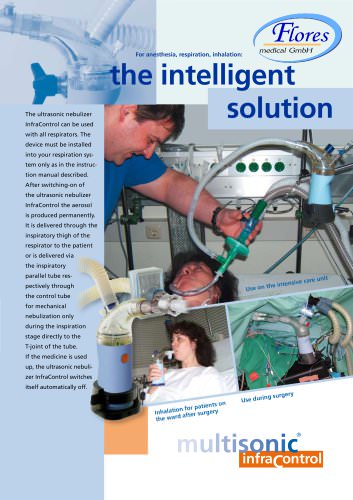 multisonic infra control
4 Pages
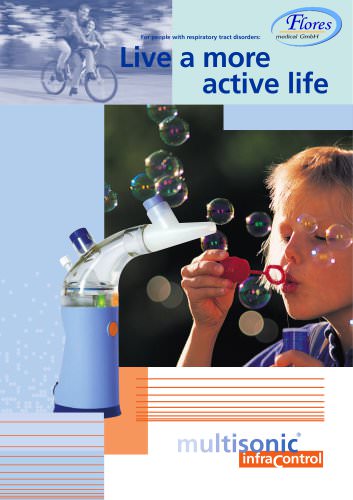 multisonic infra control
6 Pages