
- Catalogs
- Flow-Meter
- MAK/300, MAK/500, MAK/300 Antibacteria, MAK/500 Antibacteria - surgical suction pump jar


- Company
- Products
- Catalogs
- News & Trends
- Exhibitions
MAK/300, MAK/500, MAK/300 Antibacteria, MAK/500 Antibacteria - surgical suction pump jar

MAK/300, MAK/500, MAK/300 Antibacteria, MAK/500 Antibacteria - surgical suction pump jar
- Models: MAK/300 and MAK/500, available in standard and Antibacteria versions.
- Capacity: 300 ml and 500 ml respectively.
- Materials: Polycarbonate jar and lid, brass fittings, and high-strength polycarbonate screw nut.
- Sterilization: All parts can be sterilized in an autoclave at 121 °C for 15 minutes.
- Dimensions: Vary slightly between standard and Antibacteria versions, with the MAK/300 Antibacteria being 70x84x206 mm and the MAK/500 Antibacteria being 70x84x237 mm.
- Weight: Ranges from 0.20 Kg to 0.25 Kg depending on the model.
- Supply Depression: Maximum -950 mbar for 5 minutes.
- Connections: Inlet connection is ISO G 1/2” F, and outlet connection is a hose connector with a diameter of 8.0 to 9.2 mm.
Catalog excerpts

COLLECTION CONTAINERS FOR SMALL QUANTITY OF FLUIDS The collection containers for suctioned liquids named MAK/300 and MAK/500, are used for the collection of small volumes of suctioned fluids and have been designed and manufactured for applications of “high flow and high vacuum”. The two models have capacities of 300 ml and 500 ml respectively in standard execution, or fitting a special lid for housing an antibacterial filter (Antibacteria version). These devices are generally employed or simply for the collection of suctioned fluids, or like a safety container to protect the equipment and the plant upstream of the suction source, in case the safety overflow valve of the collecting primary container does not work regularly. The jar and the lid are made in polycarbonate, with fittings in brass, with ergonomic screw nut in high-strength polycarbonate. All parts can be sterilized in an autoclave (121 °C - 15 min.). 02 01 HOUSING FOR ANTIBACTERIAL FILTER Ø 50 MM (FOR ANTIBACTERIA VERSION ONLY) Matched with EASYVAC ® and EasyVAC ® plus vacuum regulators, or with AV and EasyAIR® Venturi suction units, the collection containers MAK series provide simplicity of use and versatility, allowing extreme operating economy. 02 POLYCARBONATE NUT FOR VACUUM REGULATOR CONNECTION REGISTERED OFFICE AND FACTORY ADDRESS: Flow Meter Spa - Via del Lino, 6 - 24040 Levate - Bergamo - ITALY Ph. +39 035 594047 I Fax +39 035 59482 I [email protected] I www.flowmeter.it VAT. N. IT01737
Open the catalog to page 1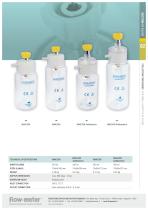
TECHNICAL SPECIFICATIONS INLET CONNECTION ISO G 1/2” F. OUTLET CONNECTION hose connector 0 8.0 - 9.2 mm flow-meter" ENGINEERING REVOLUTION IN MEDICAL TECHNOLOGY REGISTERED OFFICE AND FACTORY ADDRESS: Flow Meter Spa - Via del Lino, 6 - 24040 Levate - Bergamo - ITALY Ph. +39 035 594047 I Fax +39 035 59482 I [email protected] I www.flowmeter.it VAT. N. IT01737040160
Open the catalog to page 2All Flow-Meter catalogs and technical brochures
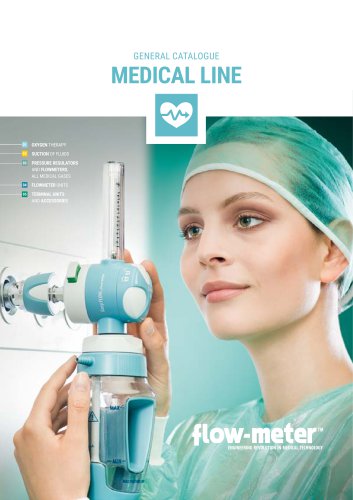 Medical Line - General Catalogue
124 Pages
 EN ISO 9170-2 AGSS Type 1
3 Pages
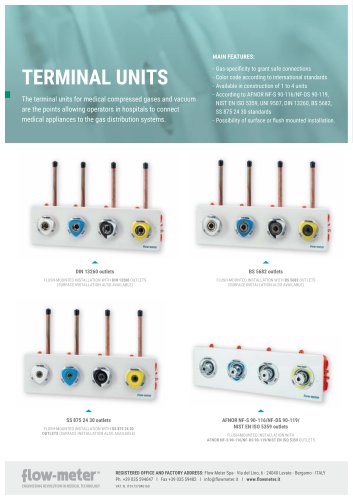 Terminal Units
8 Pages
 Rs, Rs twin - air flowmeter
2 Pages
 SF 2, SF 4 - flowmeters
2 Pages
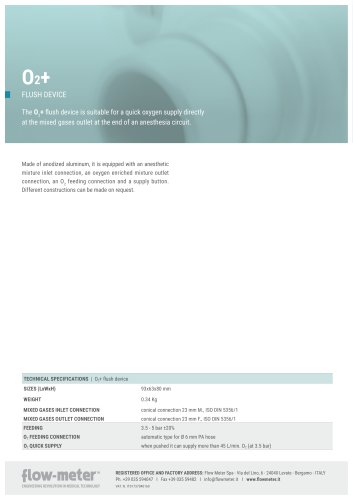 O2+ - flush device
2 Pages
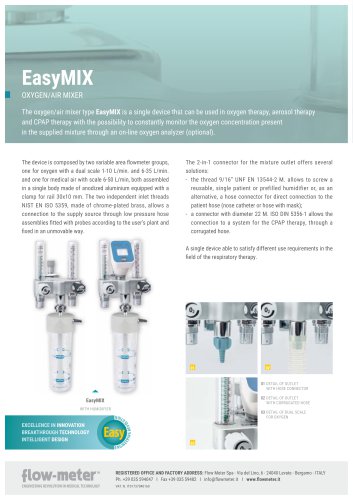 EasyMIX - oxygen/air mixer
2 Pages
 MU - pressure regulator
2 Pages
 EASYSAFE® - safety jar
2 Pages
 EasySAFE® PLUS - safety jar
2 Pages
 EASYVAC® - vacuum regulator
2 Pages
 EasyOX - bubbling humidifier
2 Pages






Archived catalogs
 Flowmeter Presentation
20 Pages
 EASY
EASY16 Pages

- Surgical suction pump
- Medical gas pressure reducer
- Medical gas flow meter
- Gas outlet
- Hospital flow meter
- Medical pressure regulator
- O2 flow meter
- Oxygen pressure reducer
- Humidifier
- Surgical suction pump on casters
- Adjustable-flow pressure regulator
- Suction jar
- Variable-area flow meter
- Body fluids suction jar
- Oxygen gas mixer
- Single-stage pressure regulator
- Medical gas blender
- Laboratory pressure regulator
- Air flowmeter