


- Products
- Catalogs
- News & Trends
- Exhibitions
TwinLight? Laser Assisted Endodontics

TwinLight? Laser Assisted Endodontics
This report discusses advancements in endodontic treatments using laser technology, specifically focusing on the TwinLight™ laser-assisted endodontics developed by Fotona d.d. The report highlights the limitations of traditional root canal treatments and the benefits of using Nd:YAG and Er:YAG lasers.
Traditional Root Canal Treatment Limitations
Classical root canal treatments involve mechanical cleaning and chemical rinsing, which have limited bactericidal effects and cannot fully penetrate dentinal tubules or remove the smear layer.
Laser Technology in Endodontics
Over the past two decades, various laser sources have been explored to enhance dental treatments. The TwinLight™ concept combines Nd:YAG and Er:YAG lasers to address the limitations of traditional methods.
Nd:YAG Laser in Endodontics
The Nd:YAG laser is effective for deep disinfection due to its deep penetration and high peak-pulse power, achieving significant bacterial reduction up to 1,000µm into dentin.
Er:YAG Laser in Endodontics
The Er:YAG laser is used for effective debridement and cleaning of the root canal system through a photo-acoustic effect, removing the smear layer and opening dentinal tubules without thermal damage.
TwinLight™ Endodontic Treatments
The TwinLight™ Endodontic Treatment (TET) combines both laser wavelengths for comprehensive root canal treatment. It involves three steps: accessing the pulp chamber with the Er:YAG laser, cleaning the canal system with photo-acoustics, and deep decontamination with the Nd:YAG laser.
Conclusion
The TwinLight™ approach improves root canal treatment outcomes by addressing anatomical and bacterial challenges. It reduces the risk of bacterial spread and enhances the precision of root fillings. The technology also shows promise in other dental applications, such as implant setting and periodontal therapy.
Figures and Data
Figures in the report illustrate the absorption coefficients of different laser wavelengths, the removal of debris using the Er:YAG laser, and the decontamination process with the Nd:YAG laser.
Catalog excerpts

I industry report _ endodontics TwinLight laserassisted endodontics Author_Dr Kresimir Simunovic, Switzerland preparation of side canals and other branches, as well as the complete removal of the smear layer, are impossible using classical means. Fig. 1 Fig. 1_Absorption coefficient in human tissues, a as a function of laser wavelength. The absorption coefficient is at a minimum with the Nd:YAG laser wavelength (1,064 µm), and at the maximum with the Er:YAG laser wavelength (2,940 µm). Fig. 2_Removal of the debris and smear layer from the root canal walls using the Er:YAG laser. The treatment is accompanied by collateral irrigation with saline solution. Fig. 3_Deep decontamination with the Nd:YAG laser (3–5 times per session). _Classical root treatment involves cleaning the root canal using mechanical means and rinsing with antibacterial solutions and solvents. However, there are two major disadvantages of standard chemomechanical preparations.1 First, the bactericidal effect of the rinsing solutions is limited to the root canal. Because of the narrow diameter of the dentinal tubules and the high surface tension of the liquid solutions, they are able to penetrate only a small distance down the tubules. The penetration depth of chemical disinfectants reaches only 100µm into the dentinal tubules2, while the bacteria can penetrate over 1,000µm from the canal lumen3, and remain protected in the deeper layers of dentin. The second important disadvantage is that the mechanical Over the past twenty years many types of laser sources have been studied and used as a means to improve upon the classical dental treatments.1, 4 No single “universal” laser source has been found that could be effectively and safely used for every dental procedure. Instead, as studies have demonstrated, each of the laser-assisted procedures should be performed with a laser that produces laser pulses at a wavelength that is known to be most effective for that particular procedure. In addition, many treatments would benefit immensely if they were performed with a succession or simultaneously using a multiplicity of laser sources. Of course, having a large number of laser sources in a practice would be impractical and very expensive. For this reason, the TwinLight™ treatment concept has been developed by Fotona d.d., based on the scientific understanding and clinical experience that for most laser-assisted treatments there exists an optimal combination of two basic complementary crystal laser sources, namely the Nd:YAG and the Er:YAG laser sources. The Nd:YAG laser wavelength (1,064nm) is the most versatile and most deeply penetrating laser wavelength, while the Er:YAG laser wavelength (2,940nm) is the wavelength with the highest absorption in human tissues (Fig. 1). The use of the TwinLightTM laser-treatment concept in the field of endodontics was recently introduced by Dr Norbert Gutknecht.5 _The Nd:YAG laser wavelength in endodontics For addressing the problem of deeply lying bacteria, lasers with a deep penetration into dentin, and preferably with a high peak-pulse power, are now being routinely used for disinfecting root canal systems.6-15 As a result of their capability to spread and
Open the catalog to page 1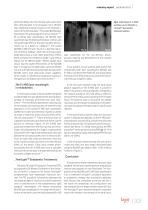
industry report _ endodontics penetrate deeply into the dentinal walls, lasers have been demonstrated to be physically more efficient than traditional chemical irrigants in the decontamination of the dentinal walls.13 The pulsed Nd:YAG laser has become the gold standard for this procedure.1, 6–9 Of all dental laser wavelengths, the Nd:YAG laser wavelength has the deepest penetration in dentin, and the bactericidal effect of this laser has been demonstrated up to a depth of 1,000µm.7–9 The pulsed Nd:YAG (1,064nm) laser results in a bacterial reduction of 85% at 1,000µm, while the continuous-wave...
Open the catalog to page 2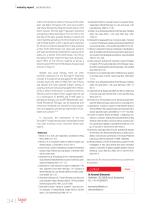
I industry report _ endodontics to be continued by the selective removal of the smear layer and debris throughout the root-canal system, and finally followed by deep decontamination of the dentin tubules. The TwinLight™ approach represents a progressive decontamination from the first to the last step of the laser-assisted therapy. It reduces the risk of bacteria spreading into the perioperative area and the body system, which is particularly important for immuno-compromised patients. It also produces a clean three-dimensional root canal wall anatomy with open and decontaminated dentin tubules,...
Open the catalog to page 3All Fotona catalogs and technical brochures
 StarFormer®
4 Pages
 Dynamis Pro
40 Pages
 XPulse® and XPulse II®
8 Pages
 Fotona4D
16 Pages
 StarWalker® MaQX
20 Pages
 AvalancheLase®
8 Pages
 StarWalker® PQX
12 Pages
 FotonaSmooth™ SP
16 Pages
 Multi-Application Laser Systems
40 Pages
 QX MAX
4 Pages
 AT Fidelis
2 Pages
 A R T E S - 1 0 0 0
4 Pages
 M E T R I X
2 Pages
 L I R D - 4
2 Pages
 XP-2 Focus
6 Pages
 XP MAX
4 Pages


Archived catalogs
 AT Fidelis Old
2 Pages

- Aesthetic medicine laser
- Skin and body treatment unit
- Trolley-mounted laser
- Diode laser
- Tabletop laser
- Dermatology laser
- Hair removal laser
- Skin rejuvenation laser
- Surgical laser
- Tattoo removal laser
- Pigmented lesion treatment laser
- Acne treatment laser
- Picosecond laser
- Alexandrite laser
- Lipolysis laser
- Podiatry laser
- Gynecological surgery laser