


speciality gas equipment

speciality gas equipment
- Product Range: Includes standard equipment such as pressure regulators, valves, and ultra-high purity equipment, along with accessories for installation and laboratory use.
- Speciality Gas Equipment Know-How: Highlights the importance of high-quality regulators for handling high-purity gases, ensuring pressure stability, flow capacity, and contamination prevention.
- Quality Standards: GCE Druva systems are ISO9001 certified, with rigorous testing including helium leak rate certification and performance charts for flow capabilities.
- High Purity Regulators Series 500: Detailed specifications and applications.
- Pressure Regulators Series 320: Overview and technical details.
- Ultra High Purity Gas Equipment: Designed for critical applications requiring high purity and safety.
- Point-of-use Regulators EMD 400: Specifications and usage in laboratory settings.
- Laboratory Pressure Regulator EMD 3100: Features and benefits for laboratory applications.
- Gas Monitoring Systems: Includes DGM and GasCom systems for safety and efficiency.
- Safety Equipment: Gas safety protection systems, cylinder cabinets, and safety relief valves.
- Performance Charts: Provide flow capabilities and performance data.
- Recommendations: For stainless steel and copper tubing, unit conversion, and gas properties.
- GCE high purity gas systems are certified according to various national and international guidelines, ensuring compliance and safety.
- Includes analysis technology, chemical process technology, pharmaceutical industry, and more, highlighting the versatility of GCE Druva equipment.
- Emphasizes continuous quality improvement and customer collaboration to meet market demands and ensure product reliability.
Purging is crucial for safety and maintaining gas purity. It removes residual gases, atmospheric air, and moisture, which is especially important for high-purity, toxic, and corrosive gases. This process enhances safety, extends equipment lifespan, and ensures system reliability.
- Cylinder Pressure Regulators (FMD): Reduce cylinder pressure to a usable level.
- Line Pressure Regulators (LMD): Reduce line pressure for equipment.
- Point-of-Use Regulators (EMD): Provide accuracy and shut-off at the point of use.
- Gas Panels (SMD, BMD): Installed in storage areas to manage pressure for in-house use.
- Ultra High Purity Regulators: Designed to maintain gas purity with features like polished surfaces and metal diaphragms.
- Single-Stage Regulators: Require frequent adjustments as delivery pressure increases with decreasing cylinder pressure.
- Dual-Stage Regulators: Maintain constant delivery pressure despite changes in cylinder pressure, reducing the need for adjustments.
Purity levels range from pure gas (99.5%) to ultra-pure gas (99.99999%), with corresponding maximum contamination levels in ppm.
Key questions include the need for standard or ultra-high purity regulators, single or dual-stage, purge systems, and specific construction materials. Other considerations include outlet pressure range, flow rate, gas supply level, and connection types.
Order codes specify material, gas type, connection standards, and pressure levels. Options include brass, chrome-plated brass, and stainless steel materials, with various inlet and outlet pressure specifications.
Detailed specifications for various FMD and SMD models, including inlet and outlet pressures, material options, and purging capabilities.
- Materials: Options include stainless steel 316L and brass, both specially cleaned and treated for durability and performance.
- Pressure Ranges: Various configurations allow for downstream pressures from 0.2 to 200 bar, with specific models offering different ranges.
- Connections: Inlet and outlet connections are typically NPT 1/4"f, with optional tube fittings available.
- Seals: Seat seals are made from PCTFE and PTFE, with body seals available in PCTFE and PVDF.
- Dual-stage and single-stage designs for different applications.
- Inert gas purging options for maintaining gas purity and safety during cylinder changes.
- Manual and semi-automatic switch-over capabilities for uninterrupted gas supply.
- Optional contact gauges and alarm systems for monitoring gas reserves and ensuring safety.
- Dimensions: Vary by model, with typical sizes around 400×200×185 mm.
- Weight: Ranges from approximately 2.9 kg to 5.1 kg depending on the model and configuration.
- Performance Data: Detailed performance data is available in chapter 5 of the document.
The document provides detailed technical specifications for various gas supply systems and components, including materials, pressure ranges, dimensions, and weights. Key materials include stainless steel 316L and brass CW614, with specific cleaning and plating processes. Pressure gauges cover a range from -1 to 400 bar, and components are designed for high purity gases with a maximum purity of 6.0.
Special Features and Applications
The systems are designed for uninterrupted gas supply with semi-automatic switchovers, suitable for inert, reactive, flammable, and oxidizing gases. They feature active cylinder indicators, low gas alarm signals, and are upgradable to accommodate multiple cylinders. Applications include maintaining low and constant downstream pressure independent of upstream pressure changes.
Design and Functionality
The systems include dual-stage pressure regulators, relief valves, and purge inlets/outlets. They are designed for easy maintenance with features like quick shut-off valves, clear open/closed indicators, and integrated particle filters. The systems are modular, allowing for customization with additional valves and fittings.
Order Codes and Configurations
Various configurations are available, including different materials (stainless steel or brass), inlet/outlet fittings, and pressure ranges. Order codes specify the type, material, pressure, and additional features like contact gauges and vent piping.
Safety and Compliance
The systems comply with safety standards such as ATEX and EN 837, ensuring high safety levels with integrated relief valves and ergonomic adjustment knobs. They are designed for high purity applications with guaranteed low leakage rates.
Flow Schematics and Installation
Detailed flow schematics illustrate the configuration of valves, gauges, and connections. Installation examples highlight the modular nature of the systems, allowing for efficient and safe gas supply management.
- Types: FMD 322-14, FMD 322-16, FMD 322-18
- Design: Dual-stage regulators ensuring downstream pressure is independent of upstream pressure.
- Materials: Stainless steel 316L or Brass CW614, with various seal materials including PCTFE and PTFE.
- Features: Diaphragm valve, ATEX conform adjustment knob, safety version gauge.
- Applications: Base model (FMD 322-14), shut-off capability (FMD 322-16), fine control (FMD 322-18).
- Types: LMD 320-01, LMD 320-03, with AV options.
- Design: Single-stage regulators with compact design and multiple port configurations.
- Materials: Stainless steel or brass, with PCTFE and PVDF seals.
- Features: Excellent pressure adjustment, optional relief valve, contact gauge for monitoring.
- Applications: Suitable for analytical or chemical apparatuses.
- Types: SMD 320-16, SMD 320-24, SMD 320-25
- Design: Single-stage panels with options for process gas purging and shut-off valves.
- Materials: Stainless steel or brass, with PCTFE and PVDF seals.
- Features: Mounted on stainless steel panels, optional vent piping, contact gauge for monitoring.
- Applications: Centralized or decentralized gas supply, process gas purging during cylinder changes.
- Types: BMD 320-39, BMD 322-39
- Design: Single and dual-stage manifolds with semi-automatic switch over for uninterrupted supply.
- Materials: Stainless steel or brass, with PCTFE and PVDF seals.
- Features: Indicator for active cylinder, low gas alarm signal, upgradable to multiple cylinders.
- Applications: Used when uninterrupted gas supply is required, suitable for high-pressure applications.
- Ensure compatibility with gas type and pressure requirements.
- Refer to the "burst rate chart" in chapter 5 for selecting appropriate tube fittings.
- Consider material and seal compatibility with the specific gas used.
- Specifications: Single-stage regulators for inert gases, gas mixtures, and oxygen with a purity of up to 5.0. Cylinder pressure is 230 bar with a downstream pressure range of 0.2 - 12 bar.
- Special Features: Includes a clear position indicator, easy operation, integrated relief valve, and diaphragm material made of Hastelloy.
- Description: The FMD 300-14 includes a manual cylinder connection, pressure regulator, and gauges. The FMD 300-18 adds a regulating valve at the outlet.
- Applications: Suitable for high flow rate values and flexible installation locations.
- Specifications: Double-stage regulator for inert gases with a purity of up to 5.0. Inlet pressure is 230 bar with an outlet pressure range of 0.05 - 10 bar.
- Special Features: Superior downstream pressure adjustment, hand tightening nut, and precise pressure levels due to metal bellows.
- Description: Features a preset first stage and an adjustable second stage for constant pressure levels.
- Applications: Ideal for laboratory, laser, and analytic applications requiring precise pressure levels.
- Quality Guarantee: APTech emphasizes high-quality products that meet or exceed customer requirements, with a focus on safety and reliability.
- Applications: Products are suitable for micro and optoelectronics, semiconductor fields, and other high purity gas applications.
- Specifications: Single-stage panels for low flow rates of high purity gases, with a maximum purity of 7.0 and inlet pressure of 230 bar.
- Special Features: External gas purging, springless diaphragm valve, and rupture disc for pressure limitation.
- Description: Mounted on stainless steel consoles, these panels include pressure regulators, gauges, and shut-off valves.
- Applications: Used for reactive and corrosive gases in low flow rate applications.
- Specifications: Single-stage panels for acetylene with an inlet pressure of 25 bar and downstream pressure of less than 1.5 bar.
- Special Features: Includes gas failure monitoring and connections for multiple cylinders.
- Description: Features inlet ball valve, pressure gauges, relief valve, and flashback arrestor.
- Applications: Suitable as the first stage of a central gas supply with manual switch-over capabilities.
- Specifications: Dual-stage panel for acetylene with an inlet pressure of 25 bar and downstream pressure of less than 1.5 bar.
- Special Features: Provides uninterrupted gas supply with semi-automatic switch-over and high flow rate capabilities.
- Description: Approved for connecting up to 6 cylinders with a flashback arrestor installed on the outlet side.
- Body Material: Stainless steel 316L or brass, both specially cleaned and plated.
- Gauge: Safety gauge according to EN 837-1, with a nominal width of 50 mm and accuracy class 2.5.
- Pressure Range: 0 – 2.5 / 6 / 16 bar, with specific ranges for the analytic version.
- Dimensions: Approximately 50×100×108 mm.
- Temperature Range: -25 °C to +70 °C.
- Inlet/Outlet Options: G 3/8"f or G 1/4"f, with NPT1/4"f available for specific versions.
- Weight: Approximately 0.64 kg for the basic body.
The solenoid valve control unit is designed to manage solenoid valves with five or ten output channels, an emergency shutdown input, and two zero potential signals for higher systems like DDC or PLC. It features operational indicators via LEDs and acoustic signals for emergency situations. The unit is fail-safe and complies with EC guidelines, suitable for gas cylinder stations.
Technical Data
Power supply is 230 V AC, with a slow-blow fuse and relay outputs. It operates within a temperature range of up to 40°C and 0-95% humidity. The housing is polystyrene with IP 54 protection, designed for wall mounting.
Accessories
Includes signal box, relay box, and operation terminal for gas management systems.
GasCom Software
GasCom software provides automated control and monitoring of gas supply systems, featuring system status visualization, fault reduction, and statistical analysis. It supports remote control and automation of processes, with a focus on minimizing downtime and ensuring quality control.
Gas Safety Protection Systems (GSPS)
GSPS monitors and safeguards gas supply systems, ensuring safety through continuous monitoring and emergency shut-off capabilities. It is crucial for handling toxic and flammable gases, providing extensive safety functions and reducing maintenance efforts.
Safety Cylinder Cabinets
These cabinets offer fire protection and secure storage for gas cylinders, complying with DIN EN 14470-2 standards. They are designed for installation in workrooms and feature integrated air extraction and flexible fittings.
Protective Cylinder Cabinets
Constructed for outdoor use, these cabinets protect gas cylinders from weather and unauthorized access, with ventilation and flexible fittings.
Inline Gas Purifiers
Super-Clean™ gas filters maintain high gas purity, suitable for chromatography and laser resonator gases. They offer various adsorbent combinations and are TÜV-tested for reliability.
1. Gas Filters: Designed for purifying sensitive carrier and burner gases in chromatography systems. Key features include gas purity at outlet >6.0, max inlet pressure of 11 bar, and a max flow rate of 12 l/min. Available with or without visual display.
2. Preheating Appliances: LRX 500 and GVW 200 models for preheating inert and non-corrosive gases. LRX 500 is not suitable for flammable gases or oxygen, with a max inlet pressure of 230 bar. GVW 200 is for oxygen and inert gases with a max inlet pressure of 300 bar.
3. Safety Relief Valves: Spring-loaded valves for venting excess pressure, suitable for high purity gases. Opening pressures range from 6 to 21 bar, with TÜV certification.
4. Cylinder Scales: Electronic scales for gas cylinder level metering, featuring a metering range up to 135 kg and high protection class IP 65.
5. Contact Gauges: Inductive contact gauges for monitoring gas supply pressure, suitable for various gases with a max nominal pressure of 300 bar.
1. Gas Filters: Enhance productivity by minimizing downtime and maintenance costs in high-performance analysis equipment.
2. Preheating Appliances: Prevent freezing of valves and equipment, suitable for vaporizing liquid gases like CO2 and argon.
3. Safety Relief Valves: Can be installed in pipeline systems or gas control panels, with position-independent installation.
4. Cylinder Scales: Suitable for indoor or outdoor use, even in high humidity conditions.
5. Contact Gauges: Provide visual and acoustic warnings for low gas supply pressure, with adjustable switching points.
1. Filters: Various types available for moisture, oxygen, and hydrocarbon filtration, with life spans ranging from 0.4 to over 2 years.
2. Preheating Appliances: LRX 500 offers high performance for gases and liquids, with an outlet temperature of 60°C.
3. Safety Relief Valves: Flow capacity for air at 23°C varies with opening pressure, from 85.4 m³/h at 6 bar to 318.9 m³/h at 21 bar.
1. Gas Filters: Quick replacement during operation, inert and diffusion-tight versions, early visual saturation warning.
2. Preheating Appliances: High efficiency, safety protection in accordance with regulations.
3. Safety Relief Valves: Compact size, individual opening pressure settings, available in brass or stainless steel.
4. Cylinder Scales: Very flat construction, high accuracy, and temperature resistance.
5. Contact Gauges: Conform to safety regulations, freely adjustable switching points, suitable for ex-zone 1 with special amplifiers.
- Tubing: The document lists different types of tubes, including brass and stainless steel, with various dimensions and product codes. It specifies the tube fittings and end connections available.
- Hose Nozzles: Details on hose nozzles with G-thread and hose end connections are provided, including material specifications (Brass/NI-CR and SS).
- Adaptors: Information on adaptors with NPT and G-thread connections, including material details (Brass/NI-CR and SS).
- Gaskets: Specifications for gaskets used in G-threading and cylinder connections, including minimum order quantities and materials (PVDF, PCTFE, PTFE).
- Gloves: Details on single-use transparent gloves, including material (Latex, Plastic) and sizes available.
- Valves: Information on check valves and relief valves, including material, inlet/outlet specifications, and activating pressure.
- Plastic Hoses: Specifications for plastic hoses available in different materials (Polyethylene, Teflon) and dimensions.
- Valve Mountings: Details on mounting options for specific valve series, including material specifications.
- Moisture Filters: Recommended for chloric gases, with details on filter housing and inserts.
- Flow Meters: Specifications for flow meters with regulating valves, including flow rates for air, N2, and H2.
- Heating Sleeves: Information on heating sleeves for FMD series, including voltage specifications.
- Cylinder Holders: Details on cylinder holders and replacement belts.
- Adjustment Knobs: Specifications for replacement adjustment knobs for pressure regulators and valves, including series and material details.
- Service: Various services offered, including electrochemical polishing, ultrasonic cleaning, and repair training.
- Labels: Information on labels for adjustment knobs and valves, including material and diameter specifications.
- Leak-Detection Spray: Details on leak detection spray, including type and description.
- Teflon Tapes: Specifications for Teflon tapes, including material and dimensions.
- Open-Ended Wrenches: Details on single-headed wrenches, including material and size.
- Performance Charts: Various performance charts for different types of equipment, detailing pressure and flow rate specifications.
- Recommendations for Stainless Steel Tubing: Maximum allowable working pressure for inch and metric sizes of stainless steel tubing, including material and wall thickness specifications.
- Recommendations for Copper Tubing: Maximum allowable working pressure for inch and metric sizes of copper tubing, including wall thickness specifications.
- All specifications are subject to change without notice.
- Recommendations are provided for selecting appropriate tube wall thickness based on pressure requirements.
- Materials used include high-quality stainless steel and copper, with specific standards and tolerances mentioned.
GCE Group is a leading global company specializing in gas control equipment. The headquarters are located in Malmö, Sweden, with major supply units in Europe and Asia. The company operates 15 subsidiaries worldwide and employs over 850 people.
Business Areas
GCE Group's operations are divided into four main business areas:
- Cutting & Welding Technology
- Valves
- Healthcare
- Druva
Additional Information
For more details, visit their website at www.gcegroup.com. Note that product alterations are subject to change without notice.
Catalog excerpts
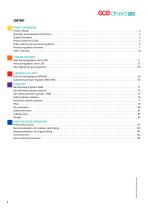
content Product Information Product Range . . . . . . . . . . . . . . . . . . . . . . . . . . . . . . . . . . . . . . . . . . . . . . . . . . . . . . . . . . . . . . . . . . . . . . 2 Speciality Gas Equipment Know How . . . . . . . . . . . . . . . . . . . . . . . . . . . . . . . . . . . . . . . . . . . . . . . . . . . . . . . . 3 Quality Standards . . . . . . . . . . . . . . . . . . . . . . . . . . . . . . . . . . . . . . . . . . . . . . . . . . . . . . . . . . . . . . . . . . . . 4 Product Selection Guide . . . . . . . . . . . . . . . . . . . . . . . . . . . . . . . . . . . . . . . . . . . ....
Open the catalog to page 3
Product Range Standard equipment Ultra High Purity equipment Connection material Pressure regulators, 316L, AOD/VAR Brass or stainless steel Cylinder pressure regulators FMD Single cylinder gas panels SMD: Single-stage Dual-stage With process or inert gas purging Multi cylinder gas manifolds BMD S ingle-stage, with manual switch over Single-stage, with automatic switch over With process or inert gas purging Assembling material: Tube fittings C-profile rails Valve mounting Elbow tube fittings Straight tube fittings Adapter fittings Hose nozzles 2. Pressure stage Line pressure regulators LMD Point-of-use...
Open the catalog to page 4
Speciality Gas Equipment Know How High-purity gases require high-quality regulators Proper handling of expensive high-purity gases requires the highest quality of valves and pipelines, not at least of the design, planning, installation and commissioning of the entire gas distribution system. The fulfillment of user-specific demands such as pressure stability, flow capacity and maintaining of the gas composition needs to be guaranteed in the same way as the prevention of contamination from the gas source down to the „point-of-use“. Handling of compressed gases presupposes intensive knowledge of...
Open the catalog to page 5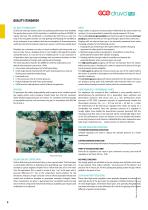
Quality Standards GCE Quality Management GCE Druva clean-gas systems prove its quality by performance and reliability. The production process of the regulators is certified according to ISO9001 at regular intervals. This certification is considered by GCE Druva as only one step in the long path towards not only gaining and keeping the confidence of our customers in our products but also to strengthen it. Unannounced reaudits by internal and external supervisors assure a continuous quality level. Purge utilises a sequence of pressurisation followed by de-pressurisation by venting. It is recommended...
Open the catalog to page 6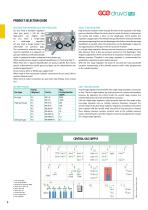
Product Selection Guide Questions to be answered selecting a regulator Single-stage regulators Do you need a standard regulator/ valve (gas purity < 6.0) for ultra high-purity use (higher 6.0)? Do you need a single-stage or dual-stage regulator? Do you need a purge system? See information on previous page. The construction material does not need be specified as it depends on gas type. GCEDruva will automatically taylor it’s proposal to makes a proposal to the chosen gas. Which outlet pressure range is required (specification in “Technical data“)? Which flow rate is required (Specification on...
Open the catalog to page 7
Order code for your pressure regulators Series 500 3100 320 100 Purity Application < 6.0 < 6.0 < 5.0 Standard Laboratory diverse for techn. Gases and Laser gases diverse Application area 0 = without KI = contact gauge FMD = cylinder pressure regulator SMD = gas supply panel for 1 cylinder BMD = gas supply manifold for 2 or more cylinder LMD = line regulator EMD = point-of-use regulator Material of Outlet fitting B = brass BC = chrome-plated brass SS = stainless steel Outlet fitting Type of pressure reducing N14 = 1/4" NPT f. CL3, CL6*, CL8, CL10, CL12 (CL6 = NPT-tube fitting for tube outside...
Open the catalog to page 8
Pressure regulators overview Cylinder pressure regulators 500 overview Outlet: tube fitting Outlet: shut-off valve Outlet: regulating valve With inert gas purging Stainless steel Type -27 with shut-off valve at outlet Type -26 without FMD 510-14 Inlet pressure: 12 bar / 175 psi Outlet pressure: 0.2 – 3 bar abs 3 – 45 psi abs FMD 510-16 Inlet pressure: 12 bar / 175 psi Outlet pressure: 0.2 – 3 bar abs 3 – 45 psi abs FMD 510-18 Inlet pressure: 12 bar / 175 psi Outlet pressure: 0.2 – 3 bar abs 3 – 45 psi abs FMD 540-14 Inlet pressure: 12 bar / 175 psi Outlet pressure: 0.2 – 2 bar 3 – 30 psi FMD...
Open the catalog to page 9
Gas supply panels, series 500 and Acetylene SMD 502/532-16 Dual-stage Brass or stainless steel Inlet pressure: 230 /300 bar 3300/4350 psi Outlet pressure: 3, 6, 10.5 bar 45, 85, 150 psi SMD 500/532-24 Single-stage Brass or stainless steel Inlet pressure: 230 /300 bar 3300/4350 psi Outlet pressure: 14, 28, 50, 200 bar / 200, 400, 720, 2900 psi SMD 500/532-25 Single-stage Brass or stainless steel Inlet pressure: 230 /300 bar 3300/4350 psi Outlet pressure: 14, 28, 50, 200 bar / 200, 400, 720, 2900 psi SMD 500/532-27 Single-stage, with inert gas purging Stainless steel Inlet pressure: 230 /300 bar...
Open the catalog to page 10
LMD 510-01/-03 Single-stage Brass or stainless steel Inlet pressure: 12 bar / 175 psi Outlet pressure: 0.2 – 2 / 0.2 – 3 bar abs. 3 – 22 / 3 – 45 psi abs. LMD 522-03 Dual-stage Brass or stainless steel Inlet pressure: 230 bar / 3300 psi Outlet pressure: 0.2 – 2 / 0.2 – 3 bar abs. 3 – 22 / 3 – 45 psi abs. LMD 545-01/-03 Single-stage Brass or stainless steel Inlet pressure: 40 / 12 bar - 580 /175 psi Outlet pressure: 0.20 / 1.3 bar - 3/ 19 psi 40 bar Type: 0.5 / 3.0 bar - 7 / 45 psi Point-of-use regulators series 500 EMD 510-06 Single-stage Brass or stainless steel Inlet pressure: 12 bar /175 psi...
Open the catalog to page 11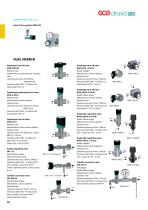
Laboratory gas supply cont. Point of Use regulator EMD 400 Valve Overview Diaphragm regulating and s/o valve MVR-A 500 G Model: In-line Material: Brass chrome-plated / Stainless steel Upstream pressure: 40 bar (O2) /50 bar 600/725 psi Nominal width: DN2 – Kv-Value: 0.02 Inlet/Outlet: NPT 1/4" Diaphragm shut-off valve MVA 501 G Model: In-line Material: Brass / Brass chrome-plated / Stainless steel Upstream pressure: 40 bar (O2) / 50 bar 600 (O2) / 725 psi Nominal width: DN8 – Kv-Value: 0.5 Inlet: NPT 1/4"f or G3/8"f Outlet: NPT 1/4"f or G3/8"f Packed regulating valve FAV 115 Model: Elbow design...
Open the catalog to page 12All GCE Group catalogs and technical brochures
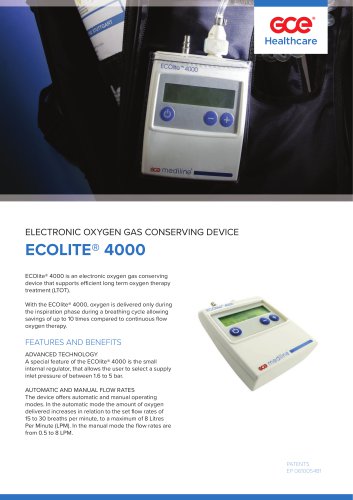 ECOlite® 4000: Leaflet
2 Pages
 ZEN-O: Brochure - UNI
12 Pages
 ZEN-O lite: Brochure - UNI
12 Pages

Archived catalogs
 ECOlite® 4000
2 Pages
 Elite
Elite2 Pages
 BAG VALVE MASK
2 Pages
 Medimeter
2 Pages
 MEDIWET
2 Pages
 GAS ALARM G4
2 Pages
 GAS ALARM MC7701
2 Pages
 GCE MEDIUNIT CZ TYPE
2 Pages
 GCE MEDIUNIT DIN TYPE
2 Pages
 PRESSURE MONITOR DN15
2 Pages
 PRESSURE WATCH DN20
4 Pages
 SHUT OFF VALVE BOX DN20
2 Pages
 MM40 - HP UNIT SEMIAUTO
4 Pages
 MM90 - HP UNIT AUTO
2 Pages
 GSS
GSS2 Pages
 APS II
4 Pages
 MEDIEJECT PLASTIC
2 Pages
 MEDISELECT® II
4 Pages
 VARIMED
2 Pages
 Medivital
4 Pages
 MEDIEVAC+
2 Pages
 MediEject
2 Pages
 Inogen One® G2
2 Pages
 Inogen One® G3
2 Pages
 NUVO 8
2 Pages
 TECHLINE CATALOGUE
48 Pages
 MFC CATALOGUE
16 Pages
 Zeno_lite
2 Pages
 Leaflet_Suction_jars
2 Pages
 VALVES
12 Pages
 HEALTHCARE CATALOGUE
44 Pages
 MEDICAL CENTRAL GAS
48 Pages
 Zeno_Brochure
8 Pages
 HP DRUVA CATALOGUE
49 Pages
 APTECH - UHP CATALOGUE
6 Pages
 CENTRAL GAS SUPPLY
48 Pages
 MEDIVITAL®
4 Pages
 HEALTHCARE CATALOGUE
64 Pages
 GCE CENTRAL GAS SYSTEMS
408 Pages
 MEDIVITOP®
4 Pages
 GCE GROUP VALVES
12 Pages
 MASS FLOW CONTROLLER
16 Pages
 APTECh
8 Pages
 GAS ALARM C44
2 Pages
 EASE II
2 Pages
 MEDIEVAC+ Old
2 Pages


- Medical dolly
- Medical device trolley
- Oxygen concentrator
- Medical gas pressure reducer
- Metal trolley
- Medical oxygen concentrator
- Medical gas flow meter
- Gas outlet
- Oxygen concentrator on casters
- Hospital flow meter
- Medical pressure regulator
- Portable oxygen concentrator
- O2 flow meter
- Home care oxygen concentrator
- Oxygen pressure reducer
- Humidifier
- Gas valve
- PSA oxygen concentrator