
- Catalogs
- GE Healthcare
- GSI infographic


- Products
- Catalogs
- News & Trends
- Exhibitions
GSI infographic

GSI infographic
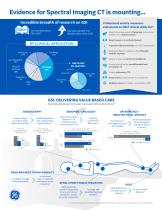
Spectral Imaging CT, particularly Gemstone Spectral Imaging (GSI), has seen a significant increase in research and application from 2010 to 2017. This document reviews the clinical utility and advancements in Dual-Energy CT (DECT) across various medical fields.
Professional Society Consensus
DECT is recognized for its utility in several clinical applications, including:
- Quantitative assessment of fatty liver and contrast uptake in hepatic lesions.
- Evaluation of renal masses and urothelial tumors.
- Improved iodine sensitivity in DECT angiography.
- Reduced artifacts in patients with orthopedic metallic implants.
- Routine use in carotid/cerebral and extremity CTA, pulmonary CTA, and renal stone characterization.
Clinical Applications by Anatomy
The document categorizes DECT applications by anatomy, with significant focus on:
- Abdo-pelvic (38%)
- Chest (32%)
- Head & Neck (13%)
- Renal (16%)
- Bone (1%)
Clinical Applications by Specialty
DECT applications are also categorized by specialty, including:
- Oncology (31%)
- Cardiology (17%)
- Vascular/Perfusion (18%)
- Renal Stone (3%)
- Liver damage/Fat (4%)
- Orthopedic (12%)
Key Findings and Benefits
GSI has demonstrated several clinical benefits:
- 6x reduction in non-diagnostic scans with GSI MAR, enhancing evaluation of metal implants.
- Low keV images can reduce iodine load by at least 50%, benefiting patients with compromised renal function.
- Improved detection of liver lesions by 17% and kidney lesion characterization by 12%, reducing unnecessary follow-ups.
Specific Study Outcomes
Several studies highlight the efficacy of DECT:
- Marin (2017) showed improved specificity in renal lesion characterization.
- Liu (2016) demonstrated enhanced detection of small and multiple lesions in hepatocellular carcinoma.
- Dong (2013) reported superior intravascular enhancement in pulmonary angiography.
- Shuman (2017) found reduced iodine DECT aortography comparable to standard iodine SECT.
- Reynoso (2016) showed reduced periprosthetic artifacts with GSI-MARS technology.
- Li (2014) demonstrated 100% detection of gout tophi using dual-energy spectral CT.
Conclusion
The document underscores the growing evidence supporting the clinical utility of Spectral Imaging CT, particularly in improving diagnostic accuracy and reducing unnecessary procedures across various medical applications.
Catalog excerpts
Evidence for Spectral Imaging CT is mounting... Incredible breadth of research on GSI Journal publications 2010-2017 Professional society consensus statements on DECT clinical utility for3: Avg. yearly growth in # of publications 2011-2017 Quantitative assessment of fatty liver and contrast uptake in focal hepatic lesions Renal masses and urothelial tumors Improved iodine sensitivity from DECT angiography Reduced artifacts in patients with orthopedic metallic implants Known or suspected pancreas neoplasms Liver damage/Fat 4% Vascular/ Perfusion 18% Routine clinical use for carotid/cerebral and extremity CTA Abdo-pelvic 38% Routine pulmonary CTA Renal stones to discriminate uric acid stones Radiation doses are reliably comparable to SECT GSI: DELIVERING VALUE BASED CARE Example findings from peer reviewed GSI publications* ANGIOGRAPHY Low keV images can reduce iodine load by at least 50% Pulmonary Angiography Imaging, Total Iodine, g4 ABDOMEN – ONCOLOGY benefitting patients with compromised renal function3,4,5 CT Aortography (no difference in CNR or SNR), Total Iodine, g5 Improves liver lesion detection 17% and kidney lesion characterization 12% 77.8% Kidney Lesion Characterization, Specificity enhancing evaluation of metal implants and adjacent bone or tissue6,7 Periprosthetic Imaging, Rate of Non-Diagnostic Studies6 6x reduction in non-diagnostic scans with GSI MAR Liver Lesion Detection after transarterial chemoembolization (TACE), Specificity2 ORTHOPEDICS – REDUCED METAL ARTIFACT HEAD AND NECK TUMOR VISIBILITY 2.3x higher average tumor attenuation for increased tumor conspicuity and improve tumor evaluation12 RENAL STONE CHARACTERIZATION 100% Sensitivity and 99.7% Specificity for uric acid stones,9 and atomic number for stone composition for faster and simplified diagnosis workflow GOUT 100% detection by uric acid (calcium) mapping *The example findings cited are limited to the referenced studies only and may not be broadly applicable to your clinical practice
Open the catalog to page 1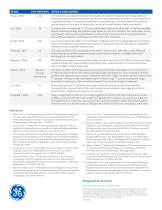
# OF PATIENTS ARTICLE CONCLUSION The results of our study demonstrate that analysis of contrast-enhanced dual-energy material attenuation significantly improves the specificity for characterization of small (1–4 cm) renal lesions compared with that of conventional attenuation measurements. This improvement in specificity may decrease the frequency of unnecessary work-up for small indeterminate renal lesions. Compared with conventional CT, GSI could significantly improve the detection of small and multiple lesions without increasing the radiation dose. Based on spectrum features, GSI could assess...
Open the catalog to page 2All GE Healthcare catalogs and technical brochures
 Vscan Air™ CL
6 Pages
 Voluson™ Expert Series
4 Pages
 Vivid T9
9 Pages
 SIGNA™ Explorer
34 Pages
 Versana Active™
2 Pages
 MAC 2000 ECG Analysis System
5 Pages
 EMR Gateway Pro for MAC 2000
2 Pages
 Revolution EVO Gen 3
28 Pages
 Discovery MR750
5 Pages
 Seno Iris™
5 Pages
 SWAN
SWAN2 Pages
 GE Adventure Series™
14 Pages
 Mobile X-ray Systems
10 Pages
 GoldSeal
8 Pages
 Invenia™ABUS
6 Pages
 CardioMem CM 3000
2 Pages
 Lullaby Resus Plus
4 Pages
 Brivo NM615
5 Pages
 Aespire 7900
6 Pages
 Aespire View
4 Pages
 Aisys Carestation
12 Pages
 Avance Carestation
12 Pages
 Lunar iDXA Brochure
8 Pages
 Brochure Discovery IGS 730
9 Pages
 Prodigy for Bone Health
8 Pages
 Senographe Care
7 Pages
 SenoBright White Paper
7 Pages
 SenoBright Brochure
20 Pages


- GE ultrasound system
- GE B/W ultrasound system
- GE color doppler ultrasound system
- Portable ultrasound system
- Multipurpose ultrasound imaging system
- Patient monitor
- Radiology software
- Visualization software
- Tablet computer software
- Tablet PC software
- Digital radiography system
- Reporting software
- Phototherapy lamp
- Convex-array ultrasound system
- Linear-array ultrasound system
- Blood pressure patient monitor
- Multipurpose radiography system
- X-ray system
- ECG patient monitor
- SpO2 patient monitor