
- Catalogs
- GEA Tiromat Packaging - GEA Food Solutions Germany
- Pharmaceutical Biotechnology

Pharmaceutical Biotechnology

Pharmaceutical Biotechnology
GEA Westfalia Separator Group is a leader in downstream processing technology for pharmaceutical biotechnology, focusing on aseptic process management, GMP compliance, and efficient recovery of active ingredients. The company has a rich history in mechanical separation technology, contributing significantly to the pharmaceutical industry with innovative processes and systems.
GEA offers separators designed for pharmaceutical biotechnology, ensuring gentle product treatment and reliable scale-up. Collaborations with universities and research institutes support new developments, providing efficient and economical solutions.
GEA's separators and decanters facilitate high-concentration separation of enzymes, crucial for accelerating organic processes. The production involves fermentation, centrifugation, and further processing to achieve high purity and yield.
GEA's sterilizable separators enhance the yield and vitality of microbial food cultures, essential in the food industry. The process involves cultivation, separation, and packaging under sterile conditions.
GEA's separation technology is used in vaccine production, involving fermentation, centrifugation, and mixing with adjuvants. Aseptic processes are crucial for vaccine production.
GEA's technology is vital in hormone production, such as insulin, involving biosynthetic production, separation, washing, and crystallization stages.
GEA's separators facilitate the extraction and processing of pharmaceutical proteins, ensuring high yield and purity.
GEA supports the cultivation of mammalian cell cultures for protein production with efficient separation solutions.
Optimized machinery reduces shear forces on cells, enhancing productivity and reducing risks in human protein production. The hydrohermetic inlet minimizes shear forces effectively.
Blood plasma fractionation involves separating plasma proteins using temperature, alcohol concentration, and pH adjustments, crucial for extracting components like Factor VIII concentrate.
The Cohn process for plasma fractionation requires precise temperature control, with self-cleaning separators enhancing efficiency and reducing manual handling.
GMP emphasizes quality assurance through documentation and process validation. GEA provides support in machine qualification and validation, ensuring GMP compliance.
GEA offers a range of separators for various applications, highlighting their suitability for specific processes.
The hydrohermetic inlet reduces shear forces, enhancing cell vitality. Viscon® technology allows precise control of solid discharge concentrations.
The hydrostop system and metering pistons enhance the efficiency and quality of the separation process.
Sterilization-in-place (SIP) and cleaning-in-place (CIP) processes maintain aseptic conditions and prevent cross-contamination.
The CIP process involves using sodium hydroxide and nitric acid solutions to dissolve sediments, followed by rinsing with high-purity water.
Good machine design for effective cleaning includes features like good drainage, smooth surfaces, and optimal wetting.
Fully automatic CIP systems are controlled by programmable logic controllers, allowing adaptation to local requirements.
GEA uses direct frequency converter drives and stainless steel control cabinets to prevent particle emission and facilitate cleaning.
This design hermetically seals the drive section from the process room, preventing contamination.
The hycon system is designed for aseptic processes, featuring hermetic isolation and steam-sterilized systems.
Chamber centrifuges are used for processes requiring precise temperature control, with triple cooling methods maintaining low temperatures.
Heat management in separators ensures controlled product temperatures and efficient cooling.
The hycon system features closed handling of solids and compliance with GMP standards, suitable for low-temperature applications.
GEA Group is a global engineering company known for innovative equipment and process technology, valuing excellence, passion, integrity, responsibility, and diversity.
Catalog excerpts

Pharmaceutical Biotechnology Downstream processing with centrifuges and package units from GEA Westfalia Separator engineering for a better world
Open the catalog to page 1
Quality in its Purest Form Downstream processing technology Aseptic process management, optimum cleaning for optim sing production processes and products. i capability, closed product handling, reliable A critical factor underlying the success of the compliance with GMP requirements, gentle product company in pharmaceutical biotechnology is its treatment, efficient recovery of active ingredients ability to swiftly translate new developments into and reliable scale-up – the requirements of pharma- marketable processes and systems which fully ceutical biotechnology are high. With separators meet...
Open the catalog to page 2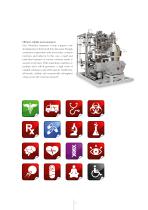
Efficient, reliable and economical GEA Westfalia Separator Group supports new developments in the branch from the outset through continuous cooperation with universities, research institutes and industry. In this way, a rapid and individual response to current customer needs is assured at all times. With stand-alone machines or package units which guarantee a high yield of valuable substances and which operate trouble-free, efficiently, reliably and economically throughout a long service life. Convince yourself!
Open the catalog to page 3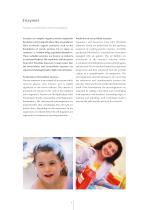
Enzymes are complex organic protein compounds located in every living cell, where they are produced. They accelerate organic processes such as the breakdown of starch, protein, fat or sugar as catalysts, i. e. without being expended themselves. These valuable proteins are known to industry as esteemed helpers. The separators and decanters from GEA Westfalia Separator Group ensure that the intracellular and extracellular enzymes are separated undamaged and in high concentrations. Production of intracellular enzymes Glucose isomerase is an example of an enzyme which converts glucose into fructose...
Open the catalog to page 4
11 Cell debris to disposal (washing liquid) 5 Rotary brush strainer Intracellular enzymes 5 Flocculents 6 Rotary brush strainer further processing 14 Biomass to disposal (washing liquid) 11 Extracellular liquid
Open the catalog to page 5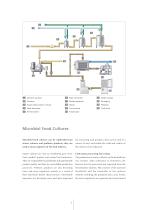
Water (waste) 12 Packaging Pelletizer Cold store Nutrient solution U Main fermenter Aeration H Nozzle separator Freeze-dried starter cultures H Waste Seed fermenter H Concentrate Microbial food cultures can be subdivided into starter cultures and probiotic products; they are used in many segments of the food industry. Starter cultures are now an established part of the food, medical product and animal feed industries. They are responsible for predictable and reproducible product quality and thus for controllable production processes. Probiotic products are also becoming more...
Open the catalog to page 6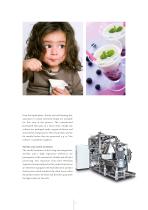
from the liquid phase. Nozzle and self-cleaning disc separators in steam-sterilised design are available for this step of the process. The concentrated lactobacilli then pass to a freeze drier. Finally, the cultures are packaged under oxygen exclusion and stored at low temperatures. This retains their activity for months before they are processed, e. g. as “live cultures” in probiotic yoghurts. Sterility and careful treatment The careful treatment of the living microorganisms, sterility and a high separation efficiency are prerequisite to the economical, reliable and efficient processing. The...
Open the catalog to page 7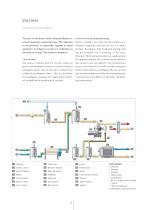
Vaccines Protection against germs Vaccines are medicines which immunise human or Process of vaccine manufacturing animal organisms against diseases. The organism When a suitable virus strain has been chosen, it is to be protected is repeatedly exposed to small isolated in ampoules and stored at -192 °C in liquid quantities of antigens (vaccines) or antibodies in nitrogen. Breeding is then conducted starting with the form of a serum. This achieves immunity. the pre-fermenter and continuing in the main fermenter. The fermentation process is supplemented Live vaccines by a nutrient solution. The...
Open the catalog to page 8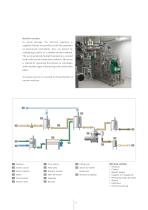
Non-live vaccines In serum therapy, the infected organism is supplied with the sera produced with the antibodies of immunised individuals. Sera are gained by multiplying bacteria in a suitable nutrient solution. The serum produced during fermentation is excreted by the cells into the fermentation solution. The serum is isolated by separating the biomass in centrifuges and by further stages of processing in the clarification phase. An aseptic process is essential in the production of vaccines and sera. ^14 Aeration Starter culture Dried nutrients Water Pre-fermenter Nutrient tank Virus culture...
Open the catalog to page 9
Hormones / Insulin Separation technology for human medicine Hormones are chemical messengers which have a In the service of human medicine regulating effect on the metabolism and organ Separators from GEA Westfalia Separator Group play activity. In collaboration with the nervous system, an important part in the production process. Nozzle they co-ordinate all bodily functions. A complicated separators operate in the depicted process, in which control mechanism ensures a harmonic interaction the solid material is extracted continuously in a of the bodily functions. The separation technology constant...
Open the catalog to page 10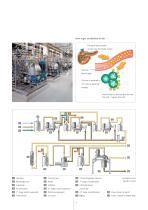
How sugar metabolism works The pancreas excretes insulin into the blood-stream. Glucose, blood sugar. Glucose is oxidised in the cells to generate energy. Insulin helps to convey glucose into the cells: it opens the cells. 10 2nd stage nozzle separator 5 1 stage nozzle separator 18 Clear phase to waste 19 Insulin crystals to freeze dryer Example insulin based on yeast
Open the catalog to page 11
Extracellular products Inclusion bodies products Intracellular products 1 Aeration 2 Microorganism 3 Substrate 11 Cellular liquid with cell containing soluble (washing liquid) 7 Extracellular liquid debris (waste) Pharmaceutical Proteins Genetically modified bioproducts Biotechnological processes can be characterised as factor is multiplied by fermentation of the micro- processes employing genetically modified micro- organisms. The DNA chain with the modified gene organisms. These are able to produce biological and the substances which it produces develop products which they would never have...
Open the catalog to page 12All GEA Tiromat Packaging - GEA Food Solutions Germany catalogs and technical brochures
 consigma-coater-2018-170309
4 Pages
 Tablet-Compression-171069
48 Pages
 GEA Lyophil LYOPLUS™
2 Pages


- Valve
- Control software
- Agitator
- Medical valve
- Spectroscope
- Benchtop agitator
- Electronic stirrer
- Automatic packing machine
- Pharmaceutical product packing machine
- Mixer
- Floor-standing packing machine
- Pharmaceutical product filling machine
- Stainless steel valve
- Tableting machine
- Benchtop mixer
- Industrial mixer
- Sample preparation homogenizer
- Press for the pharmaceutical industry
- Rotator mixer