
- Catalogs
- Geistlich Pharma
- Peri-Implant Augmentation

Peri-Implant Augmentation

Peri-Implant Augmentation
This document offers an in-depth analysis of peri-implant augmentation techniques and materials, emphasizing long-term studies and product specifications. It includes insights from European dental professionals on their experiences with Geistlich biomaterials over 3.5 to 12 years.
- Geistlich Bio-Oss® Collagen: Small granules with porcine collagen, suitable for periodontal defects and extraction sockets, available in 100 mg to 500 mg sizes.
- Geistlich Bio-Gide®: A bilayer collagen membrane for easy handling, available in 25 × 25 mm and 30 × 40 mm sizes.
- Geistlich Bio-Oss Pen®: Applicator for precise delivery of bone substitute material, available with small and large granules.
Studies show that Geistlich Bio-Oss® and Geistlich Bio-Gide® provide predictable and stable outcomes for up to 12-14 years, supporting implant survival and maintaining marginal bone height.
- 3.5-year Follow-up: Stable clinical situations with no peri-implant inflammation.
- 9.5-year Follow-up: Stable bone structures with minimal changes.
- 12-year Follow-up: Excellent esthetic outcomes and long-term stability of the facial bone wall.
Discusses surgical techniques such as simultaneous GBR augmentation and early implant placement with contour augmentation, highlighting the effectiveness of Geistlich products in maintaining bone volume and supporting soft tissue integration.
The document highlights the long-term success and reliability of Geistlich biomaterials in dental implantology, supported by clinical evidence and expert testimonials.
Conducted over 3.5 to 12 years in Switzerland and France, these studies assess the long-term success and stability of Geistlich biomaterials.
Details the range of Geistlich biomaterials, including Geistlich Bio-Oss® and Geistlich Bio-Gide®, used for periodontal defects, extraction sockets, and minor bone augmentations, available in various sizes and forms.
Emphasizes the importance of predictable therapy and high implant survival rates, with Geistlich products contributing to long-term stability and success.
Provides contact details for professionals and the Geistlich Biomaterials company for further inquiries.
Catalog excerpts

Indication Sheet PIR - Special Edition Peri-Implant Augmentation Long-term stability O EY T ESS K C SUC 3.5-year follow-up by Dr. Paul Stone, University of Edinburgh Dental Institute and Blackhills Specialist Referral Clinic, Scotland 9.5-year follow-up by Dr. Christian Ramel, Clinic of Fixed and Removable Prosthodontics, University of Zurich, and Private Practice, Zurich, Switzerland 4 and 5.5-year follow-up by Dr. Claude Andreoni and Dr. Thomas Meier, Private Practice, Zurich 10-year follow-up by Dr. Jean-Pierre Gardella (surgeon) and Dr. Christian Richelme (prosthodontist), Private Practice, Marseille, France 12-year follow-up by Prof. Daniel Buser and Prof. Urs Belser, University of Berne, Switzerland
Open the catalog to page 1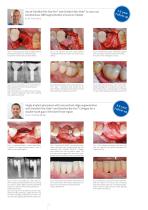
Use of Geistlich Bio-Oss Pen® and Geistlich Bio-Gide® to carry out simultaneous GBR augmentation around an implant by Dr. Paul Stone Fig. 2 The Geistlich Bio-Oss® graft particles completely filling the crestal and small buccal defects. Fig. 1 An intra-operative view of surgical site 36 showing the implant site osteotomy and associated crestal and buccal bone defect. Fig. 3 A Geistlich Bio-Gide® membrane adapted over the implant and graft material ensuring exclusion of non-osteogenic tissues. 3.5 years after grafting 9 months after grafting 3.5 years after grafting Fig. 4, A First x-ray follow-up:...
Open the catalog to page 2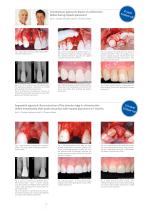
Simultaneous approach: Repair of a dehiscence defect during implant placement by Dr. Claude Andreoni and Dr. Thomas Meier Fig. 1 Status after insertion of the implant (SPI®, Thommen Medical AG). Fig. 2 After covering the exposed implant surface with bone chips from the surrounding area, the Geistlich Bio-Oss® granules are applied using the Geistlich Bio-Oss Pen®. Fig. 3 Covering of the graft with two layers of Geistlich Bio-Gide®. Here the collagen membrane is applied using the “double layer” technique to stabilize the graft and protect it from the ingrowth of soft tissue. 4 months after grafting...
Open the catalog to page 3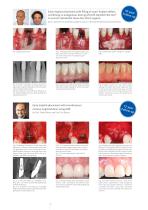
Early implant placement with filling of a peri-implant defect, combining an autogenous bone graft with Geistlich Bio-Oss® to correct substantial tissue loss (front region) by Dr. Jean-Pierre Gardella (surgeon) and Dr. Christian Richelme (prosthodontist) A Fig. 2 , A Filling the defect with autogenous bone cores. Fig. 2 , B Placement of Geistlich Bio-Oss® to maintain volume and protect the autogenous graft against resorption. Fig. 3 Geistlich Bio-Gide® arranged in a double layer. 6 months after grafting 10 years after grafting 6 months after grafting 10 years after grafting Fig. 4, A First x-ray...
Open the catalog to page 4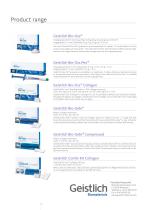
Product range Geistlich Bio-Oss® Small granules (0.25–1 mm) | Quantities: 0.25 g, 0.5 g, 1.0 g, 2.0 g (1 g ≈ 2.05 cm3) Large granules (1–2 mm) | Quantities: 0.5 g, 1.0 g, 2.0 g (1 g ≈ 3.13 cm3) The small Geistlich Bio-Oss® granules are recommended for smaller 1–2 socket defects and for contouring auto genous block grafts. The large Geistlich Bio-Oss® granules enable improved regeneration over large distances and provide enough space for the ingrowing bone. Geistlich Bio-Oss Pen® Small granules (0.25–1 mm) | Quantities: 0.25 g ≈ 0.5 cc, 0.5 g ≈ 1.0 cc Large granules (1–2 mm) | Quantity: 0.5 g...
Open the catalog to page 5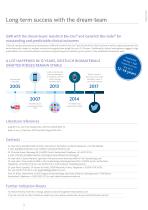
Long-term success with the dream-team GBR with the dream-team: Geistlich Bio-Oss® and Geistlich Bio-Gide® for outstanding and predictable clinical outcomes Clinically, implant placement and simultaneous GBR with Geistlich Bio-Oss® and Geistlich Bio-Gide® perform as well as implant placement into native bone with respect to implant survival and marginal bone height for up to 12–14 years.1 Additionally, clinical investigations suggest a high predictability for successful esthetic outcomes and good long-term stability (up to 6 years) of the established facial bone wall.2 A LOT HAPPENED IN 12 YEARS,...
Open the catalog to page 6All Geistlich Pharma catalogs and technical brochures
 Orthoss
4 Pages
 Chondro-Gide ®
2 Pages
 Geistlich Bio-Oss Pen®
2 Pages
 Geistlich Bio-Gide® Shape
4 Pages
- Orthopedic surgery bone substitute
- Dental sugery bone substitute
- Synthetic bone substitute
- Granules bone substitute
- Allograft bone substitute
- Collagen tissue matrix
- Xenograft bone substitute
- Absorbable tissue matrix
- Buccal tissue matrix
- Putty bone substitute
- Silk tissue matrix
- Malleable bone substitute
- Orthopedic tissue matrix
- Bone scraper