Product Information µCP3.0
Product Information µCP3.0
The GESIM μContactPrinter is designed for microcontact printing (μCP) and nanoimprint lithography (NIL), offering automated processes for creating micro- and nanostructures. It includes a casting station for molding stamps and supports various materials, including teflonized silicon and PFPE.
Automated Stamping Process
- Inking: The stamp is immersed in the sample in a time-controlled manner, with an option for dry inking.
- Drying: Conducted in a nitrogen flow at pressures between 100 – 800 kPa.
- Stamp Loading: The stamp is picked up by the print head.
- Stamping: Features include a substrate holder with predefined stop positions, a fine positioning table, video microscope alignment, and controlled inflation of the PDMS stamp. An option for NIL includes curing by an external UV lamp.
Micro- and Nanostructure Fabrication
Microcontact printing allows for nanoscale work, transferring molecules from a PDMS stamp to a surface. It is popular in life sciences for studying the effects of structured matrix proteins and growth factors on stem cells. NIL replicates stamp structures in a polymer, fixed by UV cross-linking, and is significant in microelectronics and cell biology.
GESIM μContactPrinter Models
- μContactPrinter 3.0: Semi-automatic with manual loading and alignment, but automated inking, drying, and printing.
- μContactPrinter 4.1: Fully automatic with XYZ robotics, spin-coating, and microdispensing capabilities.
Technical Specifications
- Stamps available in various sizes, including custom options.
- Substrate holder options include mechanical and vacuum fixation, with temperature control up to 145 °C.
- Adjustable substrate table with high precision and optional air cushion for fast adjustments.
- Extras include a UV source for NIL and a microfluidic flowthrough stamp.
- Controlled via Windows software, compatible with 115 or 230 V AC, and requires compressed air or nitrogen.
Conclusion
The GESIM μContactPrinter systems provide versatile and automated solutions for microcontact printing and nanoimprint lithography, catering to various scientific and industrial applications.
Catalog excerpts

μContactPrinter Systems for Microcontact Printing and NIL
Open the catalog to page 1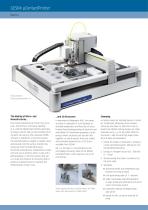
GESIM μContactPrinter Basics Fully automatic GESIM μContactPrinter 4.1 The Making of Micro- and Nanostructures… Few simple methods exist to print tiny structures. One of them, microarray spotting (e. g. with the GESIM Nano-Plotter) generates structures around 100 μm. Microcontact printing (μCP) can work on the nanoscale: PDMS (silicone) is molded on a structured master; the resulting stamp is soaked in sample, dried, and pressed onto the surface, transferring molecules from the protruding areas. Chemicals, biomolecules, nanoparticles, beads, and cells can be printed, which is why μCP is getting...
Open the catalog to page 2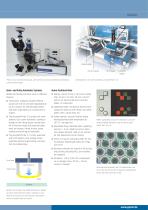
Stamp holder Ink-dry station Print head Substrate holder PVM-A on an inverted microscope, with external UV lamp and electronic/pneumatic Workstations in the semi-automatic μContactPrinter 3.0 control module (right) Semi- and Fully Automatic Systems Some Technical Data GESIM microcontact printers come in different flavours: ■ Stamps, round: 10 mm x 10 mm (Si master chip: 15 mm x 15 mm), 20 mm x 20 mm and for 24-well and 96-well microtiter plates, or customized ■ The process validation module (PVM-A) consists of Z-drive and table (adjustable on an air cushion), for method optimization and other...
Open the catalog to page 3
© M+K Werbeagentur GmbH | www.mkwa.de GESIM μContactPrinter Gesellschaft für Silizium-Mikrosysteme mbH Bautzner Landstraße 45 01454 Großerkmannsdorf, Germany Tel. +49 (0)351 - 2695 322 Fax +49 (0)351 - 2695 320 [email protected]
Open the catalog to page 4All GeSiM catalogs and technical brochures
 Bioscaffold Printers
4 Pages
 Nano-Plotter catalogue
13 Pages