
- Catalogs
- Globus Medical
- MIS TLIF

MIS TLIF

MIS TLIF
The spine consists of vertebrae divided into three main sections: Cervical (7 vertebrae), Thoracic (12 vertebrae), and Lumbar (5 vertebrae). Below the lumbar spine is the sacrum, comprised of 5 fused vertebrae, and the coccyx or tailbone. Vertebrae support the upper body, provide muscle and ligament attachment points, protect the spinal canal, and allow nerve exit. Intervertebral discs act as cushions between vertebrae.
Degenerative Disc Disease (DDD): DDD involves the intervertebral disc and is part of aging, causing instability and pain. Discs lose flexibility and height, leading to abnormal spine motion and pain, especially during prolonged sitting, bending, or twisting.
Spondylolisthesis: This condition involves vertebrae slipping forward or backward, potentially causing spine deformity and spinal canal narrowing. Symptoms include back pain, muscle spasms, and leg pain.
Lumbar Spinal Stenosis: This is the narrowing of spinal areas, often due to age-related degeneration, causing nerve pressure and pain. Symptoms include pain, tingling, or numbness radiating from the lower back to the legs.
Transforaminal Lumbar Interbody Fusion (TLIF) involves approaching the lumbar spine through a back incision to fuse two vertebrae. Minimally invasive techniques use anatomical knowledge and imaging to minimize tissue injury, resulting in smaller scars, less pain, and quicker recovery. However, the procedure may take longer and is not suitable for all conditions. Discuss with a physician if this approach is appropriate.
The surgeon makes a small incision, removes a section of bone and disc, and inserts an interbody spacer to stabilize the spine and provide nerve space. Pedicle screws and rods are used to secure the spine during fusion. Bone grafts may be added to promote fusion.
Patients can often get out of bed the day of surgery and may be discharged the next day. Symptom improvement and pain reduction typically occur within 2 to 4 weeks, but recovery varies. A positive attitude and adherence to post-surgery instructions contribute to a successful outcome. Complications can include inadequate decompression, nerve injury, infection, or persistent pain.
Catalog excerpts

Patient Information Transforaminal Lumbar Interbody Fusion Using Minimally Invasive Surgical Techniques
Open the catalog to page 1
MIS TLIF Table of Contents Anatomy of Spine . . . . . . . . . . . . . . . . . . . . . . . . . . . . . . . . . . . . . . . . . . . . . . 2 General Conditions of the Spine. . . . . . . . . . . . . . . . . . . . . . . . . . . . . . 4–6 MIS-TLIF Procedure. . . . . . . . . . . . . . . . . . . . . . . . . . . . . . . . . . . . . . . . . . 7–8 Post-Operative Expectations. . . . . . . . . . . . . . . . . . . . . . . . . . . . . . . . . . . . . 9 The decision to receive medical treatment is individualized to the patient and the patient’s symptoms. The information presented within this brochure may not...
Open the catalog to page 3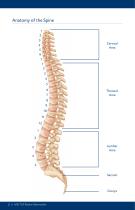
Cervical Area Thoracic Area MIS TLIF Patient Information
Open the catalog to page 4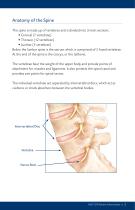
Anatomy of the Spine The spine is made up of vertebrae and is divided into 3 main sections: • Cervical (7 vertebrae) • Thoracic (12 vertebrae) • Lumbar (5 vertebrae) Below the lumbar spine is the sacrum which is comprised of 5 fused vertebrae. At the end of the spine is the coccyx, or the tailbone. The vertebrae bear the weight of the upper body and provide points of attachment for muscles and ligaments. It also protects the spinal canal and provides exit points for spinal nerves. The individual vertebrae are separated by intervertebral discs, which act as cushions or shock absorbers between...
Open the catalog to page 5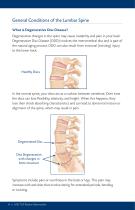
General Conditions of the Lumbar Spine What is Degenerative Disc Disease? Degenerative changes in the spine may cause instability and pain in your back. Degenerative Disc Disease (DDD) involves the intervertebral disc and is part of the natural aging process. DDD can also result from torsional (twisting) injury to the lower back. Healthy Discs In the normal spine, your discs act as a cushion between vertebrae. Over time the discs can lose flexibility, elasticity, and height. When this happens, they lose their shock absorbing characteristics and can lead to abnormal motion or alignment of the...
Open the catalog to page 6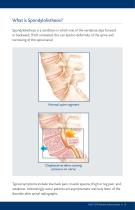
What is Spondylolisthesis? Spondylolisthesis is a condition in which one of the vertebrae slips forward or backward. If left untreated, this can lead to deformity of the spine and narrowing of the spinal canal. Normal spine segment Displaced vertebra causing pressure on nerve Typical symptoms include low back pain, muscle spasms, thigh or leg pain, and weakness. Interestingly, some patients are asymptomatic and only learn of the disorder after spinal radiographs. MIS TLIF Patient Information
Open the catalog to page 7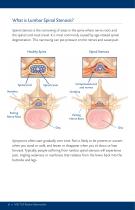
What is Lumbar Spinal Stenosis? Spinal stenosis is the narrowing of areas in the spine where nerve roots and the spinal cord must travel. It is most commonly caused by age-related spinal degeneration. This narrowing can put pressure on the nerves and cause pain. Healthy Spine Spinal cord Spinal Stenosis Spinal canal Exiting Nerve Root Compressed cord and nerves Vertebra Exiting Nerve Root Disc Symptoms often start gradually over time. Pain is likely to be present or worsen when you stand or walk, and lessen or disappear when you sit down or lean forward. Typically, people suffering from lumbar...
Open the catalog to page 8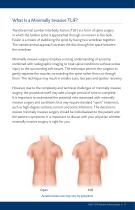
What Is a Minimally Invasive TLIF? Transforaminal Lumbar Interbody Fusion (TLIF) is a form of spine surgery in which the lumbar spine is approached through an incision in the back. Fusion is a means of stabilizing the spine by fusing two vertebrae together. The transforaminal approach accesses the disc through the space between the vertebrae. Minimally invasive surgery employs a strong understanding of anatomy combined with radiographic imaging to treat spinal conditions without undue injury to the surrounding soft tissues. The technique permits the surgeon to gently separate the muscles surrounding...
Open the catalog to page 9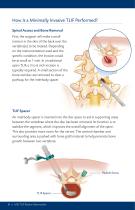
How Is a Minimally Invasive TLIF Performed? Spinal Access and Bone Removal First, the surgeon will make a small incision in the skin of the back over the vertebra(e) to be treated. Depending on the instrumentation used and the specific condition, the incision could be as small as 1 inch. In a traditional open TLIF, a 3 to 6 inch incision is typically required. A small section of the bone and disc are removed to clear a pathway for the interbody spacer. TLIF Spacer An interbody spacer is inserted into the disc space to aid in supporting areas between the vertebrae where the disc has been removed....
Open the catalog to page 10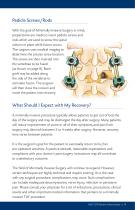
Pedicle Screws/Rods With the goal of Minimally Invasive Surgery in mind, preparations are made to insert pedicle screws and rods which are used to screw the spinal column in place while fusion occurs. The surgeon uses medical imaging to determine the precise screw location. The screws are then inserted into the vertebrae to be fused (as shown on page 8). Bone graft may be added along the side of the vertebrae to stimulate fusion. The surgeon will then close the incision and move the patient into recovery. What Should I Expect with My Recovery? A minimally invasive procedure typically allows patients...
Open the catalog to page 11
Globus Medical Valley Forge Business Center 2560 General Armistead Avenue Audubon, PA 19403 www.globusmedical.com ©2011 Globus Medical. All rights reserved. Patents pending. Life moves us is a registered trademark of Globus Medical. Caution: Federal (USA) Law Restricts this Device to Sale by or on the Order of a Physician.
Open the catalog to page 12All Globus Medical catalogs and technical brochures
 Discover the SHIELD™ VCF System
20 Pages
 POSTERIOR CERVICAL FUSION
12 Pages
 ExcelsiusGPS
12 Pages
 CERVICAL LAMINOPLASTY
14 Pages
 Discover the AFFIRM™ VCF System
20 Pages
 SECURE-C®
24 Pages
 ACDF
ACDF16 Pages
 TLIF patient brochure
12 Pages
 SI-LOK™
12 Pages
 TRANSITION
12 Pages
 complete bone graft
1 Page
 SP-Fix
12 Pages
 SECURE®-C
24 Pages
 Adolescent Idiopathic Scoliosis
16 Pages
 ADULT SCOLIOSIS
16 Pages
 MIS LLIF
16 Pages
 MONUMENT
2 Pages
 CREO AMP® Threaded
1 Page
 CREO MCS?
2 Pages
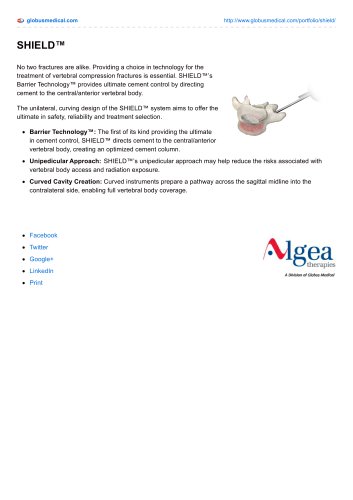 SHIELD?
1 Page
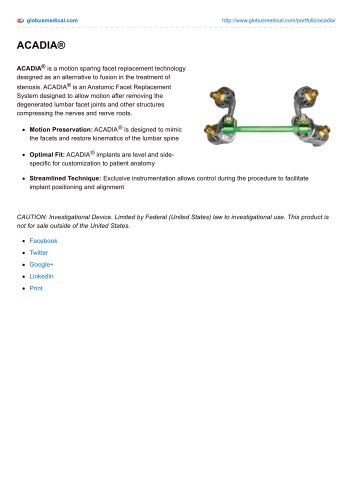 ACADIA®
1 Page
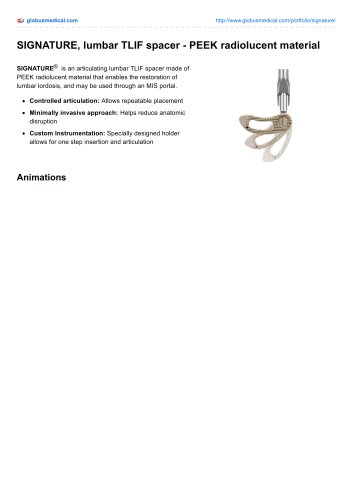 SIGNATURE®
1 Page
 TRUSS®
1 Page
 XPand®-R
1 Page
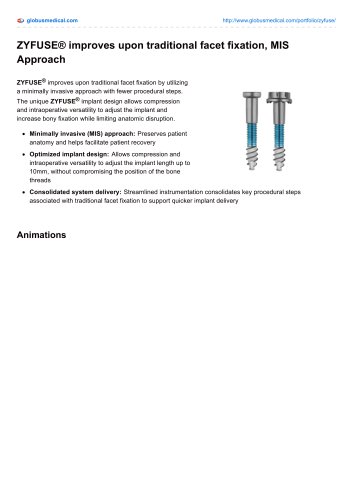 ZYFUSE®
1 Page
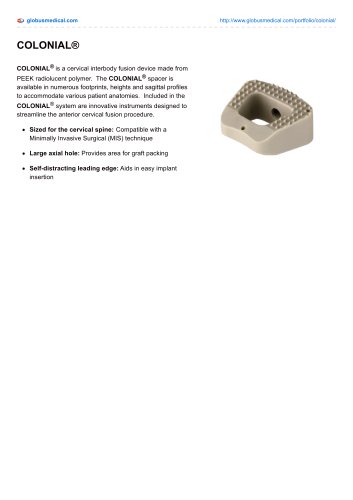 COLONIAL®
1 Page
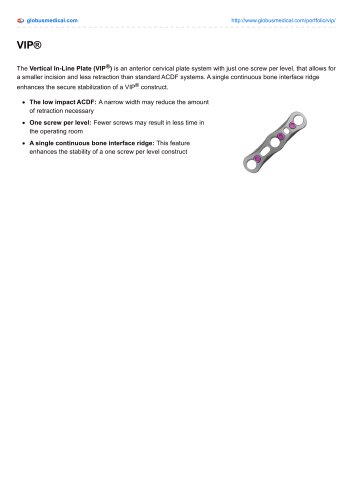 VIP®
VIP®1 Page
 PROVIDENCE?
1 Page
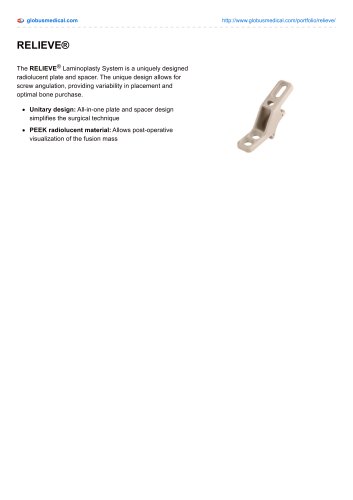 RELIEVE®
1 Page
 ASSURE®
1 Page
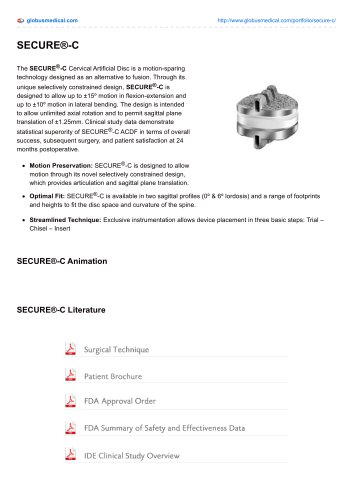 SECURE®-C
2 Pages
 COALITION®
1 Page
 CAPITOL?
1 Page
 LATIS
LATIS3 Pages
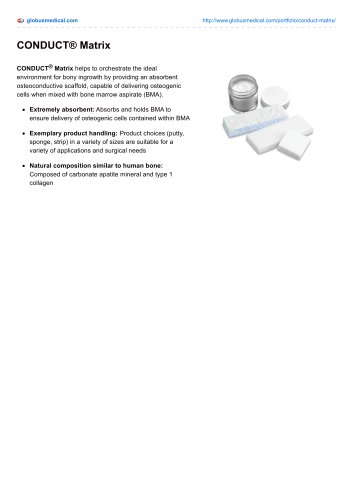 CONDUCT® Matrix
1 Page
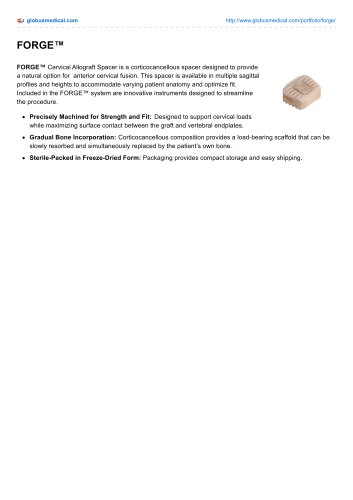 FORGE?
1 Page
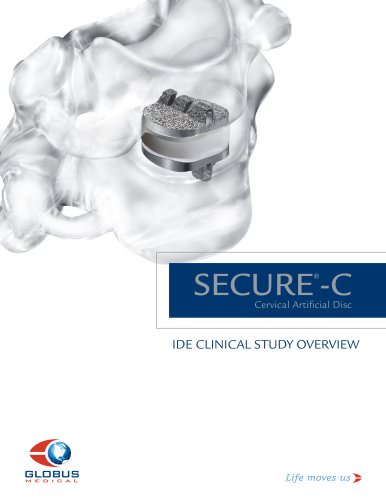
 SECURE®-C technical overview
12 Pages




- Bone plate
- Compression plate
- Metallic compression plate
- Locking compression plate
- Retractor
- Orthopedic surgery instrument kit
- Distal compression plate
- Interbody fusion cage
- Surgical retractor
- Biopsy needle
- Proximal compression plate
- Forearm compression plate
- Medial compression plate
- PEEK interbody fusion cage
- External fixation system
- Femoral stem
- Adult external fixation system
- Humerus compression plate
- Radius compression plate
- Lumbar interbody fusion cage