
- Catalogs
- GLOOR MEDICAL
- SWISS optio low vac

SWISS optio low vac

SWISS optio low vac
- Continuous vacuum adjustment up to -85 mbar, with a specific version for thoracic drainage up to -70 mbar.
- Equipped with a silent operation feature and an integrated shut-off valve for interrupting the suction process.
- Includes an overpressure valve to prevent overpressure on the patient side.
- Certified according to EN ISO 10079-3 and CE marked under the Medical Products Guideline 93/42/EEC.
- Construction: Diaphragm vacuum regulator.
- Vacuum regulation ranges: Standard (0 to -85 mbar), Thoracic drainage (0 to -70 mbar).
- Vacuum indication: 0 to -150 mbar.
- Suction capacity varies with vacuum levels, e.g., 27 l/min at -25 mbar, 52 l/min at -85 mbar.
- Material: Brass body with nickel-plated external parts.
- Operating temperature: -20°C to +60°C.
- Dimensions: 92 x 147 x 133 mm; Weight: 960 grams.
- GM701x standard and GM702x thoracic drainage versions available.
- Ordering requires specification of version and inlet/outlet configurations.
Catalog excerpts
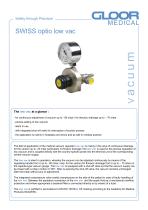
Safety through Precision durch Präzision The low vac at a glance : - for continuous adjustment of vacuum up to - 85 mbar / for thoracic drainage up to – 70 mbar - precise setting of low vacuum - silent in use - with integrated shut-off valve for interruption of suction process - the application is mainly in hospitals and clinics and as well in medical practice The field of application of the medical vacuum regulator low vac is mainly in the area of continuous drainage, for the version up to -70 mbar particularly in thoracic drainage The low vac is used for the precise regulation of low vacuum and is coupled directly with the country-specific probe into the terminal unit of the corresponding central vacuum supply. The low vac is silent in operation, whereby the vacuum can be adjusted continuously by means of the regulating handle from 0 up to - 85 mbar, resp. for the version for thoracic drainage from 0 up to – 70 mbar on the capsule-type vacuum gauge. The low vac is equipped with a shut-off valve so that the vacuum supply can be closed with a rotary motion of 180°. After re-opening the shut-off valve, the vacuum remains unchanged after the break without any re-adjustment. The integrated overpressure valve avoids overpressure on the side of the patient in case of faulty handling of the low vac. Between the aspiration connection of the low vac and the septic fluid jar a mechanical overflow protection and where appropriate a bacterial filter is connected directly or by means of a tube. The low vac is certified in accordance to EN ISO 10079-3. CE marking according to the Guideline for Medical Products 93/42/E
Open the catalog to page 1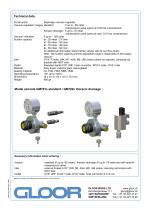
Construction diaphragm vacuum regulator Vacuum regulation ranges standard : 0 up to - 85 mbar overpressure valve opens at 0.05 bar overpressure thoracic drainage : 0 up to -70 mbar overpressure valve opens at max. 0.01 bar overpressure Vacuum indication Suction capacity Inlet Outlet Material Sealing material Operating temperature Dimensions Weight 0 up to - 150 mbar at - 25 mbar : 27 l/min at - 55 mbar : 43 l/min at - 70 mbar : 48 l/min at - 85 mbar : 52 l/min for additional information about further values, ask for our flow charts Note : the suction capacity and the adjustable range is dependent...
Open the catalog to page 2All GLOOR MEDICAL catalogs and technical brochures
 SWISS optio jetflow
2 Pages
 SWISS optio NO
2 Pages
 SWISS optio mini
2 Pages
 SWISS optio basic regflow
2 Pages
 SWISS optio reduc hp1
2 Pages
 SWISS optio HP stabilo
2 Pages
 SWISS optio varius
2 Pages
 SWISS optio HP stabilo mini
2 Pages
 SWISS optio basic
2 Pages
 SWISS optio regflow
2 Pages
 SWISS optio reduc hp2
2 Pages
 SWISS optio humidifier
1 Page
 SWISS optio hoses
2 Pages
 SWISS optio reduc LP
2 Pages
 SWISS optio clean vac
2 Pages
 SWISS optio clean vent mini
2 Pages
 SWISS optio clean vent
2 Pages
 SWISS optio varius clean
2 Pages
 SWISS optio adapters
2 Pages
 SWISS optio accessories
6 Pages
 SWISS optio flow switch
2 Pages
 SWISS optio gas mixer
2 Pages
 SWISS optio combined holder
2 Pages
 SWISS optio Y-manifold
2 Pages
 SWISS optio change-over
3 Pages
 Medical cylinder trolley
2 Pages

- Medical dolly
- Hospital trolley
- Treatment cart
- Medical device trolley
- Anodized aluminum trolley
- Emergency trolley
- Equipment trolley
- Medical sensor
- Compact trolley
- Medical gas pressure reducer
- Medical gas flow meter
- Gas outlet
- Hospital flow meter
- Medical pressure regulator
- O2 flow meter
- Gas sensor
- Oxygen pressure reducer
- Humidifier
- Straight tubing