- Catalogs
- Gogoa Mobility Robots
- Hand of Hope

Hand of Hope

Hand of Hope
The document introduces the 'Hand of Hope', a robotic hand rehabilitation device designed to aid stroke survivors in regaining hand mobility. It highlights the prevalence of stroke-related disabilities and the importance of early rehabilitation.
Neuroplasticity
Neuroplasticity is the brain's ability to reorganize itself by forming new neural connections. This concept is crucial for stroke recovery, as repetitive activities can help re-establish neural pathways, aiding in neuromuscular rehabilitation.
Device Overview
The 'Hand of Hope' is an sEMG-driven robotic device that assists patients in motor relearning by detecting voluntary EMG signals indicating an intention to move. It provides positive feedback and interactive games to enhance training outcomes.
How It Works
- Intention to Move: Detects voluntary EMG signals from the brain.
- Motion Signal: Processes signals and delivers them to the hand brace.
- Perform Movement: The brace assists in hand motion.
- Positive Feedback: Reinforces hand function through feedback.
- Interactive Games: Enhances training with real-time interaction.
Intended Use and Indications
The device is intended for patients needing hand and forearm rehabilitation, particularly those with decreased muscular activity post-stroke or injury. It aids in motor learning, voluntary muscle contraction, and control of abnormal muscle activity.
Children's Use
The device is adaptable for pediatric use, addressing size and interface constraints, and is suitable for neurological and orthopedic issues in children.
Training Modes
- Continuous Passive Motion: Repeated passive movements.
- EMG Biofeedback Training: Assists in hand motion based on EMG thresholds.
- Open & Grasp Training: Controlled by voluntary muscle contraction.
Interactive Games
Games play a crucial role in rehabilitation, motivating patients and enhancing interaction with therapists. Advanced levels require more complex movements involving the elbow and shoulder.
System Features
- Patient Database: Stores individual settings and training details.
- Forearm Support: Provides comfort and aids in training.
- Easy-to-use: Simple software and setup.
- Portable: Lightweight and easy to carry.
- Cleaning: Easy maintenance with removable inserts.
Specifications
The device comes in various sizes with specific dimensions and weights. It includes advanced training software, forearm support, and a portable workstation.
Research Model
A special edition for scientific analysis, allowing integration with various physiological sensing technologies and real-time EMG signal access.
Company Information
Rehab-Robotics, a member of Vincent Medical Holdings Limited, is dedicated to integrating robotics into rehabilitation to maximize patient recovery outcomes.
Catalog excerpts
Member of Vincent Medical Holdings Limited
Open the catalog to page 1
Over 17 Million people worldwide suffer a stroke each year A stroke is the largest cause of a disability with half of all survivors being left with an impairment of the hand and arm leading to an inability to execute their activities of daily living. Consequently a patient can lose motivation and hope which is key to their rehabilitation, especially when the greatest recovery can be see in the first days and weeks after a stroke. Hand of Hope Lets introduce you to the Hand of Hope, an award winning, state-of-the-art sEMG driven robotic hand rehabilitation device that combines advances in robotics...
Open the catalog to page 2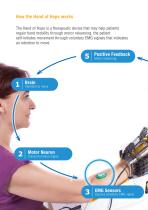
How the Hand of Hope works The Hand of Hope is a therapeutic device that may help patients regain hand mobility through motor relearning, the patient self-initiates movement through voluntary EMG signals that indicates an intention to move. Positive Feedback Motor relearning Motor Neuron Transmit motion signal Capture voluntary EMG signal
Open the catalog to page 4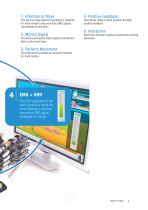
1. Intention to Move The Hand of Hope detects the patient's intention for hand motion using voluntary EMG signals commanded by the brain 2. Motion Signal The Device processes these signals and delivers them to the hand brace 4. Positive Feedback The Patient relearns hand function through positive feedback 5. Interactive Real-time interactive games enhance the training outcomes The Hand brace provides an assistive function for hand motion 4 EMG + HOH The HOH responds to the user's desire to move the hand through a real time interactive EMG signal displayed on the bar
Open the catalog to page 5
The hand brace is worn on the impaired hand with 2 surface sensors attached to the extensor and flexor muscles of the forearm to detect the surface electromyographic signals (sEMG) for active participation during exercise. Intended Use The Hand of Hope therapy device is intended for use in patients that require hand and forearm rehabilitation. Potential goals for the use of HOH could be, but not limited to the following: • Motor learning via interactive use of the biofeedback system • Help initiation of the voluntary muscle contraction and voluntary movement • Maintain voluntary muscle contraction...
Open the catalog to page 6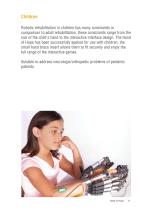
Children Robotic rehabilitation in children has many constraints in comparison to adult rehabilitation, these constraints range from the size of the child's hand to the interactive interface design. The Hand of Hope has been successfully applied for use with children, the small hand brace insert allows them to fit securely and enjoy the full range of the interactive games. Suitable to address neurologic/orthopedic problems of pediatric patients.
Open the catalog to page 7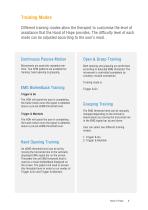
Training Modes Different training modes allow the therapist to customise the level of assistance that the Hand of Hope provides. The difficulty level of each mode can be adjusted according to the user’s need. Continuous Passive Motion Movements are passively repeated over time. Two CPM patterns are available for training: hand opening & grasping. EMG Biofeedback Training Trigger & Go The HOH will assist the user in completing the hand motion once the signal is detected above a pre-set sEMG threshold level. Trigger & Maintain The HOH will assist the user in completing the hand motion once the...
Open the catalog to page 9
For Hand Opening Desperate Bee For Hand Opening & Grasping Ball & Basket For Hand Grasping UFO Catcher Training Mode Open & Grasp Training Training Mode Grasp Training Training Mode Arm Training For Hand Opening Hungry Bird Training Mode Hand Training
Open the catalog to page 10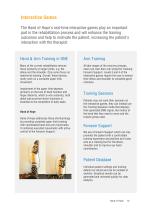
The Hand of Hope's real-time interactive games play an important part in the rehabilitation process and will enhance the training outcomes and help to motivate the patient, increasing the patient's interaction with the therapist Hand & Arm Training in ONE Arm Training Many of the current rehabilitation devices At later stages of the recovery process, focus primarily on larger joints, e.g. the users can train their arm using the Tracking elbow and the shoulder. Only some focus on Forearm Support. Levels 3 and 4 of the hand/wrist training. Overall, these devices interactive games...
Open the catalog to page 11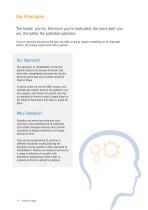
The harder you try, the more you’re motivated, the more alert you are, the better the potential outcome. If you’re intensely focused on the task and really trying to master something for an important reason, the change experienced will be greater. Our Approach Our approach to rehabilitation is that the patient needs to be actively involved, they drive their rehabilitation forward and see the personal gains that can be made using the Hand of Hope. In active mode we use the EMG sensors and calibrate the robotic hand to the patient's very own signals, that allows the patient who has an intention...
Open the catalog to page 12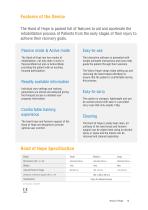
The Hand of Hope is packed full of features to aid and accelerate the rehabilitation process of Patients from the early stages of their injury to achieve their recovery goals. Passive mode & Active mode The Hand of Hope has two modes of rehabilitation, not only does it work in Passive Mode but also in Active Mode providing the patient with an exciting focused participation. Readily available information Individual user settings and training parameters are stored and analysed giving the therapist access to detailed user progress information. Comfortable training experience The hand brace and forearm...
Open the catalog to page 13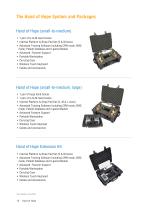
Hand of Hope (small-to-medium) • 1 pair of S-to-M hand braces • Internal Platform & Strap Pad Set (S & M sizes) • Advanced Training Software including CPM mode, EMG mode, Patient Database and 5-game Module • Advanced Forearm Support • Portable Workstation • Carrying Case • Wireless Touch Keyboard • Cables and Accessories Hand of Hope (small-to-medium, large) • 1 pair of large hand braces • 1 pair of S-to-M hand braces • Internal Platform & Strap Pad Set (S, M & L sizes) • Advanced Training Software including CPM mode, EMG mode, Patient Database and 5-game Module • Advanced Forearm Support • Portable...
Open the catalog to page 14