- Catalogs
- Greyhound Chromatography & Allied Chemicals
- Macherey Nagel Derivatization Reagents for GC

Macherey Nagel Derivatization Reagents for GC
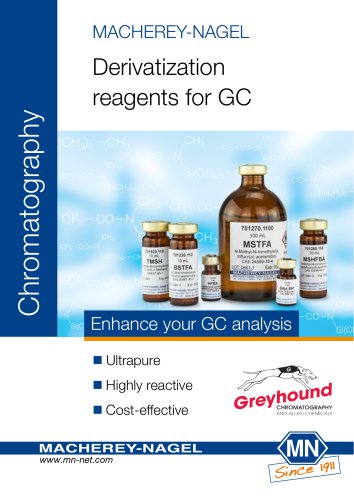
Macherey Nagel Derivatization Reagents for GC
Derivatization is essential for preparing compounds for Gas Chromatography (GC) that are otherwise challenging to separate. It improves chromatographic behavior, peak shape, stability, detectability, and volatility. Ensuring laboratory glassware does not interfere with samples is crucial, often requiring deactivation with silylating agents.
- Complete reaction (≈ 100%)
- No sample loss during derivatization
- Stability of the derivative over time
- No interaction between reagent and chromatographic system
- Silylation: Most versatile, replacing active hydrogens with trimethylsilyl groups to improve volatility and stability.
- Acylation: Used for introducing acyl groups to enhance separation.
- Alkylation (Methylation): Involves adding alkyl groups to improve chromatographic properties.
Silylation is the most common derivatization method, enhancing volatility and reducing polarity. It is not recommended for use with WAX or FFAP phases due to potential irreversible changes in column selectivity. Catalysts like TMCS or pyridine can be used to enhance reactions.
- BSA: Strong reagent for stable TMS derivatives, not recommended for carbohydrates.
- BSTFA: Offers greater volatility, useful for lower boiling TMS amino acids.
- MSTFA: Highly volatile, complete reactions without catalysts.
- MSHFBA: Useful for FID due to non-corrosive by-products.
- MBDSTFA: Provides tert-butyldimethylsilyl groups, useful for GC-MS applications.
- SILYL-271: Derivatizes all hydroxyl groups.
- SILYL-1139: Recommended for alcohols, phenols, and steroids.
- SILYL-21: Derivatizes amides and secondary amines.
- SILYL-991: Powerful for difficult-to-silylate compounds.
Derivatization is a critical step in GC analysis, with various reagents and methods available to suit different analytical needs. The choice of reagent and method depends on the specific requirements of the analysis and the properties of the compounds involved.
Catalog excerpts
Enhance your GC analysis
Open the catalog to page 1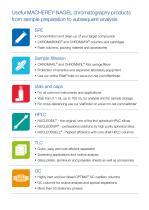
SPE ■ Concentration and clean-up of your target compounds ■ CHROMABOND® and CHROMAFIX® columns and cartridges ■ Flash columns, packing material and accessories ■ CHROMAFIL® and CHROMAFIL® Xtra syringe filters ■ Protection of sensitive and expensive laboratory equipment ■ Use our online FilterFinder on www.mn-net.com/filterfinder ■ For all common instruments and applications ■ Vials from 0.1 mL up to 100 mL for analysis and for sample storage ■ For cross-referencing use our VialFinder on www.mn-net.com/vialfinder ■ NUCLEOSIL® - the original, one of the first spherical HPLC silicas ■ NUCLEODUR®...
Open the catalog to page 2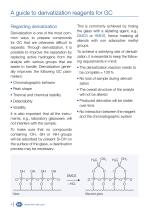
Regarding derivatization Derivatization is one of the most common ways to prepare compounds for GC that are otherwise difficult to separate. Through derivatization, it is possible to improve the separation by replacing active hydrogens from the analyte with various groups that are easier to handle. Derivatization generally improves the following GC parameters: ■ Thermal and chemical stability It is also important that all the instruments, e.g., laboratory glassware, will not interfere with the sample. To make sure that no compounds containing -OH, -SH or -NH groups will be adsorbed by present...
Open the catalog to page 4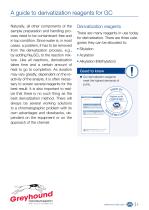
A guide to derivatization reagents for GC Derivatization reagents There are many reagents in use today for derivatization. There are three categories they can be allocated to: Silylation Alkylation (Methylation) MADE BY Highest purity Certificate / Zertifikat Silyl 991 Formula / Zusammensetzung REF LOT Expiry date / Haltbarkeit Date of analysis / Analysendatum Tester / Prüfer Specification / Spezifikation Target / Sollwert Color Farbe colorless* – yellowish farblos* - gelblich Content BSTFA Gehalt BSTFA Content TMCS Gehalt TMCS Result / Messwert * Slight turbidity may occur and has no impact...
Open the catalog to page 5
Silylation is the most versatile method of derivatization in GC, i.e. more than 80 % of all derivatization reactions are actually silylations. Usually the term silylation in GC stands for replacement of active hydrogen atoms by a trime-thylsilyl group (TMS derivative). Sometimes, however, trialkylsilyl groups or dimethylalkylsilyl groups with longer alkyl chains are used for derivatization. The trialkylsilyl group increases volatility and enhances thermal stability of the sample. As with methylation, the replacement of an active hydrogen with a silyl group reduces the polarity of the compound,...
Open the catalog to page 6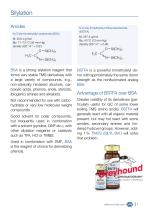
Silylation Amides N,O-bis-trimethylsilyl-trifluoroacetamide (BSTFA) BSTFA is a powerful trimethylsilyl donor with approximately the same donor strength as the nonfluorinated analog BSA. Not recommended for use with carbo hydrates or very low molecular weight compounds. Greater volatility of its derivatives (particularly useful for GC of some lower boiling TMS amino acids). BSTFA will generally react with all organic material present, but may not react with some amides, secondary amines and hindered hydroxyl groups. However, adding 1 % TMCS (SILYL-991) will solve that problem. BSA is a strong...
Open the catalog to page 7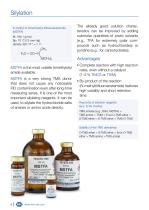
Silylation N-methyl-N-trimethylsilyl-trifluoroacetamide (MSTFA) M: 199.1 g/mol Bp: 70 °C (75 mm Hg) density d20 °/4 ° = 1.11 MSTFA is the most volatile trimethylsilyl amide available. MSTFA is a very strong TMS donor that does not cause any noticeable FID contamination even after long-time measuring series. It is one of the most important silylating reagents. It can be used, to silylate the hydrochloride salts of amines or amino acids directly. The already good solution characteristics can be improved by adding submolar quantities of protic solvents (e.g., TFA for extremely polar compounds such...
Open the catalog to page 8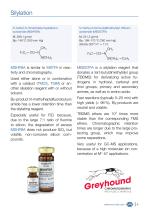
N-methyl-N-tert-butyldimethylsilyl-trifluoro acetamide (MBDSTFA) N-methyl-N-trimethylsilyl-heptafluoro butyramide (MSHFBA) Used either alone or in combination with a catalyst (TMCS, TSIM) or another silylation reagent with or without solvent. MBDSTFA is a silylation reagent that donates a tert-butyldimethylsilyl group (TBDMS) for derivatizing active hydrogens in hydroxyl, carboxyl and thiol groups, primary and secondary amines, as well as in amino acids. By-product N-methylheptafluorobutyric amide has a lower retention time than the silylating reagent. Fast reactions (typically 5–20 min) with...
Open the catalog to page 9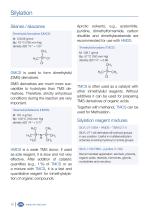
Dimethyldichlorosilane (DMCS) DMCS is used to form dimethylsilyl (DMS) derivatives. DMS derivatives are much more susceptible to hydrolysis than TMS derivatives. Therefore, strictly anhydrous conditions during the reaction are very important. Hexamethyldisilazane (HMDS) HMDS is a weak TMS donor. If used as sole reagent, it is slow and not very effective. After addition of catalytic quantities (e.g., 1 %) of TMCS or as a mixture with TMCS, it is a fast and quantitative reagent for trimethylsilyla-tion of organic compounds. Aprotic solvents, e.g., acetonitrile, pyridine, dimethylformamide, carbon...
Open the catalog to page 10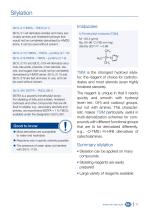
Silylation SILYL-21 HMDS – TMCS (2:1) SILYL-21 will derivatize amides and many secondary amines and hindered hydroxyls that would not be completely derivatized by HMDS alone. It can be used without solvent. Imidazoles N-Trimethylsilyl-imidazole (TSIM) M: 140.3 g/mol Bp: 94–96 °C (760 mm Hg) density d20 °/4 ° = 0.96 SILYL-2110 HMDS – TMCS – pyridine (2:1:10) SILYL-319 HMDS – TMCS – pyridine (3:1:9) SILYL-2110 and SILYL-319 will derivatize alcohols, bile acids, phenols, most steroids, sterols, and sugars that would not be completely derivatized by HMDS alone. SILYL-2110 and SILYL-319 are fast and...
Open the catalog to page 11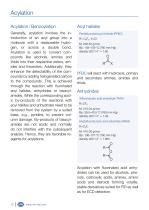
Acylation Acylation / Benzoylation Generally, acylation involves the in troduction of an acyl group into a molecule with a replaceable hydro gen, or across a double bond. Acylation is used to convert compounds like alcohols, amines and thiols into their respective esters, amides and thioesters. Additionally, they enhance the detectability of the compounds by adding halogenated carbon to the compounds. This is achieved through the reaction with fluorinated acyl halides, anhydrides or bisacylamides. While the corresponding acidic by-products of the reactions with acyl halides and anhydrides need...
Open the catalog to page 12All Greyhound Chromatography & Allied Chemicals catalogs and technical brochures
 Macherey Nagel GC Columns Catalogue
540 Pages