
- Catalogs
- Guangzhou Yeecon Medical Equipment Industrial
- A1-2S Lower Limb Feedback Training System


A1-2S Lower Limb Feedback Training System
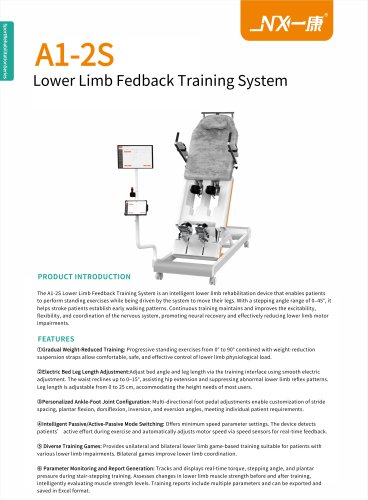
A1-2S Lower Limb Feedback Training System
The A1-2S Lower Limb Feedback Training System is designed for intelligent rehabilitation of lower limbs, particularly aiding stroke patients in developing early walking patterns. It facilitates standing exercises with a stepping angle range of 0–45°, enhancing neural recovery and reducing motor impairments.
- Gradual Weight-Reduced Training: Offers progressive standing exercises from 0° to 90° with weight-reduction suspension straps for safe and effective load control.
- Electric Bed Leg Length Adjustment: Allows smooth electric adjustment of bed angle and leg length, accommodating users' height needs and assisting in hip extension.
- Personalized Ankle-Foot Joint Configuration: Provides multi-directional foot pedal adjustments for customized stride and joint angles.
- Intelligent Passive/Active-Passive Mode Switching: Automatically adjusts motor speed based on patient effort, offering real-time feedback.
- Diverse Training Games: Includes unilateral and bilateral game-based training to improve coordination and cater to various impairments.
- Parameter Monitoring and Report Generation: Monitors real-time torque, stepping angle, and plantar pressure, evaluating muscle strength changes and generating detailed training reports.
Catalog excerpts

Lower Limb Fedback Training System PRODUCT INTRODUCTION The A1-2S Lower Limb Feedback Training System is an intelligent lower limb rehabilitation device that enables patients to perform standing exercises while being driven by the system to move their legs. With a stepping angle range of 0–45°, it helps stroke patients establish early walking patterns. Continuous training maintains and improves the excitability, flexibility, and coordination of the nervous system, promoting neural recovery and effectively reducing lower limb motor impairments. ①Gradual Weight-Reduced Training: Progressive standing exercises from 0° to 90° combined with weight-reduction suspension straps allow comfortable, safe, and effective control of lower limb physiological load. ②Electric Bed Leg Length Adjustment:Adjust bed angle and leg length via the training interface using smooth electric adjustment. The waist reclines up to 0–15°, assisting hip extension and suppressing abnormal lower limb reflex patterns. Leg length is adjustable from 0 to 25 cm, accommodating the height needs of most users. ③Personalized Ankle-Foot Joint Configuration: Multi-directional foot pedal adjustments enable customization of stride spacing, plantar flexion, dorsiflexion, inversion, and eversion angles, meeting individual patient requirements. ④Intelligent Passive/Active-Passive Mode Switching: Offers minimum speed parameter settings. The device detects patients’ active effort during exercise and automatically adjusts motor speed via speed sensors for real-time feedback. ⑤ Diverse Training Games: Provides unilateral and bilateral lower limb game-based training suitable for patients with various lower limb impairments. Bilateral games improve lower limb coordination. ⑥ Parameter Monitoring and Report Generation: Tracks and displays real-time torque, stepping angle, and plantar pressure during stair-stepping training. Assesses changes in lower limb muscle strength before and after training, intelligently evaluating muscle strength levels. Training reports include multiple parameters and can be exported and sav
Open the catalog to page 1All Guangzhou Yeecon Medical Equipment Industrial catalogs and technical brochures
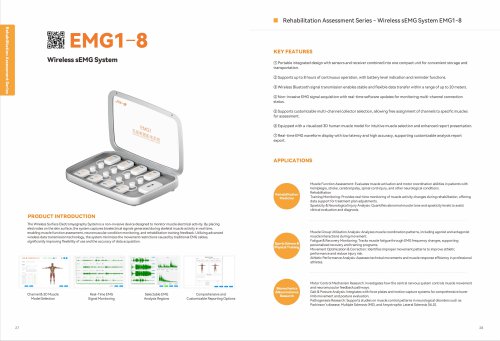 Wireless sEMG System
1 Page
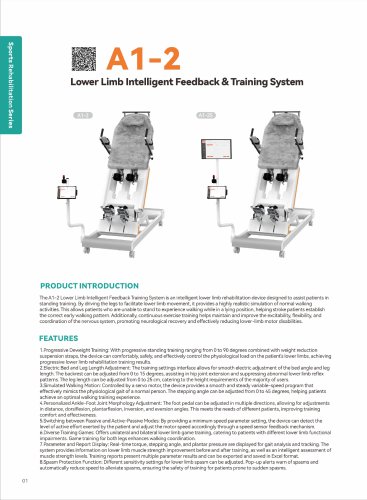 A1-2
A1-22 Pages
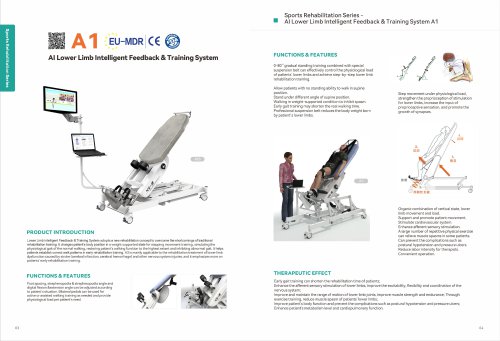 A1
A11 Page
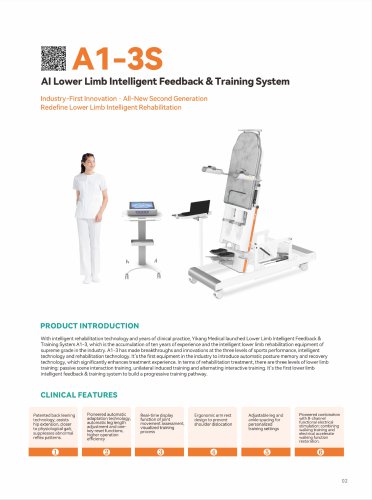 A1-3
A1-31 Page
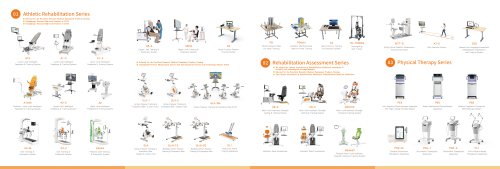 Catalog
2 Pages
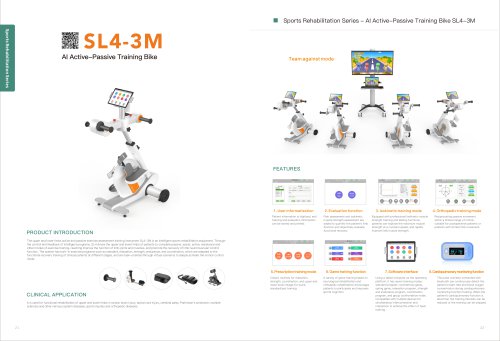 Yeecon SL4-3M Rehab Bike
1 Page
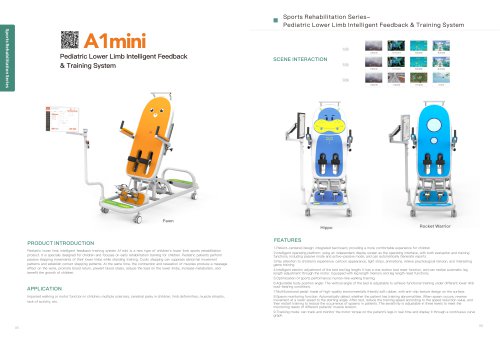 Yeecon A1mini Tilt Table
1 Page
- Hospital bed
- Yeecon examination table
- Inclinable bed
- Height-adjustable examination couch
- Electric examination couch
- Examination table with adjustable backrest
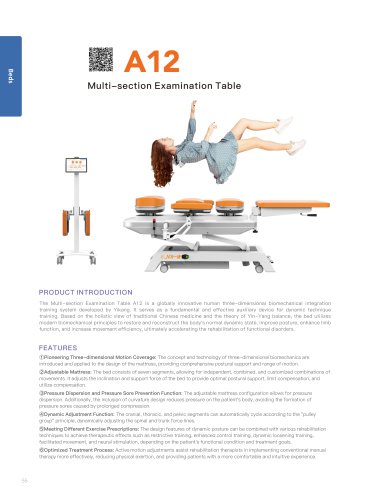
- 2 sections examination table
- Medical bed
- Manual treatment table
- Yeecon electric stimulator
- 3 sections examination table
- Patient lifter
- Gray treatment table
- Phototherapy lamp
- Yeecon physiotherapy examination table
- Electric patient lift
- Reclining examination couch
- Fixed-height treatment table
- TENS physiotherapy
- Adult treatment table