
- Catalogs
- GymnaUniphy
- Care 300


- Company
- Products
- Catalogs
- News & Trends
- Exhibitions
Care 300
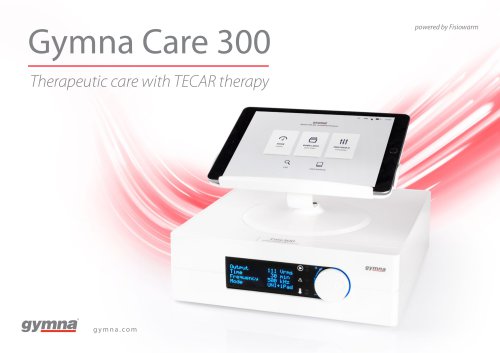
Care 300
TECAR therapy combines contact diathermy and electrotherapy, using electromagnetic energy within a spectrum of 300 KHz to 1.2 MHz. It is primarily used in physical therapy, rehabilitation, and pain management for conditions like bruises, sprains, and sports traumas.
TECAR therapy employs high-frequency currents for tissue bio-stimulation. It generates heat through capacitive or resistive electromagnetic fields, promoting vasodilation, substance exchange, and endorphin production for pain relief.
There are two modes: Capacitive, for soft tissues with high water content, and Resistive, for tissues with high electrical resistance such as deep muscles and bones.
Patients feel a pleasant warmth, with the Warmth Experience Level-score (WEL) used to assess comfort and effectiveness. The therapy is non-invasive, safe, and has minimal side effects.
Compared to high power laser and radial shockwave therapies, Gymna Care 300 is effective in both acute and chronic phases, suitable for various tissue depths, and offers high patient compliance and safety.
Therapists consider tissue location, size, and patient feedback to tailor treatments. The WEL-score helps adjust the therapeutic approach based on temperature increase and goals.
The device offers advanced TECAR therapy with multiple frequencies and modes, ensuring effective and safe treatments. It includes features like low voltage circuits and capacitive electrode coating to prevent electric shock and burns.
The Gymna Care 300 includes an app for remote control and user-friendly operation, offering pre-set protocols and advanced modes. It comes with various accessories for comprehensive treatment options.
The Gymna Care 300 provides a complete, safe, and effective solution for TECAR therapy, adaptable to specific patient needs and suitable for both professional and non-professional settings.
The Gymna Care 300 is a therapeutic device for TECAR therapy, powered by Fisiowarm. It meets stringent electrical safety standards and is classified as a Class B product for emissions.
The device features low-voltage capacitive electrodes coated with highly conductive and biocompatible gold to eliminate the risk of electric shock and burns.
The Gymna Care 300 includes fully shielded electronics to ensure safe operation during therapeutic procedures.
GymnaUniphy NV, Pasweg 6A, B-3740 Bilzen, Belgium. Tel: +32 (0)89 510 510, Fax: +32 (0)89 510 511.
The company offers a range of therapeutic services including Cryotherapy, Tecar-Diathermy, Shockwave Therapy, Physio Care, Treatment Tables, Electrotherapy, and Active Motion.
Catalog excerpts

Gymna Care 300 Therapeutic care with TECAR therapy
Open the catalog to page 1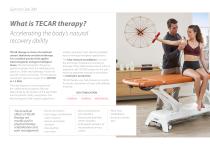
What is TECAR therapy? Accelerating the body’s natural recovery ability TECAR therapy is a form of combined contact diathermy and electrotherapy. It is a medical practice that applies electromagnetic energy to biological tissue. The electromagnetic frequency applied originates from the radiofrequency spectrum. Unlike electrotherapy it does not provoke muscle contraction. The therapeutic wavelength spectrum ranges from 300 KHz to 1.2 MHz. The high-frequency current’s path and the created electromagnetic field are determined by the position of the electrodes and the patient’s body composition....
Open the catalog to page 2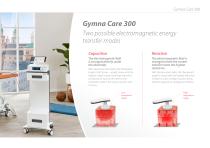
Gymna Care 300 Two possible electromagnetic energy transfer modes Capacitive The electromagnetic field is strongest directly under the electrodes The electromagnetic field is strongest where the current transfer meets the highest resistance With capacitive electrodes, the therapeutic target is soft tissue – usually tissue with the highest water content and high electrical conductance such as the dermis, the lymphatic system, the venous system and muscles. Low impedance target With resistive electrodes, the therapeutic target is tissue with the highest electrical resistance, such as deep muscles,...
Open the catalog to page 3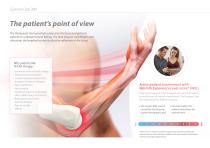
The patient’s point of view The therapeutic heat penetrates deep into the tissue and patients experience a pleasant warm feeling. The heat induces vasodilation and stimulates the lymphoid system to dissolve adhesions in the tissue. Why patients like TECAR therapy: • xtremely well-tolerated therapy E • leasant sense of warmth P • ontact between patient and C therapist (hands-on therapy) • afe and efficient S • Non-invasive • reatment starts in acute phase T (48 hrs after injury occurrence) • oth passive and active B exercise therapy • ew to no side F effects Active patient involvement with Warmth...
Open the catalog to page 4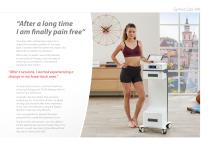
“After a long time I am finally pain free” “Five days after undergoing surgery for a supposed herniation problem in my lower back, I started to feel the same kind of pain and discomfort as before my operation. When after six weeks I was finally allowed to start physical therapy, I put my hope of resolving my complaints in my physical therapist’s intervention. “After 4 sessions, I started experiencing a change in my lower back area.” He proposed to have a combined treatment of manual therapy and TECAR therapy with his Gymna Care 300 device. Gradually I became better. The annoying irradiating pain...
Open the catalog to page 5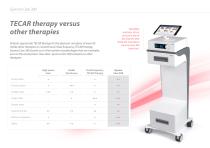
TECAR therapy versus other therapies Patients appreciate TECAR therapy for the pleasant sensation of warmth. Unlike other therapies or conventional, fixed frequency TECAR therapy, Gymna Care 300 stands out in the number of pathologies that are treatable, even in the acute phase. How does Gymna Care 300 compare to other therapies: Flexibility and ease of use are just a few of the reasons that make the innovative Gymna Care 300 stand out. High power laser Radial Shockwave Fixed frequency TECAR Therapy Acute phase Chronic phase Smaller areas Larger areas Deeper areas Superficial areas Patient compliance...
Open the catalog to page 6
The therapist’s point of view “When choosing treatment with Gymna Care 300, I take several parameters such as location, size and consistency of the tissue into account. Beside these, the patient’s body composition, the level of acuteness of the pathology and the therapeutic goals are the other main factors to take into account. tissue from warming up. Or is my therapeutic goal dependent on temperature increase? To evaluate this, I use the Warmth Experience Level-score* (WEL) score, an easy-to-use scorecard where the patient points out the warmth level experienced on a scale of one to ten.“ In...
Open the catalog to page 7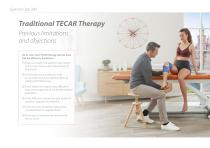
Traditional TECAR Therapy Previous limitations and objections Up to now, most TECAR therapy devices have had big efficiency limitations: T reatment depth management was limited due to only one or a very limited range of frequencies T he therapy was not effective in the acute phase due to the thermal effects of traditional TECAR therapy S ome anatomical regions were difficult to treat and manage due to the limited range of applicators I t was difficult to choose the right treatment protocol / approach for disorders T here was a risk of operator exposure to unwanted electro-magnetic fields T here...
Open the catalog to page 8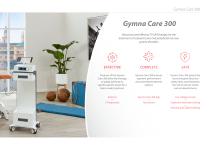
Gymna Care 300 Advanced and effective TECAR therapy for the treatment of osteoarticular and peripheral nervous system disorders Features of the Gymna Care 300 allow the therapy to adapt perfectly to specific patient needs for a tailor-made treatment Gymna Care 300 ensures supreme performance and unlimited treatment options Gymna Care 300 passes the most stringent electrical safety tests and eliminates the risk of electric shock and accidental burns Capacitive electrode coating Housing and cable shielding
Open the catalog to page 9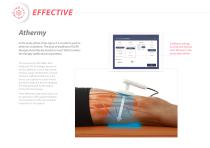
EFFECTIVE Athermy In the acute phase of an injury, it is crucial to work in athermic conditions. The dose of traditional TECAR therapy should be decreased so much that it renders the therapy ineffective and pointless. The Gymna Care 300 differs from traditional TECAR therapy because it has the ability to work at high power without a large temperature increase. Similar to traditional diathermy, the device can operate in pulsed mode, giving the body the time to dissipate the heat produced by the output during the short pause. Three different pulse-pause ratios can be selected to offer greater flexibility...
Open the catalog to page 10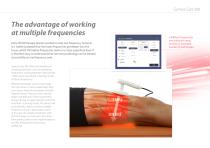
The advantage of working at multiple frequencies Early TECAR therapy devices worked on only one frequency, however it is widely accepted that the lower frequencies get deeper into the tissue, whilst the higher frequencies work on a more superficial level. It is therefore easy to understand that not every pathology can be treated successfully on one frequency only. Gymna Care 300 offers the flexibility of choosing between 5 pre-set operating frequencies varying between 300 kHz and 1 MHz and in “automatic scanning” mode of these frequencies. Whether therapists want to treat deep into the tissue...
Open the catalog to page 11All GymnaUniphy catalogs and technical brochures
 D6
D62 Pages
 Thermo 500+
3 Pages
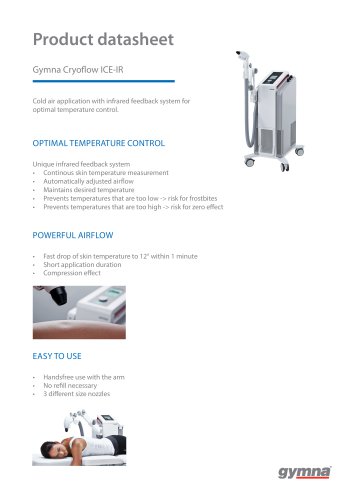 Gymna Cryoflow ICE-IR
2 Pages
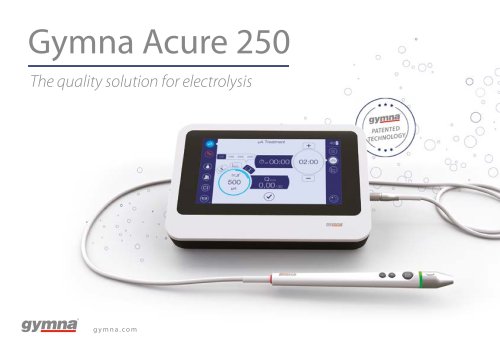 Gymna Acure 250
9 Pages
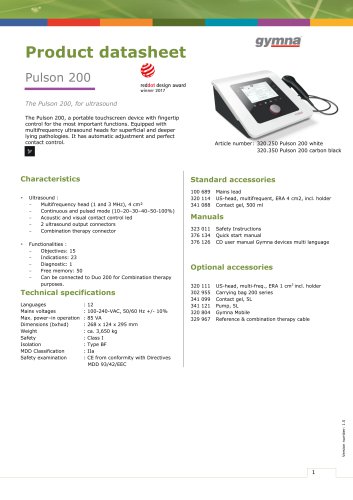 Pulson 200
4 Pages
Archived catalogs
 Gymna W-move
12 Pages
 Table G2
6 Pages
 Gymna ONE
8 Pages
 Gymna series 400
7 Pages
 GYMNA Myo 200
2 Pages
 Pulson 100
2 Pages
 Gymna Acure 250
4 Pages
 Gymna 200 series
12 Pages
 Gymna Cryoflow ICE-CT
3 Pages
 Gymna ShockMaster 300
4 Pages
- Diode laser
- Gym station
- Tabletop laser
- Electric stimulator
- Dermatology laser
- Massage table
- TENS physiotherapy
- Rehabilitation system
- Heat therapy unit
- 2-section massage table
- EMS physiotherapy
- Electric massage table
- Weight training bench
- Massage table on casters
- ESWT unit
- Physical therapy laser
- Orthopedic treatment ESWT unit
- Massage table with armrests
- Computer-assisted rehabilitation system
- Rehabilitation gym machine