
- Catalogs
- HAEMONETICS
- TEG Functional Fibrinogen - Whole blood fibrinogen monitoring assay

- Products
- Catalogs
- News & Trends
- Exhibitions
TEG Functional Fibrinogen - Whole blood fibrinogen monitoring assay

TEG Functional Fibrinogen - Whole blood fibrinogen monitoring assay
Catalog excerpts
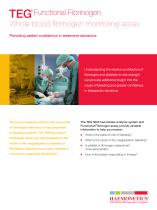
Whole blood fibrinogen monitoring assay Providing added confidence in treatment decisions Understanding the relative contribution of fibrinogen and platelets to clot strength can provide additional insight into the cause of bleeding and greater confidence in therapeutic decisions. There is increasing evidence that correction of fibrinogen deficiency is very important in bleeding patients. The TEG Functional Fibrinogen assay can help determine if the origin of the coagulopathy is platelets or fibrinogen, allowing you to tailor therapy to correct the underlying dysfunction. The TEG 5000 hemostasis analyzer system and Functional Fibrinogen assay provide valuable information to help you answer: ■■ What is the patient’s risk of bleeding? What is the cause of the coagulopathic bleeding? Is platelet or fibrinogen replacement more appropriate?
Open the catalog to page 1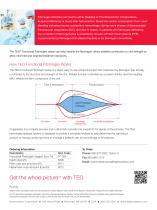
Fibrinogen disorders can lead to either bleeding or thromboembolic complications. Acquired deficiency is found after hemodilution, blood loss and/or consumption from major bleeding including trauma, postpartum hemorrhage, during some phases of disseminated intravascular coagulation (DIC), and also in sepsis. In patients with fibrinogen deficiency, the correction of fibrinogenemia is possible by infusion of fresh frozen plasma (FFP), cryoprecipitate (a fibrinogen-rich plasma fraction) or by fibrinogen concentrate. The TEG® Functional Fibrinogen assay can help identify the fibrinogen versus platelet...
Open the catalog to page 2All HAEMONETICS catalogs and technical brochures
 NexSys PCS
6 Pages
 PCS 2
PCS 24 Pages


Archived catalogs
 MCS®+ 9000
4 Pages
 Cell Saver® Elite® brochure
8 Pages
 cell saver Ellite+
8 Pages
 MCS+ 8150
4 Pages
 Introducing TEG 6s - White Paper
35 Pages
 TEG Plateletmapping Assay
2 Pages
 TEG Global Hemostasis Assay
2 Pages
 Blood Track
12 Pages
 SafeTrace Tx
4 Pages
 MCS®+8150
4 Pages
 Acrodose PL Systems
2 Pages
 EdgeBlood
4 Pages
 Cell Saver Elite
4 Pages
 MCS®+
MCS®+4 Pages
 TEG ® 5000
8 Pages
 ACP ® 215
4 Pages
 Donor Doc
4 Pages
 ElDorado Control
4 Pages
 Donor Doc Phlebotomy
2 Pages
 ElDorado Donor
4 Pages
 Surround
2 Pages
 OrthoPAT
4 Pages
 cardioPAT ®
8 Pages
 Cell Saver ® 5+
8 Pages
 EdgeCell
4 Pages
 Donor Doc Phlebotomy'
2 Pages
 eDonor
2 Pages


- Analysis software
- Sample preparation system
- Visualization software
- Automatic sample processor
- Laboratory software
- Benchtop sample preparation system
- Hospital software
- Treatment software
- Data management software
- Recording software
- Hemostasis analyzer
- Test software
- Automatic coagulometer
- Benchtop coagulometer
- Interpretation software
- Medical management system
- Hospital management system
- Compact sample preparation system
- Fibrinogen hemostasis analyzer
- Cytology sample processor