
- Catalogs
- Hamamatsu Photonics France
- ORCA®-Fusion


ORCA®-Fusion

ORCA®-Fusion
- Resolution: 2304 × 2304 pixels (5.3 Megapixels)
- Frame Rate: Up to 100 frames/s at 2304 × 2048 ROI
- Readout Noise: 0.7 electrons rms (Ultra quiet scan)
- Dynamic Range: 21,400:1
- Pixel Size: 6.5 μm × 6.5 μm
- Peak Quantum Efficiency: 80%
- Read Noise: Minimized through advanced design with different scan modes for noise reduction.
- Photo Response Non-Uniformity (PRNU): Calibrated to 0.06% for reliable intensity measurements.
- Dark Signal Non-Uniformity (DSNU): Measured at 0.06 electrons, crucial for low-light imaging accuracy.
- Linearity: Maintains high linearity (99.67% to 99.74%) across scan modes for accurate intensity representation.
Catalog excerpts
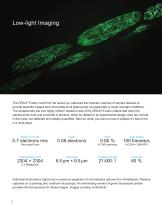
The ORCA®-Fusion, built from the sensor up, balances the complex nuances of camera features to provide beautiful images and robust data at all lights levels, but especially in tough low-light conditions. The exceptionally low and highly uniform readout noise of the ORCA®-Fusion means that when the sample emits even just a handful of photons, either by default or by experimental design, they are not lost in the noise, but detected and reliably quantified. After all, when you want to hear a whisper it’s best to be in a quiet place. READOUT NOISE DSNU Ultra quiet Scan HIGH SPEED HIGH RESOLUTION...
Open the catalog to page 2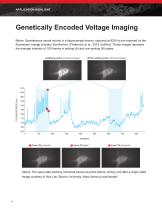
APPLICATION HIGHLIGHT Genetically Encoded Voltage Imaging Below: Spontaneous neural activity in a hippocampal neuron, captured at 828 Hz and reported by the fluorescent voltage indicator SomArchon, (Piatkevich et al., 2019, bioRxiv). These images represent the average intensity of 100 frames in spiking (A) and non-spiking (B) states. (A) Spiking window (100 frame average) (B) Non-spiking window (100 frame average) FRAMES 1 Frame 152 (pre-spike) Above: The same data showing individual frames at points before, during, and after a single spike. Image courtesy of Han Lab, Boston University. https://www.bu.edu/hanlab/...
Open the catalog to page 4
The Neural Activity Holy Grail Imaging neuronal activity using voltage sensitive indicators is a scientific quest that challenges the limits of neuroscience and compels advances in chemistry and protein engineering, as well as live animal, deep tissue, high speed and computational imaging. Scientists are making great progress in each of these areas and see a bright future for this burgeoning field (Please see the “References” below for a sampling of this work). A huge hurdle is finding imaging technology that can deliver the necessary speed, sensitivity and field of view, while also offering...
Open the catalog to page 5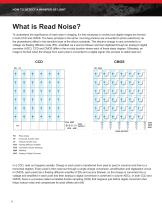
HOW TO DETECT A WHISPER OF LIGHT To understand the significance of read noise in imaging, it’s first necessary to review how digital images are formed in both CCD and CMOS. The basic principle is the same: incoming photons are converted to photo (electrons) via the photoelectric effect in the sensitive layer of the silicon substrate. This electron charge is next converted to a voltage via floating diffusion node (FD), amplified via a source follower and then digitized through an analog to digital converter (ADC). CCD and CMOS differ in the on-chip location where each of these steps happen. Ultimately,...
Open the catalog to page 6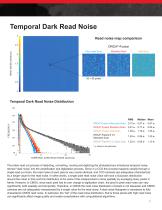
Temporal Dark Read Noise 3 Read noise map comparison READ NOISE (electrons) ORCA®-Fusion Ultra quiet Scan Standard Scan Fast Scan Temporal Dark Read Noise Distribution 106 105 Median Mean ORCA -Fusion Ultra quiet Scan ORCA®-Fusion Standard Scan ORCA®-Fusion Fast Scan TEMPORAL DARK READ NOISE (electrons) The entire read out process of detecting, converting, moving and digitizing the photoelectrons introduces temporal noise, termed “read noise” into the amplification and digitization process. Since in a CCD this process happens serially through a single read out chain, the read noise of each pixel...
Open the catalog to page 7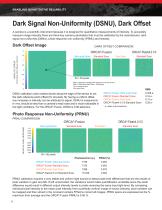
ENABLING QUANTITATIVE RELIABILITY Dark Signal Non-Uniformity (DSNU), Dark Offset A camera is a scientific instrument because it is designed for quantitative measurements of intensity. To accurately measure image intensity there are three key camera parameters that must be calibrated by the manufacturer: dark signal non-uniformity (DSNU), photo-response non-uniformity (PRNU) and linearity. Dark Offset Image DARK OFFSET COMPARISON ABSOLUTE ERROR (Pixel Signal / Mean Signal) (electrons) Ultra quiet Scan Standard Scan Standard Scan Mean subtracted averaged dark image from 20 000 frames 2000 × 2000...
Open the catalog to page 8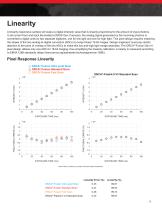
Linearity A linearly responsive camera will output a digital intensity value that is linearly proportional to the amount of input photons. In all current front and back illuminated sCMOS Gen II sensors, the analog signal generated by the incoming photons is converted to digital units by two separate digitizers, one for low light and one for high light. This pixel design requires matching the slopes of the two analog-to-digital converters (ADCs) to output linear 16 bit images. Design engineers must pay careful attention to the point of overlap of the two ADCs to make this low and high light merge...
Open the catalog to page 9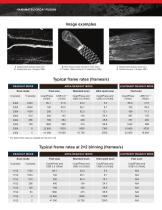
Image examples Typical frame rates (frames/s)
Open the catalog to page 10
Readout noise *1 Fast scan Standard scan Ultra quiet scan 1.4 electrons, rms 1.0 electrons, rms 0.7 electrons, rms Full well capacity *1 Dynamic range *1 Conversion factor *1 Cooling Temperature Forced-air cooled Water cooled Water cooled (Max cooling) -5 ˚C (Ambient temperature: +25 ˚C) -5 ˚C (Water temperature: +25 ˚C) Less than -15 ˚C *1, *4 Dark current *1, *5 Cooling temperature: -5 ˚C Cooling temperature: -15 ˚C Dark offset 0.5 electrons/pixel/s 0.2 electrons/pixel/s 100 counts Camera ORCA®-Fusion Digital CMOS camera Effective number of pixels 2304 (H) × 2304 (V) Dark signal non-uniformity...
Open the catalog to page 11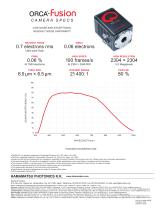
CAMERA SPECS LOW NOISE AND EXCEPTIONAL READOUT NOISE UNIFORMITY READOUT NOISE HIGH SPEED Ultra quiet Scan HIGH RESOLUTION PIXEL SIZE DYNAMIC RANGE QUANTUM EFFICIENCY (%) HAMAMATSUCAMERAS.COM ● DCAM-API is a registered trademark of Hamamatsu Photonics K.K. (EU, Japan, UK, USA). ● ORCA is a registered trademark of Hamamatsu Photonics K.K. (China, EU, Japan, UK, USA). ● Subject to local technical requirements and regulations, availability of products included in this brochure may vary. Please consult your local sales representative. ● The product described in this brochure is designed to meet the...
Open the catalog to page 12All Hamamatsu Photonics France catalogs and technical brochures
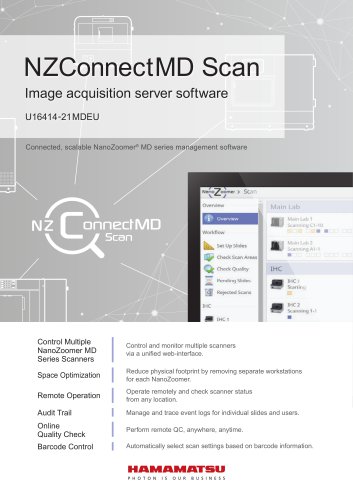 NZConnectMD Scan
3 Pages
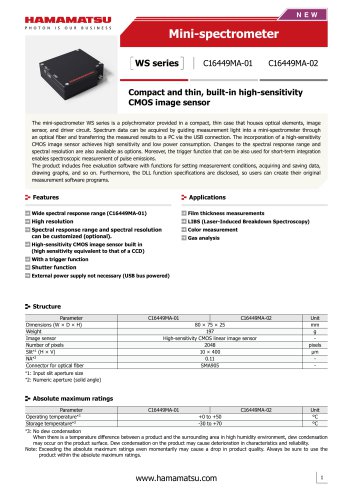 Mini-spectrometer
7 Pages
 ORCA-HALO
3 Pages
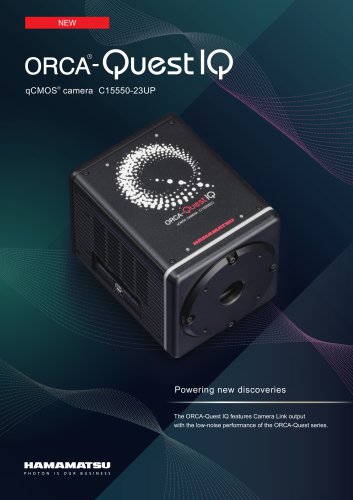 ORCA-QuestlQ
4 Pages
Archived catalogs
 TDI camera C10000-801
2 Pages
 X-ray TDI camera C12300-321
4 Pages
 ORCA-spark
2 Pages
 BT-CCD camera C8000-30
2 Pages
 ORCA Lightning
8 Pages
 digital CMOS camera C14130-20P
12 Pages
 ORCA-Fusion
28 Pages

- Analysis software
- Radiology software
- Visualization software
- Control software
- Windows software
- Laboratory software
- Camera with USB port
- Spectroscope
- Cloud-based software
- Diagnostic software
- Acquisition software
- Design software
- Medical camera
- Traceability software
- Capture software
- Web-based software
- Microscope camera
- Sharing software
- Server-based software