
- Catalogs
- Hamilton Process Analytics
- Laboratory Electrodes

Laboratory Electrodes

Laboratory Electrodes
Hamilton laboratory electrodes are known for their precision, durability, and performance in various applications. They are designed for GLP environments, featuring traceability with indelible serial numbers and certificates.
- Indelible serial numbers for traceability.
- Ergonomic design with a proven electrolyte sealing system.
- Leak-proof watering cap with screw lock.
- High-quality seal between electrode head and cable (IP 68).
This technology ensures precise and rapid readings with a patented liquid junction, preventing clogging and enhancing response and accuracy.
Suitable for the entire pH range (0-14) and temperature range (-10°C to 130°C), compatible with most organic solvents, and acrylamide-free.
Extends electrode life by maintaining stable reference potentials, even in aggressive media.
Offers "V" and "HF" type glass membranes for excellent mechanical stability and low resistance, suitable for low conductivity solutions and hydrofluoric acid processes.
Certified standards with patented composition, offering high accuracy and stability.
Stable for five years with closed-loop traceability, ensuring reliable calibrations.
Wide range of electrodes for various applications, each designed with specific features for different sample types and conditions.
Hamilton electrodes provide reliable, accurate, and durable solutions for a wide range of electrochemical measurements, supported by innovative technologies and rigorous quality standards.
- Gel-Glass™: pH range 0-14, temperature 0-60°C, plastic shaft, maintenance-free Polisolve electrolyte, S7 connector.
- BioTrode™: Designed for small volume measurements, stable Everef system, 3 mm shaft diameter.
- MiniTrode™: pH range 0-14, temperature 0-100°C, glass shaft, refillable Protelyte electrolyte, S7 connector.
- SpinTrode™: Flat membrane for surface measurements, robust plastic shaft, ring diaphragm.
- FlaTrode™: pH range 0-14, temperature 0-100°C, glass shaft, refillable 3M KCl electrolyte.
- FoodTrode™: For protein media, easy to clean, stable Everef system.
- Double Pore™: Maintenance-free, pointed tip for solid samples, prevents clogging.
- Polyplast™ Family: Robust, maintenance-free, suitable for water and sewage, plastic shaft.
- TipTrode™: Refillable, pointed tip for solid samples, stable Everef system.
- Cables: Various lengths and connector types (BNC, DIN, Lemo).
- Cleaning Solutions: Includes solutions A, B, and a storage solution for maintenance.
- Electrolytes: Various types including 3M KCl and Protelyte, available in different volumes.
- Traceability: Ensures accuracy with DAkkS certification.
- Duracal Buffers: pH stability up to 5 years, certified by DAkkS.
- Patented standards with long-term stability and certified accuracy.
The measurement cell is accredited to a conductivity of 0.9 μS/cm, with consistent accuracy confirmed by DFM and NIST. Measurements trace back to SI units, with standards tested on precise apparatus.
Hamilton standards remain stable for up to 3 years, with calibration certificates available online. Bottles can remain open for 60 minutes, with clear expiration dates.
Lists various conductivity standards with values, accuracy, stability, and packaging details.
Explains the construction and function of pH electrodes, emphasizing calibration and temperature compensation.
Guidelines include ensuring the electrolyte plug is open, proper immersion, and rinsing with deionized water. Calibration should use fresh buffer solutions, and electrodes should be stored in Hamilton storage solution.
Highlights issues such as contaminated buffer solutions, defective electrodes, and temperature differences, with recommendations for proper handling and storage.
- Product Listings: Lists various models of pH meters and electrodes with specific reference numbers and connection types.
- Compatibility Information: Indicates compatibility between electrodes and meters, advising users to contact suppliers for unlisted connections.
- Accessories and Components: Includes an index of accessories and components such as BNC plugs, calibration solutions, and various electrodes.
- Specifications and Standards: Provides detailed specifications for different electrode types and mentions standards like DAkkS and NIST.
- Contact Information: Provides contact details for Hamilton representatives and notes on trademark ownership.
- Electrode Selection: Includes a table to assist users in choosing the appropriate electrode for their application.
- Calibration and Maintenance: Provides recommendations for calibration, cleaning, and storage to ensure accurate measurements and prolong equipment lifespan.
- Traceability and Certification: Emphasizes traceability and the use of certified reference materials for accuracy and compliance.
Catalog excerpts
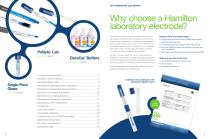
Why choose a Hamilton laboratory electrode? Hamilton electrodes are precision instruments known for high quality, long lifetime and remarkable performance in a wide range of applications. The sensors are designed to help you with the daily work in GLP environments. Due to the indelible serial number on the sensor and a certificate with serial number and the measured millivolt values for your documentation, traceability is guaranteed. Hamilton can also supply the most accurate laboratory electrode in the market. Our Single Pore Glass was tested by PTB (Physikalisch-Technische Bundesanstalt, Germany)...
Open the catalog to page 2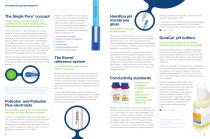
The Single Pore® concept Precise, reliable and rapid readings with a patented liquid junction ensuring optimal contact between electrolyte and sample Since its introduction in 1991, the Single Pore concept continues to prove its reliability. Instead of the many tiny pores in a ceramic diaphragm, a Single Pore about 200 times larger in cross-section (in the form of a capillary) ensures reliable contact to the sample. This Single Pore is practically impossible to clog. In combination with a dedicated electrolyte, the flow rate through the pore is defined, resulting in enhanced contact between the...
Open the catalog to page 3
Polyplast Family Polilyte Family Liq-Glass Family Electrode Liq-Glass Temp BNC/Cinch 242055 9 Liq-Glass Temp Lemo 242054 9 Polilyte Lab Temp BNC/Cinch 242059 10 Polilyte Lab Temp Lemo 242062 10 Polyplast Temp BNC/Cinch 242051 18 Polyplast Temp Lemo 242052 18 Single Pore Glass 238160 9 Crème fraîche, milk, cream *For samples containing protein (P), replace the electrolyte 3 M KCI with the separately available electrolyte Protelyte Yeast fermentation solution Water, ultra-pure Viscous samples TRIS buffer Titration, non-aqueous Surfaces (e.g., leather, paper, skin, agar plates) Starch solution,...
Open the catalog to page 4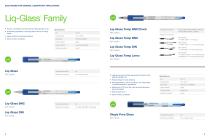
ELECTRODES FOR GENERAL LABORATORY APPLICATIONS ■ Robust, combination pH electrode for daily laboratory use ■ Universally applicable, in strong acids as well as in strong bases ■ Ideally suited for acid/base titrations ■ Serial number, certificate Shaft material Glass Liquid junction Ceramic diaphragm Reference system Everef Liq-Glass Temp BNC/Cinch REF 242055 Liq-Glass Temp BNC REF 242056 Liq-Glass Temp DIN REF 238406 Temperature sensor Electrical connection Liq-Glass Temp Lemo REF 242055 1m BNC cable/1 x cinch plug REF 242056 1m BNC cable / 1 x 4 mm banana plug REF 238406 1m DIN cable/1 x 4...
Open the catalog to page 5
Electrolyte Polisolve (maintenance-free) Shaft material Glass Shaft material Glass Polilyte Lab Family ■ Maintenance-free, robust, combination pH electrode that is easy to use ■ Universally applicable; well suited for measurements in emulsions and suspensions ■ Thanks to the Single Pore, clogging of the liquid junction is impossible ■ Serial number, certificate Liquid junction Single Pore Reference system Everef-B ■ Easy-to-clean, combination glass electrode with sleeve diaphragm ■ Ideally suited for viscous samples, ion-weak media or media containing protein (e.g., cosmetics) ■ For samples containing...
Open the catalog to page 6
■ Robust pH electrode with plastic shaft ■ Multiple applications, thanks to its flat membrane (e.g., for viscous media) ■ Easy to clean ■ The ring diaphragm prevents clogging ■ Serial number, certificate Electrolyte Polisolve (maintenance-free) Shaft material Plastic Liquid junction Ring diaphragm Reference system Everef ■ Combination pH electrode for measurements in very small volumes (e.g., microtiter plates) ■ Ideally suited for solutions containing protein as Protelyte prevents clogging of the diaphragm ■ Long-term stable Everef system ■ Requires an immersion depth of only 7 mm ■ Serial number,...
Open the catalog to page 7
■ Combination pH electrode for measurements in very small volumes, e.g. NMR tubes ■ Long-term stable Everef system ■ Requires an immersion depth of only 7 mm ■ Serial number, certificate Shaft material Glass Liquid junction Ceramic diaphragm Reference system Everef ■ Robust combination pH electrode for measurements in media containing proteins ■ 3 ceramic diaphragms guarantee quick and accurate measurements ■ Easy to clean ■ Long-term stable thanks to Everef system ■ Serial number, certificate Electrolyte Protelyte (refillable) Shaft material Glass Liquid junction 3 ceramic diaphragms Reference...
Open the catalog to page 8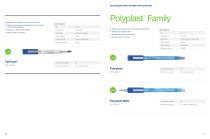
ELECTRODES FOR PORTABLE APPLICATIONS ■ Refillable combination pH puncture electrode ■ Pointed membrane tip, especially for use with solid and semisolid samples ■ Long-term, stable Everef system ■ Serial number, certificate Polyplast' Family Specifications pH 0 to 14 Electrolyte Protelyte (refillable) Shaft material Glass Liquid junction Ceramic diaphragm Reference system Everef ■ Robust maintenance-free, combination pH electrode ■ Shatter-proof plastic shaft ■ Excellent for water and sewage ■ Serial number, certificate Electrolyte Polisolve (maintenance-free) Shaft material Plastic Liquid junction...
Open the catalog to page 9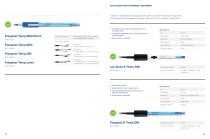
ELECTRODES FOR PORTAMESS® EQUIPMENT These “K” electrodes are especially well suited for Knick® Portamess® equipment. The electrode head creates a hermetic seal with the Portamess® storage tube. Polyplast Temp BNC/Cinch REF 242051 Polyplast Temp BNC REF 242050 Polyplast Temp DIN REF 238404 Polyplast Temp Lemo REF 242052 Temperature sensor ■ Combination electrode for daily laboratory use with glass shaft ■ Universally applicable, even in strong acids as well as strong bases ■ Serial number, certificate Electrical connection Shaft material Glass Ref 242051 1m BNC cable/1 x cinch plug Ref 242050...
Open the catalog to page 10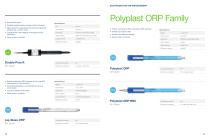
Electrolyte Polisolve (maintenance-free) Shaft material PEEK (high-performance plastic) ■ Robust PEEK shaft ■ Smallest possible surface sample contact with glass ■ Ideally suited for measurements of solid and semisolid samples (e.g., cheese, meat) ■ 2 Single Pores make clogging of the liquid junction impossible ■ Serial number, certificate Liquid junction 2 Single Pores Reference system Ag/AgCl Electrical connection 1m cable + DIN plug Polyplast ORP Family ■ Robust, maintenance-free, combination ORP electrode ■ Shatter-proof plastic shaft ■ Excellent for water and sewage ■ Serial number, certificate...
Open the catalog to page 11All Hamilton Process Analytics catalogs and technical brochures
 Conducell 4UHF VP 30
1 Page
 Conducell 4UPTF VP 30
1 Page
 Conducell 4USF VP 30
1 Page
 Conducell 4USF-VV
1 Page
 Arc Module Incyte-W SU
1 Page
 Arc Module Incyte-P SU
1 Page
 Incyte-P SU
1 Page
 CO₂NTROL RS485 425
2 Pages
 CO₂NTROL RS485 325
2 Pages
 CO₂NTROL RS485 225
2 Pages
 CO₂NTROL RS485 160
2 Pages
 VisiFerm DO SU Arc 225 C
2 Pages
 VisiFerm DO SU Arc 120 C
2 Pages
 VisiFerm mA 325 H3
2 Pages
 VisiFerm mA 225 H4
2 Pages
 VisiFerm mA 225 H3
2 Pages
 VisiFerm mA 160 H4
2 Pages
 VisiFerm mA 120 H4
2 Pages
 Conducell 4USF-VV
1 Page
 Incyte-P SU
1 Page
 CO₂NTROL RS485 120
2 Pages
 VisiFerm mA 120 H3
2 Pages

