
- Catalogs
- Hangzhou Bioer Techonology
- LineGene 9600


LineGene 9600

LineGene 9600
The document provides a detailed guide on the LineGene 9600 series, specifically the FQD-96A model, a fluorescence quantitative detection system used in fields like human genome engineering, forensic medicine, and clinical diagnostics. It is designed for PCR fluorescence quantitative detection.
The FQD-96A model is part of the LineGene series, with a maximum sample capacity of 96. It includes various ray filter packs for different detection needs. The series ranges from LineGene9620 to LineGene9680, with varying capabilities based on ray filters and photomultiplier configurations.
- Real-time PCR analysis with a fluorescence detection system.
- Applicable in diverse research and clinical fields.
- Includes various ray filter packs for enhanced detection capabilities.
The document addresses common questions about the product's application, calibration, and maintenance, covering topics like configuration, calibration procedures, Bluetooth and USB installation, and debugging common issues.
Guidelines for cleaning, maintenance, and proper placement of the instrument are provided to ensure optimal performance and longevity. Safety warnings are highlighted to prevent misuse.
Instructions on software installation, upgrading, and data management are included, ensuring effective operation and maintenance of the system's software components.
The document outlines communication accessories like RS232C, USB, and Bluetooth options, and details ray filter pack configurations. It also covers assembly variations affecting scanning and detection processes.
Recommendations for dye selection, rescanning times, computer configurations, and consumables are provided, emphasizing system compatibility.
The system complies with safety and electromagnetic compatibility standards, including IEC61010 and IEC61326, and is suitable for specific environmental conditions.
Technical features include ceramic porous semiconductor refrigerators for temperature control, a hot pipe radiator for efficient heat transfer, and an automatic hot-lid function for consistent pressure and temperature.
The hot-lid uses an electric heat film with a heat-sensitive fuse and features to prevent reagent evaporation and minimize air flow impact.
The system performs a self-check to ensure correct positioning of the photoelectric unit, preventing damage during shipping.
The instrument is secured with a stationary fixture during shipping, which must be removed before powering the system.
The instrument features a rocker switch for the main power supply and a button switch for internal power, indicating standby mode with a green lamp.
The FQD-96A uses Bioer’s bottom detection technology for short-distance bottom fluorescence detection.
A repeat mask prevents light interference between adjacent wells, ensuring proper heat conduction.
The software reports a "temperature control failure" if temperatures are outside the 0°C to 110°C range, triggering a red error lamp and stopping heating systems.
The instrument stops operation if ambient temperature exceeds 40°C, requiring cooldown before restarting.
A temperature switch ensures the drive circuit closes if overheating occurs, with automatic reset once cooled.
Indicates issues with the module lock or optic coupling, preventing hot-lid motor movement.
Upon failure detection, the system stops all control signals, with a red lamp and buzzer alerting the user.
Users can measure the best gain using amplification outcomes, saving parameters for optimal fluorescence signal detection.
Involves scanning row C with blue light to adjust module position, ensuring horizontal scanning.
Calibrated using high concentration reagents for accurate fluorescence signal detection.
Program upgrades do not affect calibration data stored in the CPU board's Flash memory.
Background calibration parameters restrict gain settings to ensure channel background values do not exceed 7000.
High concentration reagents and gain ratios are used to eliminate interference between channel dyes.
Correction parameters ensure temperature uniformity within specified limits.
The instrument can scan a single row for specific experiments, reducing detection time.
Access to system parameters requires a password, intended for manufacturer and technical support staff only.
Requires a password from the disc label, with upgrades performed via a communication interface box.
The OPEN key does not function while the instrument is running, as the hot-lid presses the test tube and module.
Details on hot-lid operation, prompt functions, and multi-instrument operation via USB, Bluetooth, or RC232C interfaces are provided.
Correction coefficients and data files are managed through the CPU board's FLASH memory, with exclusive coefficients for each instrument.
Configuration steps for Bluetooth devices and USB adapter boxes are provided, ensuring proper installation and operation.
Common issues and solutions are outlined, including electric hot-lid descent problems and communication failures.
Manual procedures for power failure, communication connection settings, and default control temperatures are provided.
Details on PCR principles, fluorescence probe FRET, baseline and threshold settings, and common issues like poor linear relation and low amplification efficiency are covered.
The document provides a comprehensive FAQ reference for the LineGene 9600, focusing on reagent application cases in various industries.
Explains the significance of the melting curve and Tm peaks in DNA analysis.
Addresses potential interference in dual-channel setups and software corrections.
Guidelines for using multi-channel dyes and potential amplification inhibition are provided.
Multiple reagent groups can be analyzed simultaneously if temperature parameters match.
Temporary cycle adjustments can be made using interface controls during operation.
Programs for relative quantification and SNP analysis are included.
Reports can be output in various formats for analytical purposes.
Parameters can be viewed but not modified during software operation.
Customized analysis parameters can be saved and loaded, requiring a password for import.
Users can add customized dyes by selecting appropriate ray filter channel wavelengths.
The software allows customization of sample data columns.
Recent use records can be accessed through the software's diary feature.
The software prompts maintenance after 1200 hours of use, to be performed by technical support staff.
Catalog excerpts
Caution: The document contains copyright protected and patented material. Without prior written consent from Hangzhou Bioer Technology Co., Ltd., any part of the manual shall not be duplicated, reproduced or translated into any other The information contained in this document is to help customer to understand the product quickly. The expressions are not complete or exclusive and can't be used as evidence. This document can't replace the users' manual of product. The information contained in this document might suffer negligence although it is checked. Since product and software keep updating, it can't be valid all the time. The information is for reference only. Hangzhou Bioer Technology Co., Ltd reserves the right for final explanation. The contents in this document might change without further notice. Please contact technical support person if there is any doubt on this document or 9600 series products Reference for Customer Flie Version: May Version: Hangzhou Bioer Technology Co., Ltd.
Open the catalog to page 1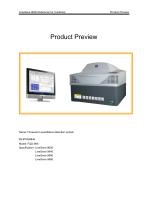
LineGene 9600 Reference for Customer Product Preview Product Preview Name: Florescent quantitative detection system
Open the catalog to page 2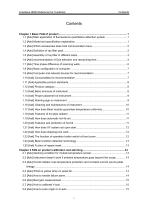
LineGene 9600 Reference for Customer 2.3 [Ask] Hot-lid radiator over-temperature protection and constant-current source plate
Open the catalog to page 3
LineGene 9600 Reference for Customer 2.10 [Ask] Why gain setting scope is restricted after background calibration parameter is
Open the catalog to page 4
LineGene 9600 Reference for Customer 5.23 [Ask] Why the first 3 cycles in amplification curves always accompanied with lift or fall39
Open the catalog to page 5
LineGene 9600 Reference for Customer
Open the catalog to page 6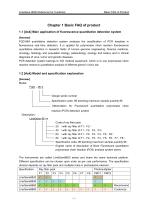
LineGene 9600 Reference for Customer Chapter 1 Basic FAQ of product 1.1 [Ask] Main application of fluorescence quantitative detection system FQD-96A quantitative detection system analyzes the amplification of PCR template in fuorescence real-time detection. It is applied for polymerase chain reaction fluorescence quantitative detection in research fields of human genome engineering, forensic medicine, oncology, histology and population biology, paleontology, zoology and botany and in clinical diagnosis of virus, tumor and genetic diseases. PCR detection system belongs to IVD medical equipment,...
Open the catalog to page 7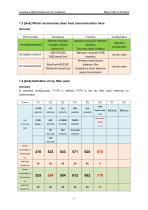
LineGene 9600 Reference for Customer 1.3 [Ask] Which accessories does host communication have
Open the catalog to page 8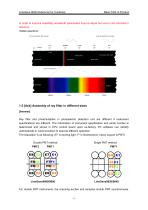
LineGene 9600 Reference for Customer In order to improve capability, wavelenth parameters may be adjust but user is not informed in Visible spectrum: Short wavelength (high energy) Long wavelength (low energy) scope of visible lights 1.5 [Ask] Assembly of ray filter in different sizes Ray filter and photomultiplier in photoelectric detection unit are different if instrument specifications are different. The information of instrument specification and serial number is determined and stored in CPU control board upon ex-factory. PC software can identify automatically in communication to execute...
Open the catalog to page 9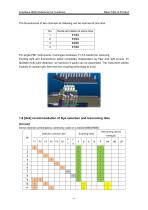
LineGene 9600 Reference for Customer The fluorescence of two channels as following can be scanned at one time.
Open the catalog to page 10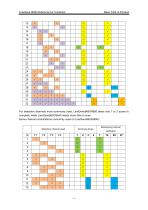
LineGene 9600 Reference for Customer
Open the catalog to page 11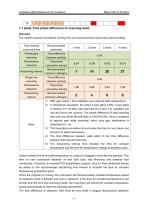
LineGene 9600 Reference for Customer It takes certain time for module temperature to conduct to reagent in test tube and stabilize. This time for heat conduction depends on test tube type, wall thickness and material heat conductivity. Therefore, to develop PCR amplification program, time for heat conduction should be added on the recommended rescanning time interval to consider the time for constant temperature at detection point. When the program is running, the instrument will forecast before constant temperature period on detection point is finished and scan in advance. If the time for constant...
Open the catalog to page 12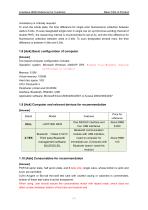
LineGene 9600 Reference for Customer consistency is critically required. To scan the whole plate, the time difference for single color fluorescence collection between wells is 5.04s. To scan designated single color in single row (or synchronous exciting channel of double PMT), the rescanning interval is recommended to set at 2s, and the time difference for fluorescence collection between wells is 0.48s. To scan designated several rows, the time 1.8 [Ask] Basic configuration of computer The lowest computer configuration includes: Operation system: Microsoft Windows 2000/XP SP2/ Windows Vista/Windows7...
Open the catalog to page 13
LineGene 9600 Reference for Customer 1.11 [Ask] Applicable product standards Safety standard: Volume I: General Requirements, Safety Requirements on Electrical Appliances in Measurement, Control and Laboratory (GB4793.1-2007) and 2-101 :Specilal Requirements of IVD Medical Grade Equipment, Safety Requirements on Electrical Appliances in Measurement, Control and Laboratory (YY 0648-2008/IEC 61010-2-101:2002). Safety standard: Safety Regulations for Electrical Measuring Instruments, Control Instruments Electromagnetic compatibility standard: IEC61326 Equipment category: category I (equipment category...
Open the catalog to page 14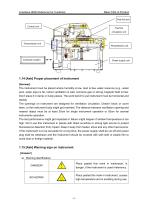
LineGene 9600 Reference for Customer Control unit Transmission unit Computer system lirculation unit Photoelectric unit Power supply unit 1.14 [Ask] Proper placement of instrument The instrument must be placed where humidity is low, dust is few, water resource (e.g., water pool, water pipe) is far, indoor ventilation is well, corrosive gas or strong magnetic field is free. Don't place it in damp or dusty places. The work bench to put instrument must be horizontal and The openings on instrument are designed for ventilation circulation. Doesn't block or cover them, or the instrument body might...
Open the catalog to page 15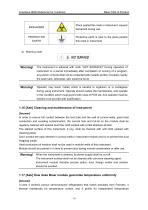
LineGene 9600 Reference for Customer Warning! The instrument is adhered with mark "HOT SURFACE!" During operation of instrument or a period immediately after completion of running of a program, any portion of body shall not be contacted with metallic portion (module) nearby the said mark; otherwise, skin would be burnt. Warning! Operator may touch matter which is baneful to organism or is contagious during using instrument. Operate should realize the harmfulness, and operate in the condition which must accord with rules of PCR lab. And operator must be trained or be provide with qualification....
Open the catalog to page 16All Hangzhou Bioer Techonology catalogs and technical brochures
 ESMgenepure
30 Pages
 Reagents Catalog 2009-2010
39 Pages


- Solvent reagent
- Molecular biology reagent
- Enzyme reagent
- Histology reagent
- Dye reagent kit
- Laboratory test tube
- Microtiter plate
- Laboratory bath
- Pipette tip
- Tissue reagent
- 96-well microplate
- PCR system
- Laboratory microplate
- DNA extraction reagent
- Benchtop laboratory bath
- Mobile health vehicle
- Benchtop water bath
- Heating laboratory bath
- Centrifuge sample tube