
- Catalogs
- Hangzhou Singclean Medical Products
- Singclean Peripheral Nerve Guide Brochure


Singclean Peripheral Nerve Guide Brochure
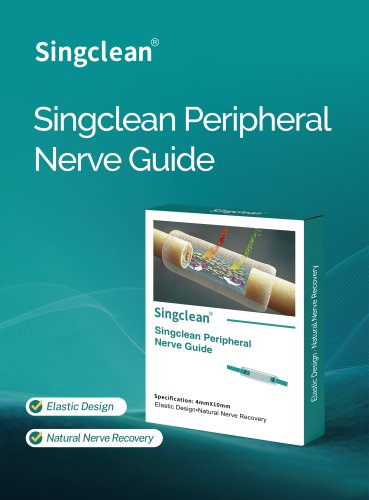
Singclean Peripheral Nerve Guide Brochure
Singclean® Peripheral Nerve Guide is a biocompatible, semi-permeable, absorbable chitosan tube designed for peripheral nerve repair. It provides a protective environment for axonal regrowth and is metabolically resorbed. It is suitable for nerve defects not exceeding 20 mm, with specifications ranging from 2mmX10mm to 6mmX10mm.
Traditional nerve repair methods face limitations, especially for defects greater than 5mm. The Singclean® guide offers a biomimetic microenvironment, serving as an alternative to autologous nerve grafting and promoting directed nerve regeneration.
The guide constructs a protective channel, creating an isolated regenerative microenvironment and providing directional guidance for axonal regeneration. It inhibits neuroma formation by restricting disorganized growth.
Made from chitin, the guide is fully degradable within 12 months, eliminating the need for a second surgery. It maintains elasticity when wet, is ready to use without rinsing, and offers high transparency for accurate suturing. It prevents neuroma formation and lifelong pain.
Studies show good repair effects and biocompatibility, with significant nerve fiber growth and healing observed. Local biological reactions post-implantation scored below irritation thresholds, indicating safety.
The guide's degradation rate aligns with nerve regeneration, maintaining shape and guiding nerve repair over three months.
Compared to other brands, Singclean® offers advantages such as being ready to use, maintaining strength when wet, and providing a microenvironment for nerve repair without the need for rinsing.
Preoperative preparation involves checking the guide's packaging and using it directly. The surgical procedure includes exposing the injured nerve, debriding nerve stumps, bridging with the conduit, inspecting, repositioning, and closing the incision.
Contraindications include severe organ decompensation, cachexia, pathological nerve injury, local infections, long-segment defects, certain patient demographics, and chitin allergies.
Catalog excerpts

Singclean Peripheral Nerve Guide Elastic Design Natural Nerve Recovery
Open the catalog to page 1
About Singclean® Peripheral Nerve Guide •Singclean® Peripheral Nerve Guide It is a biocompatible, semi-permeable, absorbable chitosan tube. It provides a protective environment across nerve discontinuities, as well as an isolated conduit environment guiding axonal regrowth, and is resorbed via normal metabolic pathways. •Indications This product is intended for the repair of peripheral nerves. The length of the nerve defect to be repaired does not exceed 20 mm.
Open the catalog to page 2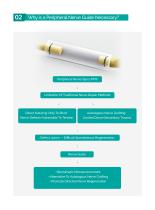
Why is a Peripheral Nerve Guide Necessary? Peripheral Nerve Injury (PNI) Limitation Of Traditional Nerve Repair Methods Direct Suturing: Only To Short Nerve Defects+Vulnerable To Tension Autologous Nerve Grafting: Limited Donor+Secondary Trauma Defect >5mm → Difficult Spontaneous Regeneration Nerve Guide →Biomimetic Microenvironment →Alternative To Autologous Nerve Grafting →Promote Directed Nerve Regen
Open the catalog to page 3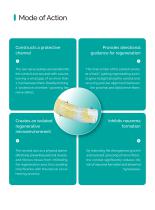
Constructs a protective channel Creates an isolated regenerative microenvironment The inner lumen of the conduit serves as a“track,” guiding regenerating axons to grow straight along the conduit and ensuring precise alignment between the proximal and distal nerve fibers. Inhibits neuroma formation >> The conduit acts as a physical barrier, effectively preventing external muscle and f ibrous tissue from infiltrating the regeneration area, thus avoiding interference with the natural nerve healing process. >> The two nerve stumps are inserted into the conduit and secured with sutures, leaving a...
Open the catalog to page 4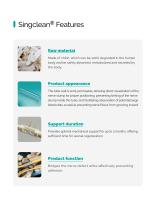
Singclean® Features Raw material Made of chitin, which can be 100% degraded in the human body and be safely absorbed, metabolized and excreted by the body. Product appearance The tube wall is semi-permeable, allowing direct visualization of the nerve stump for proper positioning, preventing kinking of the nerve stump inside the tube, and facilitating observation of potential large blood clots, as well as preventing nerve f ibers from growing inward. Support duration Provides optimal mechanical support for up to 3 months, offering sufficient time for axonal regeneration. Product function Bridges...
Open the catalog to page 5
Singclean® Advantages
Open the catalog to page 6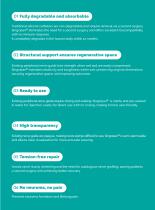
01 Fully degradable and absorbable Traditional silicone catheters are non-degradable and require removal via a second surgery. Singclean® eliminates the need for a second surgery and offers excellent biocompatibility with no immune response. It completely degrades in the human body within 12 months. 02 Structural support ensures regenerative space Existing peripheral nerve guide lose strength when wet and are easily compressed. Singclean® maintains elasticity and toughness when wet, preserving original dimensions, securing regenerative space, and improving outcomes. 03 Ready to use Existing peripheral...
Open the catalog to page 7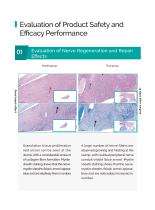
Evaluation of Product Safety and Efficacy Performance 01 Evaluation of Nerve Regeneration and Repair Effects Model group Test group 14 days after surgrey Good repair effect Granulation tissue proliferation (red arrow) can be seen at the stump, with a considerable amount of collagen fiber formation. Myelin sheath staining shows that the nerve myelin sheaths (black arrow) appear blue and are relatively few in number. A large number of nerve f ibers are observed growing and healing at the stump, with residual peripheral nerve conduit visible (blue arrow). Myelin sheath staining shows that the nerve...
Open the catalog to page 8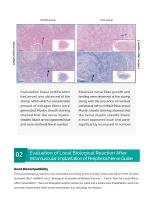
Model group Test group 3 months after surgery Good repair effect Granulation tissue proliferation (red arrow) was observed at the stump, within which a considerable amount of collagen fibers were generated. Myelin sheath staining showed that the nerve myelin sheaths (black arrow) appeared blue and were relatively few in number. Extensive nerve fiber growth and healing were observed at the stump, along with the presence of residual peripheral nerve conduit (blue arrow). Myelin sheath staining showed that the nerve myelin sheaths (black arrow) appeared blue and were significantly increased in number....
Open the catalog to page 9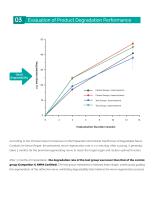
Evaluation of Product Degradation Performance Degradation Rate (%) Good Degradability Test Group 1 (2mmx10mm) Test Group 2 (4mmx10mm) Implantation Duration (weeks) According to the Chinese Expert Consensus on the Preparation and Clinical Trial Process of Degradable Nerve Conduits for Nerve Repair, the peripheral nerve regeneration rate is 1–2 mm/day. After suturing, it generally takes 3 months for the proximal regenerating nerve to reach the target organ and restore optimal function. After 3 months of implantation, the degradation rate of the test group was lower than that of the control group...
Open the catalog to page 11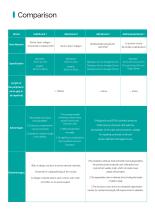
3.The structure is soft, and as an orthopedic regeneration conduit, its mechanical strength still requires time for validation.
Open the catalog to page 12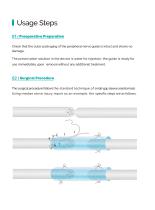
Usage Steps 01 / Preoperative Preparation Check that the outer packaging of the peripheral nerve guide is intact and shows no damage. The preservation solution in the device is water for injection; the guide is ready for use immediately upon removal without any additional treatment. 02 / Surgical Procedure The surgical procedure follows the standard technique of small-gap sleeve anastomosis. Using median nerve injury repair as an example, the specific steps are as follows:
Open the catalog to page 14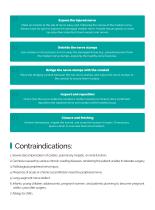
Expose the injured nerve Make an incision at the site of nerve injury and, following the course of the median nerve, dissect layer by layer to expose the damaged median nerve. Handle tissues gently to avoid injuring other important blood vessels and nerves. Debride the nerve stumps Use a blade or microscissors to trim away the damaged tissue (e.g., pseudoneuroma) from the median nerve stumps, exposing the healthy nerve fascicles. Bridge the nerve stumps with the conduit Place the bridging conduit between the two nerve stumps, and suture the nerve stumps to the conduit to secure them in place....
Open the catalog to page 15
•Elastic Design •Natural Nerve Recovery Add: No.125(E), 10th Street, Hangzhou Qiantang Area, Zhejiang, China P.c.: 310018 E-mail: [email protected] www.singclean.net
Open the catalog to page 16All Hangzhou Singclean Medical Products catalogs and technical brochures
 SKformula Skincare Brochure
20 Pages
 Singclean Company
22 Pages
 Singfiller HA Filler Brochure
12 Pages
 Singderm Catalog
20 Pages
 SKformula PDRN
1 Page
 Singderm PLLA
4 Pages
 Singjoint
6 Pages
 IVD Catalogue OTK001
6 Pages
 BV Combo Test Kit BV001
2 Pages
 Singclean HBsAg Test Kit HBV001
10 Pages




- Singclean Medical test kit
- Singclean Medical blood test kit
- Singclean Medical serum test kit
- Singclean Medical immunoassay test kit
- Rapid chromatographic immunoassay test
- Singclean Medical plasma test kit
- Blood rapid screening test
- Cassette rapid test
- Immunoassay rapid diagnostic test
- Singclean Medical infectious disease test kit
- Syringe
- Rapid plasma test
- Wound care
- Molecular detection kit
- Medical kit
- Whole blood detection kit
- Singclean Medical respiratory disease test kit
- Optical test kit
- Singclean Medical clinical test kit
- Singclean Medical cassette test kit