


HI4114

HI4114
The Hanna HI 4014 and HI 4114 are ion selective electrodes designed for measuring potassium ions in aqueous solutions. The HI 4014 is a half-cell electrode requiring a separate reference, while the HI 4114 is a combination electrode with an integrated reference.
Specifications
These electrodes utilize a PVC membrane with an organic ion exchanger to measure potassium ions. They operate within a measurement range of 1M to 1x10⁻⁶M, at temperatures from 0-40°C, and a pH range of 1.5 to 12.0. They require the absence of organic solvents and cationic detergents.
Theory of Operation
The electrodes function as potentiometric devices for rapid determination of free potassium ions. The HI 4014 requires a separate reference electrode, while the HI 4114 includes one. The PVC membrane is impregnated with valinomycin, which encloses the ion and allows it to diffuse through the membrane, creating a voltage proportional to the potassium ion concentration.
Equipment Required
The HI 4014 requires a Hanna HI 5315 Double Junction reference electrode and a suitable ion or pH/mV meter. Additional equipment includes a magnetic stirrer, electrode holder, and plastic beakers.
Solutions Required
Potassium measurements require a 0.1 M potassium standard and an Ionic Strength Adjuster. Standards with concentrations below 10-3 M should be prepared daily.
Design Elements
The electrodes consist of a sensor handle, sensing module, and various components like O-rings and ceramic junctions. Proper assembly and maintenance are crucial for optimal performance.
General Guidelines
Ensure proper assembly, avoid temperature shocks, and maintain consistent ionic strength and temperature during calibration and measurement. Rinse electrodes between samples and avoid rubbing membranes.
Electrode Preparation
For HI 4014, assemble the sensor handle and module, ensuring no air pockets. For HI 4114, unwrap the Parafilm seal, assemble the electrode, and fill with solution.
Direct Calibration and Measurement
Calibrate the meter with standards and measure unknowns directly. Use freshly prepared standards and ensure consistent conditions.
Storage and Care
Store electrodes in dilute standards for short periods and disassemble for long-term storage. Avoid high temperatures and refrigerate modules to extend their lifespan.
Warranty
Hanna Instruments warrants the electrodes to be free of defects for six months from the purchase date, provided they are used and maintained as instructed.
Catalog excerpts
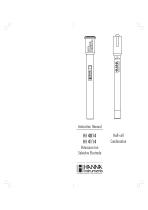
SENSOR HANDLE Instruction Manual Half-cell Combination HI 4014 HI 4114 Potassium Ion Selective Electrode
Open the catalog to page 1
Potassium HI 4014 Potassium half-cell Potassium HI 4114 Potassium combination electrode I. Introduction The Hanna HI 4014 and HI4114 are ion selective electrodes designed for the measurement of potassium ions in aqueous solutions. They utilize a replaceable sensing module that contains an organic polymer membrane that is sensitive to potassium. HI 4014 is a half-cell electrode that requires a separate reference. HI 4114 is a combination ion selective electrode. II. II Specifications Type: PVC membrane with organic ion exchanger Potassium (K+) 1M to 1X 10⁻⁶M 39100 to 0.039ppm Ion measured: Measurement...
Open the catalog to page 2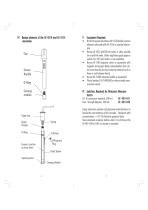
IV. Design elements of the HI 4014 and HI 4114 electrodes Sensor Handle O-Ring Sensing module V. Equipment Required: • HI 4014 requires the Hanna HI 5315 Double Junction reference electrode with HI 7076 as external electrolyte. • Hanna HI 4222 pH/ISE/mV meter or other suitable ion or pH/mV meter. (Note: log/linear graph paper is useful if an ISE (ion) meter is not available). • Hanna HI 180 magnetic stirrer or equivalent with magnetic stirring bars (Note: Isolate beakers from stirrer motor heat by placing insulating material such as foam or cork between them). • Hanna HI 76404 electrode holder...
Open the catalog to page 3
VII. VII General Guidelines • Ensure the o-ring is installed on modules before screwing into the sensor handle or inner stem. Due to shipping or storage the internal solution inside the sensing modules may have developed an air pocket near the membrane. Gently shaking the sensor down (like the old style mercury thermometers) will place the internal solution next to the membrane. Presoaking the potassium sensor in a 10-2 M standard for at least half-hour before calibration will help to optimize the sensor response. Calibration standards and sample solutions should have the same ionic strength....
Open the catalog to page 4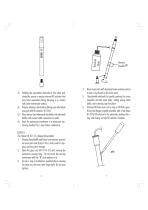
Deionized Water SENSOR HANDLE 3) Holding the assembled electrode at the cable end, shake the sensor to ensure internal fill solution that may have separated during shipping is in contact with inner membrane surface. 4) Prepare reference electrode by filling outer electrolyte reservoir with fill solution HI 7076. 5) Place sensor (and reference) electrodes into electrode holder and connect cable connectors to meter. 6) Soak the potassium membrane in a potassium containing standard for a hour before calibration. 4. Rinse inner stem with deionized water making certain to wet o-ring found on the inner...
Open the catalog to page 5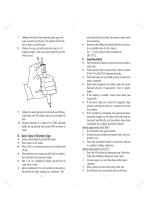
HI 4114 IUM POTASS TION NA COMBI 7. Holding the body of the electrode gently press the upper cap with your thumb. This permits the fill solution to drain out of the body. 8. Release the cap and verify electrode returns to its original position. (You may need to gently assist for this to occur). 9. Tighten the electrode cap onto the body and fill electrode body until fill solution volume is just below fill hole. 10. Position electrode in a Hanna HI 76404 electrode holder (or equivalent) and connect BNC connector to meter. IX. • • • Quick Check of Electrode Slope Connect electrode(s) to pH/mV/ISE...
Open the catalog to page 6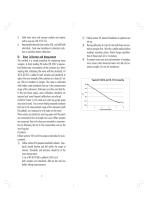
XI Direct Calibration and Measurement XI. This method is a simple procedure for measuring many samples. A direct reading ISE meter (HI 4222 or equivalent) determines concentration of the unknown by a direct reading after calibrating the meter with the standards. HI 4014-00 ISE is added to both samples and standards to adjust the ionic strength of the solutions at a dose of 2 mL per 100 mL standard or sample. The meter is calibrated with freshly made standards that are in the measurement range of the unknowns. Unknowns are then read directly. In the non-linear region, more calibration standards...
Open the catalog to page 7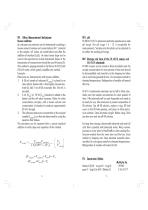
Techniques XII. Other Measurement Techniques Known addition An unknown concentration can be determined by adding a known amount (volume and concentration) of K+ standard to the sample. mV values are noted before and after the addition of standard (∆E). An ideal sensor slope can be used in the equation but actual determined slopes at the temperature of measurement should be used if known (S). This method is preprogrammed in the Hanna HI 4222 pH/ ISE/mV meter, which greatly simplifies the method . Example: Potassium ion determination with known addition. 1. A 50 mL sample of unknown (VSAMPLE) is...
Open the catalog to page 8
WARRANTY Hanna Instruments Ion Selective Electrodes are warranted to be free of defects in material and workmanship for 6 months from date of purchase when used for their intended purpose and maintained according to instructions. If they fail to work when first used contact your dealer immediately. Damage due to accidents, misuse, misapplication, tampering or lack of prescribed maintenance is not covered. Hanna Instruments reserves the right to modify the design, construction or appearance of its products without advance notice.
Open the catalog to page 9All HANNA Instruments catalogs and technical brochures
 HI 3850
1 Page
 HI98103
2 Pages
 HI99181
20 Pages
 HI701
HI7012 Pages
 edge® pH•EC•DO
76 Pages
Archived catalogs
 HI 9125N Portable pH Meter
4 Pages
 HI84500
6 Pages
 HI84502
6 Pages
 General Catalog
772 Pages
 HI99151
4 Pages
 HI99191
4 Pages
 edge® dedicated Brochure
8 Pages
 Professional Waterproof Meters
12 Pages
 HI2202 edge blu
8 Pages
 HI5000 Series Benchtop Meters
12 Pages
 Hanna Titration Catalog
40 Pages
 edge pH EC DO Brochure
8 Pages
 HI98129
2 Pages


- Detection kit
- Solvent reagent
- Laboratory reagent
- Laboratory agitator
- Optical test kit
- Dye reagent kit
- Benchtop laboratory agitator
- Digital thermometer
- Buffer solution reagent
- Quality control reagent
- Laboratory testing system
- Digital laboratory agitator
- Temperature sensor
- Straight electrode
- Research detection kit
- Electrolyte reagent
- Magnetic laboratory shaker
- Gas sensor
- Spectrophotometer