

HasomeD RehaCom®
HasomeD RehaCom®
RehaCom® is a certified medical device designed for cognitive function therapy, supported by over 35 years of scientific research. It is recognized by major neurological and occupational therapy associations in Germany.
RehaCom® provides targeted cognitive training for impairments in attention, memory, and executive functions. It offers standardized tasks with performance-specific feedback, adaptable to user needs.
The online version allows for flexible, device-independent training. It is cloud-based, requires no local installation, and complies with data protection regulations. It supports multilingual training and customizable plans.
- Attention: Includes training for alertness, reaction behavior, and divided attention.
- Memory: Covers working memory, memory strategy training, and verbal memory.
- Executive Functions: Focuses on logical reasoning and planning tasks.
- Visual Field & Neglect: Offers saccadic and restoration training.
- Visuo-Motor Coordination: Enhances coordination through specific exercises.
RehaCom® provides screenings for various cognitive disturbances, allowing for tailored therapy approaches based on impairment severity.
RehaCom® is accessible on multiple devices and supports a wide range of languages, making it suitable for diverse patient populations. It is user-friendly for both therapists and patients, facilitating home training and progress monitoring.
- Vigilance 2 Training: Enhances long-term attention during monotonous tasks.
- Sustained Attention Training: Maintains attention with high stimulus frequency.
- Selective Attention Training: Improves visual information analysis.
- Divided Attention Training: Trains simultaneous observation of multiple stimuli.
- Spatial Operations Training: Trains spatial perception and memory.
- Memory Training: Addresses memory impairments post-brain damage or psychiatric illness.
- Logical Reasoning: Enhances reasoning skills through logical series and category sorting.
- Shopping: Teaches action planning and monitoring through a simulated shopping experience.
- Plan a Vacation: Improves problem analysis and planning abilities.
- Calculations: Focuses on basic arithmetic skills and money handling.
- Saccadic Training: Therapy for visual field impairments by training large gaze jumps.
- Restoration Training: Supports neuroplastic changes for visual field defects.
- Alertness: Measures reaction times to stimuli.
- Selective Attention: Evaluates response to relevant stimuli.
- Divided Attention: Assesses ability to divide attention between stimuli.
- Working Memory: Assesses visual-spatial memory span.
RehaCom® can be used for home training, allowing clients to continue rehabilitation independently or under supervision. Therapists can monitor progress and adjust plans as needed.
RehaCom® requires specific hardware and software configurations for both classic and online versions.
RehaCom® is supported by a network of global distribution partners and scientific collaborators.
The RehaCom® system offers comprehensive tools for cognitive assessment and rehabilitation, suitable for clinical and home settings. Its modules are continuously updated with input from a neuropsychological advisory board.
Catalog excerpts
Visit our HASOMED YouTube channel and watch ‘RehaCom® Introduction’ About RehaCom® RehaCom® is a certified medical device Cognitive training with RehaCom® Overview of modules and screenings Therapy Modules Attention Memory Executive Functions Visual field & Neglect Visuo-Motor coordination Screenings Partners Home Training for Patients System Requirements RehaCom® Software and Accessories Keyboard Layout Global Distribution Pa
Open the catalog to page 2
About RehaCom® RehaCom® is a certified medical device RehaCom® is a certified medical device. Our software has been developed by therapists for therapists for more than 35 years. Prof. Regel laid the foundation in 1986 with his initial research in the field of attention. Since then, the effectiveness of RehaCom® has been examined in over 100 scientific publications and numerous unpublished university studies. This makes RehaCom® the software with the most evidence of effectiveness in cognitive function therapy. Thanks to the numerous proofs of effectiveness, RehaCom® has contributed to PC-based...
Open the catalog to page 3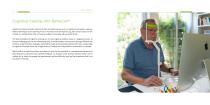
About RehaCom® Cognitive training with RehaCom® Cognitive functions include mental activities and performances such as attention, perception, memory, abstract thinking or action planning. If one or more functions are impaired, e.g. after a brain injury or in the context of a mental illness, this can lead to problems in everyday life, work and family. The basic principles of cognitive training are: to train cognitive problem areas in a targeted manner, to choose challenging, but not over-demanding tasks, to avoid boredom and monotony through different task contents, to teach solution strategies...
Open the catalog to page 4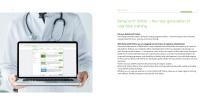
About RehaCom® RehaCom® Online – the new generation of cognitive training Discover RehaCom® Online: The leading computer-based training for treating cognitive deficits – evidence-based, tried and tested, and optimised for clinics, practices and home training. With RehaCom® Online, you are stepping into the future of cognitive rehabilitation: The proven effectiveness of RehaCom® is now combined with the flexibility and simplicity of a web-based platform. Without any installation effort and independent of devices, therapists and patients can train directly via their browser – in the practice, clinic...
Open the catalog to page 5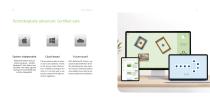
About RehaCom® Technologically advanced. Certified safe. RehaCom® Online works on almost any device – whether Windows PC, Mac, iPad or Android tablet. This makes cognitive training even more flexible and location-independent. The new solution does not require any local installation. Thanks to the secure cloud infrastructure, certified according to ISO 27001, it is not only easy to use but also compliant with data protection regulations. With RehaCom® Online, you automatically benefit from all further developments. New modules, functions and improvements are available to you directly without any...
Open the catalog to page 6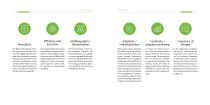
About RshaCom® About RshaCom® SOdD Modularity Multilingualism / Dissemination Adaptivity / Individualisation Continuity / progress monitoring The RehaCom® therapy modules can be used to train the most important cognitive performance areas such as attention, memory functions, executive performance and visual performance. More complex performances such as action planning and strategy formation are carried out in scenarios that are close to everyday life. At the beginning of the training it is important to agree with the client on the training goal. Many clients can work with RehaCom® largely independently....
Open the catalog to page 7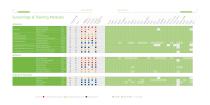
About RshaCom® About RshaCom® Screenings & Training Modules Attention Alertness Executive Function Disturbance: strongly to moderately pronounced A moderately to weakly pronounced weakly pronounced
Open the catalog to page 8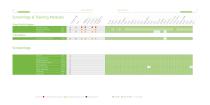
About RshaCom® About RshaCom® Screenings & Training ModulesVisual field & Neglect Visuo-Motor Visuo-Motor Coordination Disturbance: strongly to moderately pronounced A moderately to weakly pronounced weakly pronounced ^available ^Bpartly available not available
Open the catalog to page 9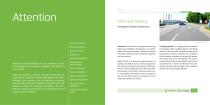
Alertness training Training tonic and phasic responsiveness. RehaCom® Online Alertness training Reaction behaviour Responsiveness Vigilance 2 Sustained Attention Attention deficit disorders are very common in both neurological and psychiatric patients and affect all areas of life. Attention and Concentration Divided Attention Divided Attention 2 While we assume a uniform concept in everyday life and speak of „attention“, science distinguishes between different sub-functions, such as alertness, sustained attention and selective attention. Depending on the disease or where the damage is located...
Open the catalog to page 10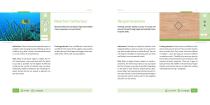
Reaction behaviour Reaction behaviour training for single and multiple choice responses to visual stimuli. Training reaction speed accuracy to visual and acoustic stimuli through single and multiple choice response tasks. RehaCom® Online RehaCom® Online Indications: Clients with reaction speed disorders or problems with changing reactions flexibly as well as inhibition (e.g., after a stroke, craniocerebral trauma or in the context of mental illness). Task: When a particular object is visible, the client should press a key associated with the object as quickly as possible. As the degree of difficulty...
Open the catalog to page 11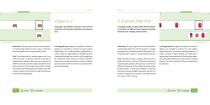
RehaCom® Online Vigilance 2 Training for the ability to maintain one's level of attention in the long term despite a monotonous task. Sustained Attention Training the ability to maintain the level of attention in the face of high stimulus frequency and high demands over a longer period of time. Indications: This training is for clients with problems in maintaining attention even when no relevant stimulus appears for a longer period of time. Task: The clients work as „quality supervisors" on a production line in a factory. They have the task of comparing the products that pass by on the belt at...
Open the catalog to page 12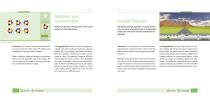
Divided Attention Selective attention training works on the exact analysis of visual information. The ability to divide attention is trained. Several items of visual information have to be observed at the same time and irrelevant information disregarded. Training material: A total of 77 sets of images were created, each with 16 coloured illustrations. Specific objects (e.g., fruit, animals), (optionally selectable) geometric shapes or letters and numbers are depicted on them. The adaptive change of difficulty ensures that the client is neither over-challenged nor under-challenged. A total of...
Open the catalog to page 13All HASOMED catalogs and technical brochures
- Electric stimulator
- Reporting software
- Diagnostic software
- Online software
- Hospital software
- Treatment software
- Data management software
- Training software
- Web-based software
- Medical software on site
- Evaluation software
- Screening software
- Telehealth software
- Physiotherapy software
- Neurological software
- Telemonitoring software
- Home care software
- SaaS software
- Telerehabilitation software