
- Catalogs
- Hayek Medical
- Hayek SCS

Hayek SCS

Hayek SCS
Introduction
This document discusses High Frequency Assisted Airway Clearance (HFAAC) techniques used in respiratory care to improve mucus clearance in patients with airway clearance difficulties.
Specifications and Mechanisms
HFAAC involves the application of high-frequency oscillations to the airway to mobilize secretions. The frequencies typically range from 5 to 25 Hz, which help loosen mucus by creating shear forces and enhancing mucociliary transport.
Procedures
The technique can be delivered via devices such as high-frequency chest wall oscillation (HFCWO) vests or intrapulmonary percussive ventilation (IPV). Treatment sessions usually last between 15 to 30 minutes, with frequency and duration tailored to patient tolerance and clinical response.
Standards and Recommendations
Clinical guidelines recommend HFAAC as an adjunct to conventional airway clearance methods, especially in patients with cystic fibrosis, bronchiectasis, or neuromuscular disorders. Proper device calibration and patient monitoring are critical to ensure efficacy and safety.
Limitations and Contraindications
Contraindications include recent thoracic surgery, unstable cardiovascular status, or active hemoptysis. Limitations involve patient compliance and potential discomfort during therapy.
Summary of Key Parameters
- Frequency range: 5-25 Hz
- Session duration: 15-30 minutes
- Devices: HFCWO vests, IPV devices
- Indications: cystic fibrosis, bronchiectasis, neuromuscular disease
- Contraindications: recent surgery, unstable cardiovascular conditions
Best Practices
Ensure individualized treatment plans, monitor patient response, and combine HFAAC with other airway clearance techniques for optimal outcomes.
Catalog excerpts
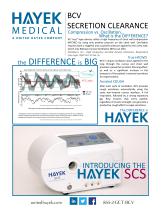
A UNITED HAYEK COMPANY SECRETION CLEARANCE All "vest"-type devices utilize a high frequency of chest wall compression (HFCWC) by using only positive pressure on the chest wall. Oscillation requires both a negative and a positive pressure applied to the chest wall, which only Biphasic Cuirass Ventilation (BCV) can offer. (Chatburn, R.L.. High Frequency Assisted Airway Clearance, Respiratory HIGH FREQUENCY OSCILLATION OF THE AIRWAY AND CHEST WALL I-ins J. Mahhici.Lr \1. Iliiih I MJNITK-} Ov/iLil;™ of\\w ,\irwa> ami CIL.I Willi. Ktspiv iiiic 2ll(E; 4?(?):7<I7-MI7 Flow (upper curve) and airway pressure and esophageal pressure (lower curve) "Utilizing the AARC Clinical Practice Guidelines as a framework for developing protocols for use, and defining desirable end points that include (but arc not limited to) sputum volume, HFO devices offer a valuable tool in the management of patients who may need assistance with secretion clearance and atelectasis." True HFCWO BCV's unique oscillatory wave applied to the lung through the cuirass and chest wall provides a powerful secretion thinning effect, as well as a significant increase in the transport of the patient's retained secretions Assisted COUGH After each cycle of oscillation, BCV provides cough assistance automatically using the same non-invasive cuirass interface. A full inspiration, followed by a strong expiratory gas flow ensures that every patient, regardless of muscle strength, can generate a productive cough effort to expel secretions. "'ranee System
Open the catalog to page 1All Hayek Medical catalogs and technical brochures
 Key Advantages
2 Pages
 Hayek HRTX
1 Page