- Catalogs
- H.B. Fuller
- Cyberbond


Cyberbond

Cyberbond
Description: Cyanoacrylate adhesives, also known as super glues, are one-component, solvent-free adhesives with rapid setting times. They are effective for bonding metals, plastics, wood, and elastomers, polymerizing quickly due to air humidity. These adhesives are noted for their strong adhesion, temperature resistance, and durability against aging and climatic conditions.
Chemical Basis and Viscosities: These adhesives are based on various ester groups, with ethyl ester being the most common. They range from liquid to thixotropic gels, catering to different applications. Thinner products are ideal for quick bonding of elastomers, while thicker viscosities are used for bridging small gaps.
Strength Figures: Cyanoacrylate adhesives provide high adhesion on most materials but are not elastic, so peeling loads should be avoided unless the bonded material is flexible. The "xtraflex" line offers partly flexible adhesive layers with high temperature resistance.
Coloured and UV-light Detectable Cyanoacrylates: These adhesives can be detected under UV light, aiding automation, and can be dyed for visual application control, with blue being a popular choice.
Base Monomers: The monomer type influences adhesion properties. The distillation process affects the adhesive's quality, shelf-life, and overall performance. Different monomers like methylester, ethylester, butylester, and alkoxyester offer various benefits.
Specific Monomers:
- Methylester (ME): Ideal for metal-to-metal bonding, offering good chemical and temperature resistance.
- Ethylester (AE): Commonly used for plastics and elastomers, with good aging and strength properties. The "xtraflex" and "xtra temp" series enhance temperature resistance.
- Butylester (BE): Preferred in medical applications due to less aggressive curing and suitability for sensitive parts.
- Alkoxyester (AOE): Odourless and user-friendly, though with lower strength compared to ethyl-based adhesives.
Criteria for Optimal Bonding:
- Humidity: Optimal relative humidity for curing is 40-70%. Low humidity slows setting, while high humidity can cause shock polymerization, reducing bond strength.
- Temperature: A 10°C increase doubles polymerization speed. Optimal curing temperature is 20-24°C.
- Material Influence: Noble metals are difficult to bond, while non-noble metals like iron and aluminum bond well. Plastics may require pre-treatment.
- Surface Conditions: Clean surfaces are crucial. Surface pH affects setting time; acidic slows it, alkaline speeds it up.
- Surface Tension: Adhesives should have lower surface tension than substrates for effective bonding.
- Adhesive Layer Thickness: Thinner layers cure faster and provide better strength.
- Mating Part Dimensions: Best for small areas; larger areas require flat, well-fitting parts.
Additional Products: Cyberbond offers activators, primers, and conditioners to enhance bonding and cleaning processes.
Dosing of Cyanoacrylates:
- Manual Application: Soft bottles with precise tips facilitate easy application.
- Automatic Application: Modular dosing systems are available for various production needs.
Economic Considerations: Despite higher initial costs, cyanoacrylates can streamline production due to their efficiency and minimal usage requirements.
Specifications and Characteristics: Cyanoacrylate adhesives are fast-reacting, solvent-free, and consist of 100% adhesive material. They are suitable for bonding various materials quickly and accurately, and can be used in vertical applications without running. They are economical and energy-efficient, and are non-dangerous goods for transportation.
Applications: These adhesives are versatile and used across numerous industries, including electronics, medical equipment, plastics, rubber, metal fabrication, and automotive. They are effective for bonding small, well-fitting pieces and are recognized for their utility in high-stress environments.
Properties and Performance: Temperature affects the strength of cyanoacrylate adhesives, with optimal performance between 15°C and 30°C. They are generally resistant to water but not recommended for permanent water exposure. Chemical resistance varies with solvent type.
Usage and Safety Considerations: Proper storage and handling are crucial. Cyanoacrylates should be stored in cool conditions and used in well-ventilated areas. Direct skin contact should be avoided. Safety data sheets provide detailed hazard information.
Specifications and Safety Precautions: Cyanoacrylate adhesives bond skin and eyelids rapidly. Avoid contact with skin and eyes, and in case of eye contact, rinse immediately with water and seek medical advice. Use in well-ventilated areas and keep out of reach of children.
Label Classification: Butyl- and Alkoxyester cyanoacrylates are less aggressive and classified as irritants.
Cyberbond Xtraflex Series: This series includes partly flexible cyanoacrylates designed for higher stress requirements, especially in electronics. They are effective in varying temperatures and humidity.
Performance and Testing: Tests show that the CB 2240 adhesive retains more strength under temperature cycling and climatic loads compared to standard adhesives.
Neomer Technology: This technology addresses bonding challenges on acidic and porous surfaces like wood, accelerating polymerization and preventing adhesive soaking.
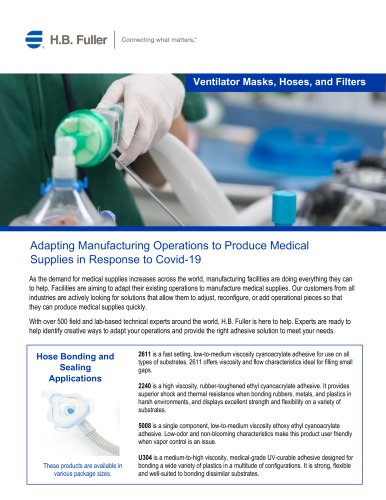
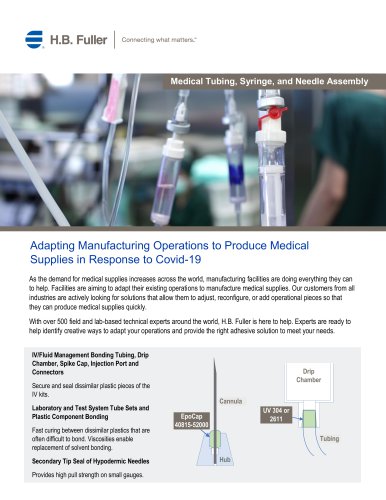
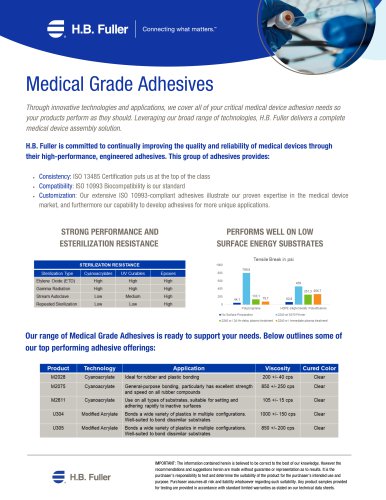
Medical Applications: Cyanoacrylates are extensively used in medical instruments and surgery, meeting ISO 10993 standards for biological compatibility and safety.
Catalog excerpts
IV Cyanoacrylate Adhesives Page 1
Open the catalog to page 1
4.1 Manual Application (soft bottles and pin cap) 8.2.5 Explanation of the Safety Data Sheet for Cyanoacrylates 3.1 Cyberbond in Single-use Medical Products
Open the catalog to page 2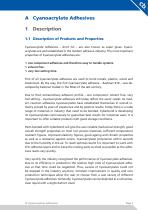
1.1 Description of Products and Properties Cyanoacrylate Adhesives – short CA – are also known as super glues. Cyanoacrylates are well established in the modern adhesive industry. The most important properties of Cyanoacrylate adhesives are: one component adhesives and therefore easy to handle systems, solvent free, very fast setting time. First of all Cyanoacrylate adhesives are used to bond metals, plastics, wood and elastomers. By the way, the first Cyanoacrylate adhesive – Eastman 910 – was developed by Eastman Kodak in the 50ies of the last century. Due to their extraordinary adhesion profile...
Open the catalog to page 3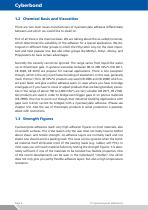
Cyberbond 1.2 Chemical Basis and Viscosities There are two main issues manufacturers of Cyanoacrylate adhesive differentiate between and which we would like to dwell on. First of all there is the chemical basis. We are talking about the so-called monomer, which determines the suitability of the adhesive for a special application. We distinguish in different Ester groups in which the Ethyl ester is by far the most important and most popular one. But also other groups like Methyl-, Butyl-, Alkoxy- and Propylesters do have certain advantages. Secondly the viscosity cannot be ignored. The range varies...
Open the catalog to page 4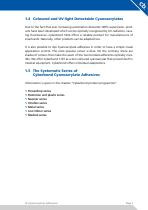
1.4 Coloured and UV-light Detectable Cyanoacrylates Due to the fact that ever increasing automation demands 100% supervision, products have been developed which can be optically recognised by UV-radiation, causing fluorescence. Cyberbond 1022 offers a reliable product for manufacturers of smartcards. Naturally, other products can be adapted too. It is also possible to dye Cyanoacrylate adhesives in order to have a simple visual application control. The most popular colour is blue. On the contrary, there are shades of colours that make the seam of the two bonded adherents optically invisible....
Open the catalog to page 5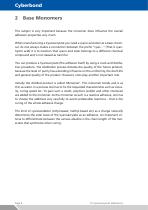
Base Monomers This subject is very important because the monomer does influence the overall adhesion properties very much. When manufacturing a Cyanoacrylate you need a cyano acid ester as a basic chemical. As one always makes a connection between the prefix “cyan…” (That is cyanhydric acid) it is to mention that cyano acid ester belongs to a different chemical compound and is not classed as harmful. You can produce a Cyanoacrylate (the adhesive itself) by using a crack-and distillation procedure. The distillation process dictates the quality of the future product, because the level of purity...
Open the catalog to page 6
2.1 Methylester (ME) The first Cyanoacrylate Adhesive ever produced was a product based on the short chained Methylester CH2=C-CN-COO-CH3. Today the importance of this type is constantly decreasing, due to the ageing properties of modern plastics and elastomers not reaching the same performance as Ethyl esters. Methyl is mainly used for bonding metal to metal and fixing difficult to bond Duroplastics. A short term higher temperature and a good resistance against most chemicals are advantages of Methyl. Due to the fact that metal to metal applications, where Methyl really perform very well, rarely...
Open the catalog to page 7
Cyberbond 2.4 Alkoxyester (AOE – Cyberbond 5000 series) These are very long-chained Cyanoacrylate adhesives and can be described as odourless. As a matter of fact the alkoxyester are very user friendly. However, one has to accept that the strength properties are not as good when compared to bonds using ethyl. Also, alkoxyester require longer setting times. Nevertheless, sufficient results in bonding can be firmly reached. CH2=C-CN-COO-CH2-CH2- R1 bzw. 2 [R1 = -O-C2H5 (Ethoxyester) bzw. R2 = -O-CH3 (Methoxyester)] When reading the two formulas it becomes evident that alkoxylester is the genera...
Open the catalog to page 8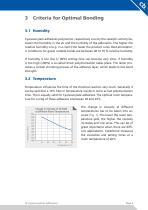
Criteria for Optimal Bonding 3.1 Humidity Cyanoacrylate adhesives polymerize, respectively cure by the catalytic activity between the humidity in the air and the humidity of the adherents. The higher the relative humidity is (e.g. in a room) the faster the product cures. Best atmospheric conditions for good, reliable bonds are between 40 to 70 % relative humidity. If humidity is too low (< 30%) setting time can become very slow; if humidity is too high (>80%) a so-called shock polymerization takes place. The latter provokes a certain shrinking process of the adhesive layer, which leads to less...
Open the catalog to page 9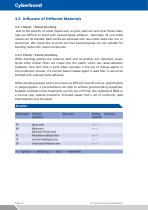
Due to the polarity of noble metals such as gold, platinum and silver these materials are difficult to bond with Cyanoacrylate adhesive. Generally, all non-noble metals can be bonded. Best results are achieved with less noble metal like iron or aluminium. We would like to point out that Cyanoacrylates are not suitable for bonding metal with metal compounds. When bonding plastics the material itself and its polarity are important issues. Quite often certain fillers are mixed into the plastic which can cause adhesion problems. One item that is quite often overseen is the use of release agents in...
Open the catalog to page 10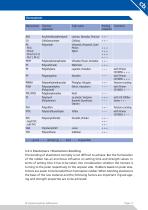
+ + + good, + + - satisfying, + - - bad,---impossible 3.3.3 Elastomers / Elastomers Bonding The bonding of elastomers normally is not difficult to achieve. But the formulation of the rubber has an enormous influence on setting time and strength values. In terms of setting time it has to be taken into consideration whether the mixture is turning to the polar respectively to the unpolar side. Rubbers based on polar elastomers are easier to be bonded than homopolar rubber. When bonding elastomers the basis of the raw material and the following factors are important if good ageing and strength properties...
Open the catalog to page 11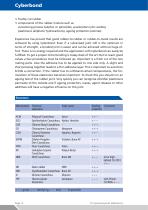
components of the rubber mixture such as vulcanising process (sulphur or peroxide), accelerators (zinc oxides), plasticisers (aliphatic hydrocarbons), ageing protectors (amines) Experience has proved that good rubber-to-rubber or rubber-to-metal results are achieved by using Cyberbond. Even if a vulcanised joint still is the optimum in terms of strength, a bonded joint is easier and can be achieved without huge effort. There is no energy required and the application with Cyberbond can easily be fulfilled. To get a proper mitre bonding is today state of the art. But to reach good values a few...
Open the catalog to page 12All H.B. Fuller catalogs and technical brochures
 Medical Grade Adhesives
1 Page
 Gown Mask Drape Covid FINAL
2 Pages