
- Catalogs
- Health Scholars
- Pediatric Emergency Care Virtual Reality

Pediatric Emergency Care Virtual Reality

Pediatric Emergency Care Virtual Reality
- Realistically models nuanced pediatric resuscitation scenarios such as respiratory distress, failure, opioid overdose, shock, CNS/metabolic impairment, and cardiopulmonary failure.
- Offers a virtual, zero-risk environment for practicing critical pediatric resuscitation management.
- Provides a readiness score for learners by assessing core competencies throughout the simulation.
The Health Scholars Pediatric Emergency Care Virtual Reality (VR) training course enables teams to complete high-risk and high-pressure scenarios involving critically ill infants and toddlers.
Learning ObjectivesProviders must recognize subtle indicators of severe illness in infants and children promptly and initiate stabilization or resuscitation as needed. The training emphasizes the pediatric assessment triangle (PAT) as a cornerstone for pediatric acute care and hospital education pathways.
VR Simulation Training Scenarios- Respiratory distress and albuterol precipitated stable SVT.
- CNS/metabolic and cardiopulmonary failure from opiate overdose.
- Viral myocarditis with hypovolemic shock from diarrhea, CNS/metabolic impairment from hypoglycemia, and unstable wide complex tachycardia.
- Respiratory failure and distributive shock from pneumonia leading to cardiopulmonary arrest.
- Patent-pending voice technology.
- Ultra-realistic in-hospital environment.
- 24/7 accessibility for frequent, independent practice.
- In-application micro-debriefs to reinforce learning gains.
Catalog excerpts
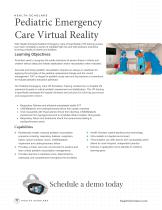
Pediatric Emergency Care Virtual Reality With Health Scholars Pediatric Emergency Care Virtual Reality (VR) training course, your team completes a series of required high-risk and high-pressure scenarios involving critically ill infants and toddlers. Learning Objectives Providers need to recognize the subtle indicators of severe illness in infants and children without delay and initiate stabilization and/or resuscitation when indicated. Accurate and timely pediatric resuscitation requires an always-on readiness for applying the principles of the pediatric assessment triangle and the correct management. PAT is integral to pediatric acute care and has become a cornerstone for hospital pediatric education pathways. Our Pediatric Emergency Care VR Simulation Training contains four in-hospital VR scenarios focused on critical pediatric assessment and stabilization. This VR training is specifically developed for hospital clinicians and includes the following assessment and management content: • Respiratory Distress and albuterol precipitated stable SVT • CNS/Metabolic and cardiopulmonary failure from opiate overdose • Viral myocarditis with Hypovolemic Shock from diarrhea, CNS/Metabolic impairment from hypoglycemia and an Unstable Wide Complex Tachycardia • Respiratory failure and distributive shock from pneumonia leading to cardiopulmonary arrest Capabilities ◆ Realistically models nuanced pediatric resuscitation ◆ Health Scholars’ patent-pending voice technology. scenarios including: respiratory distress, respiratory failure, opioid overdose, shock, CNS/Metabolic impairment and cardiopulmonary failure ◆ Provides a virtual, zero-risk, environment to practice and learn critical pediatric resuscitation managements ◆ Provides learners a readiness score, determined by assessing core competencies throughout the simulation ◆ Ultra-realistic in-hospital environment ◆ VR simulation can offer learner 24/7 accessibility which allows for more frequent, independent practice ◆ Delivers in application micro-debriefs to reinforce learning gains
Open the catalog to page 1All Health Scholars catalogs and technical brochures
 Stroke Virtual Reality
1 Page
 ACLS Virtual Reality
1 Page


