
- Catalogs
- Hingmed Medical
- Q06B International Organization for Standardization 81060-2:2018 protocol


- Company
- Products
- Catalogs
- News & Trends
- Exhibitions
Q06B International Organization for Standardization 81060-2:2018 protocol
Q06B International Organization for Standardization 81060-2:2018 protocol
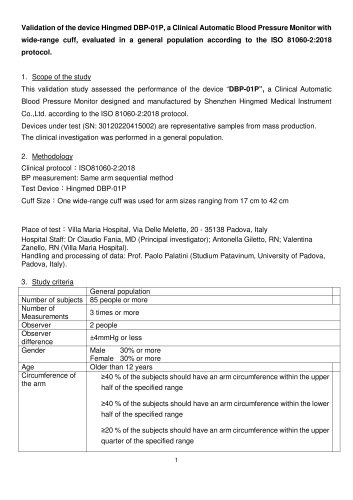
The document evaluates the accuracy of the Hingmed Q06B oscillometric blood pressure monitor, which is equipped with a wide-range cuff suitable for arm circumferences from 22 to 41 cm. The validation process adheres to the ISO 81060-2:2018 protocol, which specifies requirements for participant arm sizes.
Participants and Methods
Participants were recruited from Shenzhen University General Hospital, with an average age of 53.6 years. The study followed ethical standards and included 85 subjects after exclusions. The device's accuracy was tested against a mercury sphygmomanometer, with measurements conducted by trained observers.
Device Specifications
The Hingmed Q06B is intended for home use, featuring a measurement range of 40–260 mmHg for systolic and 20–210 mmHg for diastolic blood pressure. It includes Bluetooth connectivity and can store up to 200 readings.
Results
The device met the ISO protocol criteria, with mean differences of -0.7 mmHg for systolic and -1.6 mmHg for diastolic blood pressure compared to observer measurements. The standard deviations were below the protocol's maximum allowable values, indicating reliable performance across the tested arm size range.
Discussion
The study confirms the device's accuracy across a wide range of arm circumferences, addressing concerns about the reliability of wide-range cuffs. The results support the use of the Hingmed Q06B in the general population.
Conclusion
The Hingmed Q06B monitor satisfies the ISO 81060-2:2018 protocol requirements, demonstrating its suitability for accurate blood pressure measurement in diverse arm sizes.
Acknowledgements
The study was funded by Hingmed, China, with no reported conflicts of interest.
The study investigates the accuracy of a single rigid conical cuff with a standard-size bladder when used with an automatic oscillometric device across various arm circumferences.
Specifications
The research focuses on the performance of a specific type of blood pressure cuff and its compatibility with an oscillometric device. The cuff is described as rigid and conical, designed to fit a wide range of arm sizes.
Procedures
The methodology involves testing the cuff on subjects with different arm circumferences to evaluate its accuracy in measuring blood pressure. The study likely includes a comparison with standard measurement techniques to validate results.
Results
The findings suggest that the cuff maintains accuracy across a broad spectrum of arm sizes, indicating its potential utility in diverse patient populations.
Recommendations
The study may recommend the use of this cuff design in clinical settings where patients have varying arm circumferences, emphasizing its versatility and reliability.
Conclusion
The research concludes that a single rigid conical cuff with a standard-size bladder is effective for use with automatic oscillometric devices, providing accurate blood pressure readings across different arm sizes.
Catalog excerpts
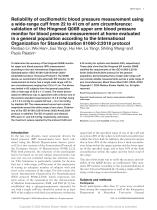
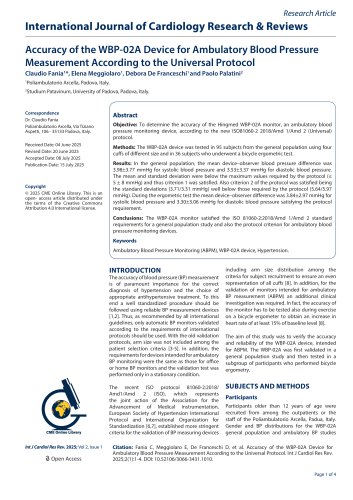
Reliability of oscillometric blood pressure measurement using a wide-range cuff from 22 to 41 cm of arm circumference: validation of the Hingmed Q06B upper arm blood pressure monitor for blood pressure measurement at home evaluated in a general population according to the International Organization for Standardization 81060-2:2018 protocol Renbao Lia, Wei Hana, Jiao Yanga, Hui Hea, Le Yanga, Shiting Wanga and Paolo Palatinib To determine the accuracy of the Hingmed Q06B monitor for upper arm blood pressure (BP) measurement according to the new International Organization for Standardization (ISO) 81060-2:2018/Amd1:2020/ Amd2:2024 protocol (‘Universal Protocol’). The Q06B device, an oscillometric fully automatic BP monitor for BP measurement at home, has a single wide-range cuff for arm circumferences ranging from 22 to 41 cm. The device was tested in 85 subjects from the general population with a mean age of 53.6 ± 11.7 years. The mean device– observer difference was in agreement with criterion one of the protocol standard requirements (≤5 ± 8 mmHg), being −0.7 ± 3.7 mmHg for systolic BP and −1.6 ± 3.6 mmHg for diastolic BP. The measurement errors had a similar magnitude across the entire range of arm sizes. Criterion two of the ISO 81060-2:2018/Amd1:2020/Amd2:2024 protocol is satisfied. The SD of systolic and diastolic BPs were 2.1 and 2.8 mmHg, respectively, well below the maximum values required by the protocol (6.90 and 6.76 mmHg for systolic and diastolic BPs, respectively). These data show that the Hingmed BP monitor Q06B satisfied the requirements of the ISO 81060-2:2018/ Amd1:2020/Amd2:2024 protocol for the general population, demonstrating that a single wide-range cuff can provide reliable measurements across a wide range of arm circumferences. Blood Press Monit XXX: XXXX–XXXX Copyright © 2025 Wolters Kluwer Health, Inc. All rights reserved. upper half of the specified range of use of the cuff and on at least 40% of the subjects with limb circumference within the lower half. In addition, the protocol requires that at least 20% of the subjects have a limb circumference lying within the upper quarter and the lower quarter of the specified range, and at least 10% of the limb circumference within the upper and the lower octal of the range. In the last two decades, most automatic devices for blood pressure (BP) measurement have been validated using the British Hypertension Society protocol [1] or two versions of the International Protocol of the European Society of Hypertension (ESH) [2,3]. With both protocols, the selection of the participants had to be based on several subject characteristics, but arm size was not included among the selection criteria. This limitation is particularly notable for devices that use a wide-range cuff because of the importance of testing an adequate number of subjects with arm sizes at the extremes of the range. For this reason, the recent International Organization for Standardization (ISO) protocol 81060-2:2018, which represents the joint action of the Association for the Advancement of Medical Instrumentation, ESH, and ISO [4–7], has established that a sphygmomanometer intended for use with a single cuff size should be tested on at least 40% of the subjects with limb circumference within the 1359-5237 Copyright © 2025 Wolters Kluwer Health, Inc. All rights reserved. Blood Pressure Monitoring XXX, XXX:XXXX–XXXX Keywords: blood pressure, cuff, device, measurement, validation, wide-range Emergency Department of Shenzhen University General Hospital, Shenzhen, China and bDepartment of Medicine, Studium Patavinum, University of Padova, Padua, Italy a Correspondence to Paolo Palatini, MD, Department of Medicine, Studium Patavinum, University of Padova, Via San Fris 121, 31029-Vittorio Veneto, Italy Tel: +39 328 4617036; e-mail: [email protected] Received 2 January 2025 Accepted 24 February 2025. The aim of this study was to verify the accuracy and reliability of the Q06B device, an oscillometric fully automatic BP monitor, according to the recommendations of the new Universal Standard [4–7] using a single cuff covering a wide range or arm circumferences. Subjects and methods Participants Study participants older than 12 years were recruited from among the outpatients or staff of the Emergency Department of Shenzhen University General DOI: 10.1097/MBP.0000000000000762 Copyright © 2025 Wolters Kluwer Health, Inc. Unauthorized reproduction of thi
Open the catalog to page 1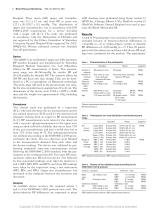
2 Blood Pressure Monitoring XXX, Vol XXX No XXX Number of subjects Number of measurements Observer Observer difference Gender Nine times or more three valid test/ reference BP pairs Two people ±4 mmHg or less Male 30% or more Female 30% or more >12 years old:100% Hospital. Their mean (SD) upper arm circumference was 31.2 ± 5.7 cm, and their BP at entry was 127.1 ± 20.3/78.7 ± 13.1 mmHg. The distribution of upper arm circumference was in accordance with ISO 81060-2:2018 requirements for a device provided with a single cuff [4-7]. The study was performed in accordance with the Declaration of Helsinki...
Open the catalog to page 2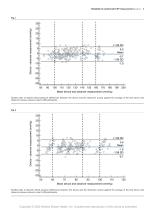
Reliability of oscillometric BP measurement Li et al. 3 Scatter plots of systolic blood pressure differences between the device and the observers (y-axis) against the average of the test device and observer pressure values (x-axis) in 85 participants. Scatter plots of diastolic blood pressure differences between the device and the observers (y-axis) against the average of the test device and observer pressure values (x-axis) in 85 participants. Copyright © 2025 Wolters Kluwer Health, Inc. Unauthorized reproduction of this article is prohibited.
Open the catalog to page 3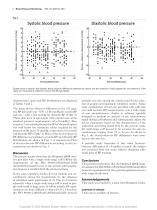
4 Blood Pressure Monitoring Scatter plots of systolic and diastolic blood pressure differences between the device and the observers (y-axis) against the circumference of the upper arm measured at midpoint (x-axis) in the 85 participants. characteristics, arms, and BP distributions are displayed in Tables 1 and 2. The mean device–observer difference in the 255 separate BP data pairs was −0.70 ± 3.66 mmHg for systolic BP and was −1.68 ± 3.64 mmHg for diastolic BP (Table 3). These data were in agreement with criterion one of the standard protocol requirements (≤5 ± 8 mmHg). Also, criterion 2 was...
Open the catalog to page 4All Hingmed Medical catalogs and technical brochures
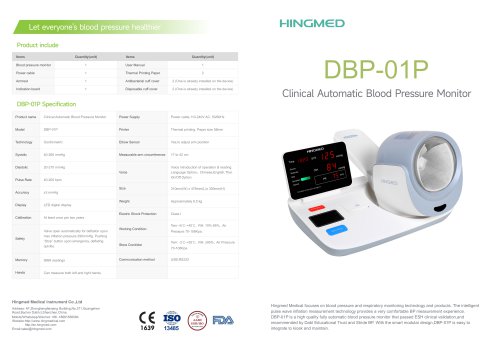 Hingmed DBP-01P Pass FDA
2 Pages
 ABPM software
39 Pages
 Hingmed Profile and Catalog
26 Pages
 Hingmed ABPM ABP-03
7 Pages
 ABP-03
2 Pages



- Analysis software
- Automatic blood pressure monitor
- Tablet computer software
- Windows software
- Blood pressure monitor with adult cuff
- Electronic ventilator
- Oscillometric blood pressure monitor
- Hospital software
- Automated software
- Non-invasive ventilator
- Ventilator with touch screen
- Portable ventilator
- Blood pressure monitor with built-in cuff
- Emergency ventilator
- Intensive care ventilator
- CPAP ventilator
- Blood pressure monitor with rechargeable battery
- Cardiology software
- Data analysis software