

DP-OAE

DP-OAE
Catalog excerpts

otoacoustic emissions leading companies
Open the catalog to page 1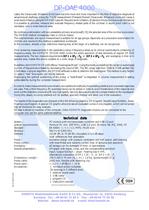
DP-OAE 4000 Lately the Otoacoustic Emissions (OAE) have become more and more important in the field of objective diagnosis at sensorineural deafness. Using the T-OAE measurement (Transient Evoked Otoacoustic Emissions) clicks will cause a wide-band-irritation, using the DP-OAE´s specific frequencies for irritation, (Distorsion-Products Otoacoustic Emissions) it is possible to provoke, measure and evaluate frequency related parts of the cochlear. A sound proof cabin is not necessary, only a noise-reduced area. By continuous stimulation with two presetable primary sinus tones(f1, f2), the selected...
Open the catalog to page 2All Homoth Medizinelektronik catalogs and technical brochures


Archived catalogs
 Tymp4000 M
2 Pages
 Rhino4000
2 Pages
 Ultasound
2 Pages
 Tymp4000
2 Pages
 Combi4000
2 Pages
 Combi4000 M
2 Pages
 Audio4000
2 Pages
 T-OAE
T-OAE2 Pages
 Rhino4000 M
2 Pages
 Audiometer 4000
2 Pages
 Bera
Bera2 Pages
 ENG
ENG2 Pages
 VNG
VNG2 Pages
 Aircalorisator
2 Pages
- Surgical system
- Cutting electrosurgical system
- Coagulation surgical system
- Windows software
- Radiofrequency electrosurgical unit
- Measurement software
- Hearing assessment system
- ENT surgery electrosurgical unit
- Urological surgery electrosurgical unit
- Navigation software
- Plastic surgery electrosurgical unit
- Vestibular testing system
- Diagnostic audiometer
- Acoustic reflex tester
- OAE screening system
- Diagnostic tympanometer
- Ear syringe
- Electric ear syringe
- Videonystagmography system
- Rhinomanometry system