
- Catalogs
- Hugo Sachs Elektronik
- BEHAVIORAL RESEARCH

BEHAVIORAL RESEARCH

BEHAVIORAL RESEARCH
- Product Offerings: The catalog lists various tools and systems for research, including video tracking systems, operant conditioning setups, and electrophysiology solutions. Key products include the SMART Video Tracking System V3.0, Modular Operant Box, and TBSI Solutions for neural recording.
- Research Applications: The products are designed for diverse applications such as studying brain functions, pathologies like Alzheimer's and Parkinson's, and screening therapeutic compounds. The catalog also covers tools for analyzing behavior in small laboratory animals.
- Technical Support: Harvard Bioscience offers extensive pre- and post-sales support, with technical staff available to assist with system configurations and answer questions.
- Innovative Solutions: The document highlights the integration of new technologies and the synergy created by combining behavioral analysis with in vivo neuronal recording and stimulation.
- Detailed Product Descriptions: Each product section provides detailed descriptions, including key features, parameters measured, and specific applications. For example, the SMART Video Tracking System V3.0 is noted for its flexibility, reliability, and advanced data analysis capabilities.
- Modular and Flexible Systems: Products like the SMART Video Tracking System offer modular structures to fit various experimental needs and budgets.
- Advanced Data Analysis: The systems provide customizable data reports and calculations for a wide range of behavioral paradigms.
- Comprehensive Support: The company emphasizes its commitment to customer service and high-quality standards.
- SMART Basic Pack: Suitable for one animal in one arena, includes essential modules like SMART V3.0, SMART-RC, SMART-CS, CONVANAUSB, and SMART-GA.
- SMART Super Pack: Builds on the Basic Pack with additional modules such as SMART-MA and SMART-TW.
- SMART Premium Pack: Offers maximum flexibility by adding modules like SMART-OF, SMART-CPP, SMART-WM, SMART-FST, SMART-PM, SMART-SI, and SMART-TY to the Super Pack.
- Tracking calculations in various zones and specific calculations like first arm choice and spontaneous alternation triplets.
- Time evolution reports and group evolution graphs for comprehensive analysis.
- Compatibility with multiple cameras and the ability to generate independent digital video files.
- Integration with the SMART system and compatibility with other tracking programs.
- Simultaneous tracking of up to four arenas with no special lighting required.
- Easy zone creation and behavior scoring with export options to Excel for analysis.
- Shock Level Tester: A13-16 model with a 25 ft. shock cable.
- Gustatory Stimuli: Pellet delivery troughs and feeders for mice and rats, with specific models for different pellet sizes.
- Levers and Lickometers: Various models for mice and rats, including retractable and optical versions.
- Response Sensors: Contact sensors and infrared activity monitors are available.
- Habitest Modular Behavioral Test Systems: Suitable for a range of experiments including self-administration, variable interval, and operant conditioning.
- Graphic State® 4 Software: Enhanced software for designing complex experiments with a user-friendly interface and advanced data analysis capabilities.
- Modular Operant Box: A flexible system that can be customized for different experimental needs, supporting up to 8 stations connected to a PC.
- Packwin V2.0 Software: A versatile platform for conducting behavioral experiments, offering advanced reporting and analysis features.
- Customized Module: Allows researchers to create complex protocols without programming knowledge. It supports a variety of operant procedures such as associative learning, memory tasks, addiction studies, attention tests, and anxiety/depression assessments.
- Pre-Configured Test Modules: These modules come with ready-to-use templates and data reports for specific experiments like the 5-Choice Serial Reaction Time Test, Vogel Test, fear conditioning, and startle response evaluation.
- Parameters Measured: Includes detailed reports on experiment duration, response patterns, and specific metrics for each type of test module.
- Key Features: Offers precision tracking in small arenas for mice and rats, with the ability to conduct various behavioral tests. The system is scalable and allows for controlled presentation of stimuli.
- Data Analysis: Automated data analysis with results presented in tables or graphs. Raw data can be re-analyzed to discover new behaviors or effects.
- Versatility: The system supports multiple experimental protocols and is compatible with various accessories to enhance functionality.
- Key Features: Optimal detection with perfect alignment of heat stimulus and photo beam trigger, adjustable sensitivity, manual and remote timer, automatic cut-off, and optional data transfer software (SEDACOM V2.0).
- Parameters Measured: Time latency response to thermal stimulus.
- Components Included: Control unit, stimulation unit, mouse tail adapter, holder for rat or mouse, footswitch, instruction manual, calibration certificate, cables, connectors, and spare fuses.
- Options: Tail-temperature recorder, SEDACOM software, RS-232/USB adapter.
- Key Features: Digital set point, built-in electronic timer, foot switch timing operation, and optional data transfer software (SEDACOM V2.0).
- Parameters Measured: Time latency to 'paw licking' and 'jumping'.
- Components Included: Base with heating plate, footswitch, cables, connectors, calibration certificate, instruction manual, and spare fuses.
- Specifications: Temperature range from 45 to 62°C, reaction time precision of 0.01 sec, and CE compliant.
- Key Features: Unmatched temperature stability, fast acclimation, homogeneous temperature distribution, and BSRamp software for temperature ramps.
- Parameters Measured: Animal reaction time to hot or cold stimulus.
- Specifications: Temperature range from -3°C to 65°C, accuracy of ±0.5°C, and automatic power requirements.
- Key Features: Monitor thermal place preference and nociceptive thresholds, unrestrained animals, and optional automatic detection software.
- Parameters Measured: Time spent in each zone, time of zone trespassing, and temperature of each zone.
- Specifications: Temperature range from -3°C to +65°C, accuracy of ±0.5°C, and dimensions including cage.
- Key Features: Continuous thermal gradient over a 120 cm base plate, monitor 2 mice or 1 rat.
- Parameters Measured: Up to 20 temperature zones per animal, time spent in each zone, and overall distance travelled.
- Specifications: Temperature range from 5 to 55°C, stability of 1°C, and automated system with video tracking.
- Key Features: Automatic detection of paw withdrawal, measurement of hyperalgesia, and modular animal enclosure.
- Specifications: Operating temperature from 15° to 30°C, adjustable IR intensity, and universal power requirements.
- Key Features: Automatic detection of paw withdrawal, consistent force application, and data portability.
- Purpose: Automates assessment of touch sensitivity on the plantar surface of rats or mice.
- Dynamic Plantar Anesthesiometer: Measures force range from 0 to 50 grams with adjustable force increase rate. It connects to a PC via a DeLta 9-pin connector.
- Electronic Von Frey: Measures mechanical allodynia with a range of 0 to 500 grams. It features internal statistical computations and is available with embedded video options.
- Paw & Tail Pressure Meter: Utilizes the Randall & Selitto test to measure pain thresholds with a digital display and adjustable pressure rates.
- Digital Water Plethysmometer: Measures small volume changes in paw volume with a resolution of 0.01 ml, useful for assessing inflammatory responses.
- The Dynamic Plantar Anesthesiometer and Electronic Von Frey are used to determine pain sensitivity thresholds by applying force to the animal's paw.
- The Paw & Tail Pressure Meter applies increasing pressure to measure pain response thresholds.
- The Digital Water Plethysmometer measures volume displacement to assess inflammation.
- T-Y Mazes: Used for evaluating learning and memory. They offer automated standard experiments with options for manual or automated door control and animal detection via photoelectric cells or video tracking.
- Radial Mazes: Available in manual, semi-automated, and automated versions. They are used for evaluating working and reference memory. The maze consists of a central area with eight arms, and the doors can be controlled manually or automatically using the maZeSoft-8 software.
- Habitest Runways & Hubs: These are modular and flexible, allowing for various configurations and the addition of stimulus-response modules. They are used in conjunction with radial arm mazes, T-mazes, and Y-mazes.
- maZeSoft-8: A comprehensive software for monitoring radial maze experiments. It allows for manual or automatic control of maze doors and provides detailed data on animal behavior, including memory errors and response latency. Data can be exported to Excel for further analysis.
- Graphic State Notation 4 Software: Used for control and data acquisition in conjunction with the Habitest system.
- Automated and manual control options for maze doors.
- Integrated parameters for detailed analysis of animal behavior.
- Data export capabilities for further analysis.
- Modular design for flexibility and reconfiguration.
- Radial Maze Dimensions: Rat - 1690 x 1690 x 1250/1450 mm; Mouse - 867 x 867 x 1250/1450 mm.
- Material Composition: Methacrylate, aluminum, stainless steel.
- Power Requirement: 110/220 Vac, 50/60 Hz.
- Designed for both mice and rats, these cages are modular and can be expanded for various applications beyond active and passive avoidance.
- Features include photocell sensor systems for animal transit detection, optional guillotine doors, and easily removable floors and drop pans for cleaning.
- Ordering information includes various models and accessories such as isolation cubicles, shockers, and blank panel sets.
- This system is versatile for conducting fear conditioning and startle reflex experiments in a single enclosure for both mice and rats.
- Key features include weight transducer sensitivity, USB connectivity, and various spatial context configurations for fear conditioning paradigms.
- Parameters measured include freezing and startle responses, with detailed data on duration, amplitude, and latency.
- Components include an experimental chamber, soundproof box, load cell amplifier, and station interface.
- A video-based system for fear conditioning, FreezeFrame combines human observer sensitivity with automation for precise movement detection.
- It is capable of measuring minute movements and is validated with high concordance with human observers.
- Features include motion detection algorithms, low-light performance, and the ability to store and export data for analysis.
- Detailed specifications for the StartFear system include chamber dimensions, material composition, and sound frequency capabilities.
- Ordering information lists various models and accessories, including shock generators and contextual kits for fear conditioning.
- Designed for conditioned place preference and black and white experiments.
- Features include real-time visualization of animal position, integrated results, and easy data export to Excel.
- Measures parameters such as total entries into compartments, permanence time, and latency to first transition.
- Includes software installation, USB license key, cables, connectors, and a digital instruction manual.
- Modular experimental enclosure for studying reward and addiction.
- Features include a removable waste tray, modular components for self-administration, and compatibility with Packwin software.
- Measures parameters like response rate, number of reinforcements, and response patterns.
- Includes experimental chamber, instruction manual, cables, connectors, and a 2-year warranty.
- Modular system for studying respiratory metabolism, food and drink intake, and activity in laboratory animals.
- Features include home cage advantage, high accuracy monitoring, and adaptability for mice and rat models.
- Applications include obesity, diabetes, metabolic disorders, and drug screening.
- Components include home cage, airtight lids, intake dispensers, and software modules for metabolism studies.
- Offers modules for respiratory metabolism, intake, and activity studies.
- Features include data extraction, calculation of physiological parameters, and real-time monitoring.
- Allows correlation between food/drink consumption, metabolism, and activity.
- Includes software installation, USB license key, cables, connectors, and a digital instruction manual.
Catalog excerpts

Behavioral Research Video Tracking Operant Conditioning Circadian Biology Sensory Motor Analgesia Social Interaction Anxiety & Depression Reward & Addiction Food & Drink / Metabolism Learning, Memory & Attention Locomotor Activity & Exploration In Vivo Electrophysiology & Optogenetics divisions of Harvard Bioscience, Inc. Call to receive other Behavioral Regenerative Medicine Electroporation & Electrofusion Animal, Organ & Cell Physiology Electrophysiology & Cell Biology Research Molecular Sample Preparation catalogs of interest Pumps Surgical Tools
Open the catalog to page 1
In addition to our high quality research products, we are proud to offer unparalleled pre- and post-sales support. Our technical staff scientists are happy to help answer any questions you may have or assist with system configurations. ► Product Specifications ► Instruction Manuals ► Working Procedures ► Application Sheets Coulbourn / Harvard Apparatus phone 508.893.8999 • toll free U.S. 800.272.2775 fax 508.429.5732 www.coulboum.com Panlab / Harvard Apparatus Spain +34934190709 • International +34834750697 fax +34934750699 www.panlab.com
Open the catalog to page 2
Our products help solve relevant problems in basic and clinical psychopharmacology. Applications include the study of brain functions (cognition, memory, emotion…), the study of related pathologies (Alzheimer’s, Parkinson’s, depression, addiction…) as well as the discovery and screening of new therapeutic compounds. Our goal has always been to offer our customers the best service and full attention which translates into a dynamic business focus, while a constant effort is made to guarantee that high quality standards are accomplished in every detail. The company is constantly renewing and evolving...
Open the catalog to page 3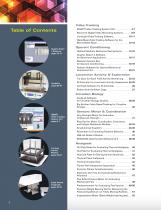
Video Tracking Graphic State® 4 Software pages 16-17 Sensory Motor & Coordination SMART Video Tracking System V3.0 pages 4-7 Analgesia Tru Scan Activity Monitor pages 22-23 Small Animal Treadmills pages 34-35
Open the catalog to page 4
Species Guide for Behavioral Systems To help you become more familiar with our product line, we have added small animal icons for every product. These icons will help guide you to which species can be used with each system. Below are the animal icons you will see throughout this catalog.
Open the catalog to page 5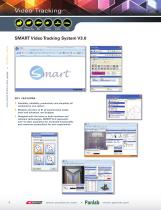
Video Tracking SMART Video Tracking System V3.0 Video Tracking • SMART Video Tracking System V3.0 } Flexibility, reliability, productivity and simplicity all } Modular structure to fit all experimental needs, basic and advanced, and budgets } Designed with the latest in both hardware and software technologies, SMART V3.0 represents over 15 years experience for increased functionality and maximum productivity for your experiments
Open the catalog to page 6
SMART V3.0 offers the most flexible and easy-to-learn software on the market for the automated evaluation of behavior in the widest range of pre-clinical and neuroscience applications. Utilizing advanced image analysis, SMART V3.0 allows the recording of activities, trajectories, events, social interactions and global activity. SMART V3.0 provides users the versatility of a modular system with the capabilities of a broadband package. Our enhanced data analysis includes customizable data reports and complete calculations for unlimited behavioral paradigms. Developed with the daily experimental...
Open the catalog to page 7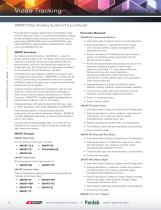
SMART Video-Tracking System V3.0 (continued) Video Tracking • SMART Video Tracking System V3.0 Running classic behavior experiments and looking to save time and expense? Opt for our experiment-targeted modules for pre-configured setup and data reports for such tests as water maze (SMART-WM), plus maze (SMART-PM), open field (SMART-OF), place preference (SMART-CPP), forced swim test (SMART-FST), etc. SMART Extensions Our Global Activity Extension - SMART-GA - is ideal for activity related experiments. This option uses frame-to-frame detection for precise monitoring of spontaneous activity and...
Open the catalog to page 8
• Information about Subjects, Sessions and Configuration • Tracking calculation in arms, center and total (entries, time, distance covered, speed, resting/slow/fast displacements etc.) • Specific calculations: first arm choice, first arm choice latency, spontaneous alternation triplets, Max Alternation triplet, total arm entries • Time evolution report lists (zone transitions, scored events) • Group evolution graph SMART-CPP (Conditioned Place Preference) • Information about Subjects, Sessions and Configuration • Tracking calculation in drug/placebo related compartment, corridor and total (entries,...
Open the catalog to page 9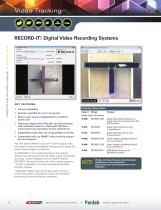
RECORD-IT! Digital Video Recording Systems Video Tracking • RECORD-IT! Digital Video Recording Systems Ensure traceability ► Systems available for one to 8 cameras ► Record each camera independently as defined by the user ► Generates digital video files that can be processed with standard codecs in a Microsoft® Windows environment (no proprietary format restrictions) ► Independent video files can be generated on-the-fly ► Compatible with our SMART video tracking system, but not exclusive We offer several different options for external digital video recording for ensuring traceability and security...
Open the catalog to page 10
Built-in RECORD-IT! BASIC NEEDS Computer Dependency Digital Video Recording / Tracking simultaneous Process of the same Experiment Quality/Price Ratio SMART Built-In/External Solution Digital Video File specifications Image source camera Number & Productivity sMART V2-5, & smart Junior compatibility Other specific Features Video Tracking • RECORD-IT! Digital Video Recording Systems Panlab www.panlab.com iimrniHBiTs
Open the catalog to page 11
LimeLight Video Tracking Software Video Tracking • LimeLight Video Tracking Software key features Developed in close collaboration with behavioral neuroscientists ► Flexible and powerful video tracking system ► Ideal for: Open Field, Plus Maze, Zero Maze, Novel Object Recognition, Conditioned Place Preference parameters measured ► Distance travelled in each region (cm or %) ► Time spent in each region (sec or %) ► Crossings into each region ► Body length from nose to base tail (mm), together with stretch-attend bouts ► Pointing direction (orientation) ► Mean distance from center ► Latency to...
Open the catalog to page 12All Hugo Sachs Elektronik catalogs and technical brochures
 SURGICAL SOLUTIONS FOR RESEARCH
260 Pages
 ISOLATED LUNG PERFUSION SYSTEMS
62 Pages


- Patient monitor
- Blood pressure patient monitor
- Medical gas flow meter
- Hospital flow meter
- Compact patient monitor
- Tabletop patient monitor
- Air flowmeter
- Induction chamber
- Veterinary patient monitor
- Non-invasive patient monitor
- Rail-mounted flow meter
- Rodent laboratory stereotactic frame
- Laboratory stereotactic frame
- Anesthetic gas scavenging system
- Anesthesia induction chamber
- Bench-top laboratory stereotactic frame
- Veterinary anesthesia induction chamber
- Mice laboratory stereotactic frame
- Rat laboratory stereotactic frame
- Digital laboratory stereotactic frame