
- Catalogs
- Hugo Sachs Elektronik
- ISOLATED LUNG PERFUSION SYSTEMS

ISOLATED LUNG PERFUSION SYSTEMS

ISOLATED LUNG PERFUSION SYSTEMS
Catalog excerpts

Isolated Lung PERFUSION SYSTEMS For Small to Large Animal Models www.hugo-sachs.de · www.harvardapparatus.com
Open the catalog to page 1
PERFUSION & TISSUE BATH SYSTEMS OVERVIEW Solutions for All Aspects of Animal Physiology Research Organs Smooth Muscle GASTROINTESTINAL TRACT • • • • Esophagus Stomach Liver/Pancreas Intestine Systems for Organs/Applications • Moist Chamber—perfusion of liver, pancreas • UP-100—perfusion of liver ex vivo or in situ • PBTO—intraluminal intestine perfusion • CP—perfusion of GI organs and tissues using S peristaltic pump • IPR—perfusion of ileum peristaltic reflexes UROGENITAL TRACT • Kidney • Placenta VASCULAR MUSCULATURE • Hind Quarter • Mesenteric Bed • Coronary Vasculature • Moist Chamber—perfusion...
Open the catalog to page 2
Isolated Lung PERFUSION SYSTEMS For Small to Large Animal Models Hugo Sachs Elektronik (HSE), part of the Harvard Bioscience family of companies, provides top-notch, fully integrated physiology research systems, including perfusion and tissue bath systems for many organ and tissue types. Hugo Sachs’ IPL Series of isolated lung perfusion systems are designed to enhance the ease of acquisition and quality of data for researchers in pulmonary physiology. These modular systems provide a full range of in-depth respiratory mechanics and are tailored for specific species from mouse to pig. Core systems...
Open the catalog to page 3
Introduction to Isolated Lung Perfusion Systems The Isolated Perfused Lung (IPL) method for ex vivo lung perfusion (EVLP) is an invaluable method for characterizing the non-respiratory capabilities of pulmonary tissues such as pulmonary metabolic activity as well as the activities of various components (pulmonary alveolar macrophage, alveolar tissue, endothelial tissue, etc.) in response to inhaled/airborne particulates or therapies (drug testing, toxicology testing, etc.). Isolated lung systems are equally useful for evaluating respiratory functions such as respiratory mechanics and gas exchange....
Open the catalog to page 4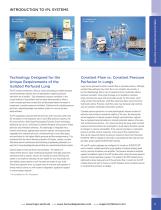
INTRODUCTION TO IPL SYSTEMS IPL-4 System for Rabbit Lungs Technology Designed for the Unique Requirements of the Isolated Perfused Lung The IPL system architecture utilizes a unique technology to enable seamless switching between positive and sub-atmospheric (negative) pressure ventilation on all models*. Sub-atmospheric pressure ventilation is the natural method of lung inflation and has been demonstrated to allow a much increased pulmonary artery flow and decreased edema formation in comparison to positive pressure ventilation. Combined with constant pressure perfusion, optimal physiologic...
Open the catalog to page 5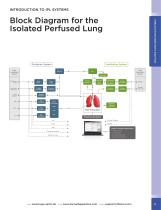
Block Diagram for the Isolated Perfused Lung Perfusion System Ventilation System ISOLATED LUNG PERFUSION SYSTEMS Data Acquisition System Lung _ Weight Pressure Transducer Flow Probe Micro Electrodes ___pH___ pCO2 ___p02___ Perfusion Pressure Perfusion Flow Weight Transducer Differential Pressure Transducer Pressure Transducer Negative Pressure Ventilator Pleural Pressure Airflow Online Calculated Parameters: • Tidal Volume • Compliance • Airway Resistance • Vascular Resistance web www.hugo-sachs.de web www.harvardapparatus.com email [email protected]
Open the catalog to page 6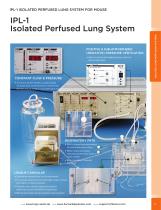
IPL-1 ISOLATED PERFUSED LUNG SYSTEM FOR MOUSE MANSDUCER MPLIFIER MODULE TRANSDUCER AMPLIFIER MODULE SERVO CONTROLLER for PERFUSION LOOP ERROR ACTUAL VALUE CONSTANT FLOW & PRESSURE POSITIVE & SUB-ATMOSPHERIC (NEGATIVE) PRESSURE VENTILATION • Option for positive and negative pressure ventilation with one-step switch ISOLATED LUNG PERFUSION SYSTEMS A switch on the SCP module can rapidly change the system from constant pressure to constant flow perfusion with no change in circuit dead-space volume RESPIRATORY PATH • Built-in, warmed pneumotachometer for minimal dead space volume • Milled infusion...
Open the catalog to page 7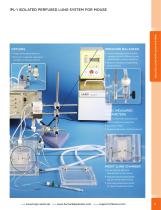
PRESSURE BALANCED • Simple add-on aerosol nebulizer • ressure-balancing vessel eliminates P transmural pressure difference during sub-atmospheric pressure ventilation • ulti-gas for hyperoxic, hypercapnic, M anesthetic or other gas mixtures • llows for simulation of hypertensive A cardiac afterload ISOLATED LUNG PERFUSION SYSTEMS IPL-1 ISOLATED PERFUSED LUNG SYSTEM FOR MOUSE BASIC MEASURED PARAMETERS • Perfusion (pulmonary artery) pressure • Perfusion (pulmonary artery) flow • Respiratory airflow • Intrapleural pressure (or tracheal pressure) MOIST LUNG CHAMBER • ccess ports for additional A...
Open the catalog to page 8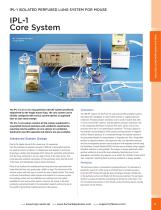
IPL-1 ISOLATED PERFUSED LUNG SYSTEM FOR MOUSE ISOLATED LUNG PERFUSION SYSTEMS IPL-1 Core System IPL-1 Isolated Perfused Lung System The IPL-1 is an ex vivo lung perfusion (EVLP) system specifically engineered for the fragile mouse lung. The core system can be initially configured with various system options or upgraded later as your needs change. The IPL-1 core system contains all the primary equipment to accomplish the basic perfusion and ventilation experiments, requiring only the addition of core options for ventilation. Application-specific upgrades and options are also available. Advanced...
Open the catalog to page 9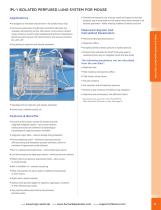
IPL-1 ISOLATED PERFUSED LUNG SYSTEM FOR MOUSE • nvestigation of ventilation and perfusion in the isolated mouse lung I • ontinuous measurement of respiratory mechanics (respiration rate, C inspiratory and expiratory air flow, tidal volume, minute volume, dynamic airway resistance, dynamic lung compliance) and perfusion characteristics (pulmonary artery pressure, left atrium pressure, lung vascular resistance, pO2, pCO2, pH) • annulae are matched to size of mouse vessel and feature tip occlusion C protectors and an articulated mini ball system which allow cannulae to be precisely positioned—further...
Open the catalog to page 10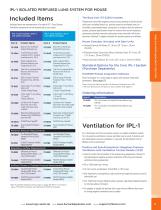
Included Items Included items are representative of a typical IPL-1 Core System. Individual components can be customized to your needs. For a functional unit the core system requires a suitable ventilation system. For only positive ventilation a mouse ventilator can be used. If positive and sub-atmospheric pressure ventilation is required, the Ventilation Control Module must be purchased. Positive and Sub-Atmospheric (Negative) Pressure Ventilation with Ventilation Control Module (VCM) • Used to control the ventilation of the isolated lung preparation. Allows for the physiological negative pressure...
Open the catalog to page 11All Hugo Sachs Elektronik catalogs and technical brochures
 BEHAVIORAL RESEARCH
100 Pages
 SURGICAL SOLUTIONS FOR RESEARCH
260 Pages


- Patient monitor
- Blood pressure patient monitor
- Medical gas flow meter
- Hospital flow meter
- Compact patient monitor
- Tabletop patient monitor
- Air flowmeter
- Induction chamber
- Veterinary patient monitor
- Non-invasive patient monitor
- Rail-mounted flow meter
- Rodent laboratory stereotactic frame
- Laboratory stereotactic frame
- Anesthetic gas scavenging system
- Anesthesia induction chamber
- Bench-top laboratory stereotactic frame
- Veterinary anesthesia induction chamber
- Mice laboratory stereotactic frame
- Rat laboratory stereotactic frame
- Digital laboratory stereotactic frame