

- Company
- Products
- Catalogs
- News & Trends
- Exhibitions
HWTAI Non-vacuum Blood Collection Tubes 2023

1 / 1 PageView full catalog
HWTAI Non-vacuum Blood Collection Tubes 2023
Product catalog summary
Overview
This document provides technical information on Non-Vacuum Blood Collection Tubes, also referred to as Non-VacuumTube. These tubes are designed for blood collection without the use of vacuum pressure, offering an alternative to traditional vacuum blood collection systems.
Main Sections
Specifications
- Material Composition: Typically made from medical-grade plastic or glass to ensure biocompatibility and safety.
- Tube Dimensions: Standard sizes compatible with common blood collection procedures.
- Closure System: Secure caps or stoppers designed to prevent contamination and leakage.
Usage Procedures
- Collection Method: Blood is drawn using syringes or other manual methods and then transferred into the tube.
- Handling Instructions: Emphasis on aseptic techniques to maintain sample integrity.
- Storage Conditions: Recommendations for temperature and time limits to preserve sample quality.
Standards and Compliance
- Compliance with relevant medical device regulations and quality standards to ensure safety and reliability.
- Guidelines for labeling and traceability.
Recommendations and Best Practices
- Use in settings where vacuum tubes are unsuitable or unavailable.
- Training for healthcare professionals on proper collection and handling techniques.
- Disposal protocols to prevent biohazard risks.
Summary of Key Points
- Non-vacuum blood collection tubes provide a safe and effective alternative to vacuum tubes.
- Proper handling and aseptic technique are critical to maintain sample integrity.
- Compliance with medical standards ensures product safety and performance.
- Suitable for specific clinical scenarios requiring manual blood collection.
See more
Catalog excerpts
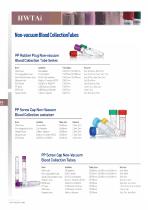
Non-vacuum Blood CollectionTubes
Open the catalog to page 1All HWTAi catalogs and technical brochures
 Lancet
19 Pages
 HWTAI Reagen bottle 2023
20 Pages
 Mechanical pipette- HWTAi
10 Pages
 Syringe Series-hwtai.com
3 Pages
 Extension Tube-Hwtai.com
1 Page
 Neele Series-Hwtai.com
1 Page
 Dental Series-Hwtai.com
2 Pages
 Insulin Series-Hwtai.com
3 Pages
 Mask Series-Hwtai
2 Pages
 Oxygen Therapy-Hwtai
1 Page
 Feeding tube-HWTAI
2 Pages
 Vaginal speculum-Hwtai
4 Pages
 Reagent Bottle-Hwtai
13 Pages
 Safety Lancets
7 Pages
 Flocked Swab-HWTAi
2 Pages
 Vacuum Tube-HWTAI
3 Pages
 Pipette Tip-Hwtai
5 Pages
 Test Tube-Hwtai
4 Pages
 Specimen Container-Hwtai
3 Pages
 Deep Well 96 Plate-HWTai
3 Pages


Archived catalogs
 HWTAI Medium 2023 V1
88 Pages
 PET animal testing products
20 Pages


Related Searches
- Detection kit
- Solvent reagent
- Blood detection kit
- Serum detection kit
- Catheter
- Immunoassay detection kit
- Rapid chromatographic immunoassay test
- Plasma detection kit
- Blood rapid screening test
- Cassette rapid test
- Immunoassay rapid diagnostic test
- Research reagent
- Laboratory reagent
- Skin and body treatment unit
- Infectious disease detection kit
- Diagnostic reagent
- Positioning pillow
- Rapid serum test
- Unisex medical clothing
*Prices are pre-tax. They exclude delivery charges and customs duties and do not include additional charges for installation or activation options. Prices are indicative only and may vary by country, with changes to the cost of raw materials and exchange rates.
About MedicalExpo
MedicalExpo is a marketplace that offers B2B players a complete experience, from product sourcing to purchase. MedicalExpo is an entity of VirtualExpo Group.
Are you a buyer?
Are you a supplier?