
- Catalogs
- iac Acoustics
- Rubber Buffers - GB

Rubber Buffers - GB

Rubber Buffers - GB
Product Description
The document details rubber buffers composed of natural rubber blocks vulcanised onto galvanized steel plates with central threads. These buffers vary in density to provide different damping characteristics suitable for shock absorption and vibration control.
Applications
Rubber buffers are used to absorb kinetic energy and reduce impact shocks in equipment such as cranes, rail wagons, and stopping mechanisms. They also function as limiting elements to control extreme oscillations and resonance frequency shifts, and can be integrated into flexible guide rails.
Installation and Fitting
Buffers can be mounted on fixed or mobile machinery parts. For enhanced damping, two buffers may be installed in series opposite each other to increase shock absorption capacity.
Technical Specifications
- Buffer Types: GB2517, GB3036, GB5045, GB5068, GB7590, GB90110.
- Load Capacity: Peak loads range from 15–20 kg (GB2517) up to 800 kg (GB90110), with normal operating loads recommended at about half the peak load.
- Dimensions: Diameter ranges from 25 mm to 90 mm; height ranges from 17 mm to 110 mm.
- Thread Sizes: Metric threads from M6x18 to M12.
Performance Data – Load vs Deflection
Extensive load-deflection curves illustrate the relationship between applied load (kg) and deflection (mm) for various buffer models, essential for selecting appropriate buffers based on stiffness and energy absorption needs.
- GB2517: Max load ~20 kg, deflection up to 20 mm.
- GB3036: Max load ~80 kg, deflection up to 40 mm.
- GB5045 & GB5068: Max loads up to 400 kg, deflections up to 30 mm.
- GB7590 & GB90110: Max loads up to 1000 kg, deflections up to 40 mm.
Additional series such as FA, IAC SD, SANDWICH, MD, SCB, and FDA provide varied load-deflection profiles and natural frequency data, indicating suitability for diverse vibration damping applications.
Key Parameters and Recommendations
- Peak load values correspond to short duration (~1 second); normal loads should be about half peak load for durability.
- Deflection data informs buffer stiffness and energy absorption capacity.
- Buffers can be combined in series to enhance damping performance.
- Selection criteria should include load, deflection, natural frequency, and installation context.
Detailed Buffer Load-Deflection Characteristics
Graphs for multiple buffer models (e.g., AD series, ADF, ADM, ADP) show load capacities from tens to thousands of kilograms and deflections typically from 0 to 5 mm, with some models allowing up to 30 mm. Load-deflection curves generally indicate elastic or progressive deformation behavior.
Material Variants and Performance
- Sandwich Series: Very high load capacity up to 16,000 kg with deflections up to 5 mm, ideal for heavy-duty applications.
- GB Series: Broad load range (20–1000 kg) with deflections up to 40 mm, suitable for medium loads.
- White and White Hollow: Moderate load capacities with smaller deflection ranges, suited for lighter loads.
FDA Series Buffers
FDA series buffers (FDA-25 to FDA-100 and FDA1 to FDA9) exhibit scalable load capacities from hundreds to thousands of kilograms and deflections up to 30 mm, supporting a wide range of load requirements.
SCB Series Buffers
SCB buffers (various sizes) include load-deflection and natural frequency data, with load capacities from 10 to 1000 kg and deflections up to ~3 mm. Natural frequency information highlights their suitability for vibration-sensitive applications.
Configuration and Application Notes
Buffers can be arranged in parallel or series configurations to tailor mechanical response and serve as stops against extreme movements, enhancing safety and performance in dynamic load scenarios.
Summary of Critical Information
- Load Capacity: 10 kg to 16,000 kg depending on type and material.
- Deflection Range: Typically 0–5 mm; some models up to 30–40 mm.
- Material Impact: Sandwich materials offer highest load capacity; GB and FDA series cover medium to high loads; White variants suit lighter loads.
- Dynamic Properties: SCB series includes natural frequency data for vibration damping considerations.
- Configuration: Parallel and series arrangements recommended to optimize damping and safety stops.
This comprehensive data supports engineers and designers in selecting appropriate rubber buffers for energy absorption, shock mitigation, and controlled deflection in mechanical systems.
Catalog excerpts
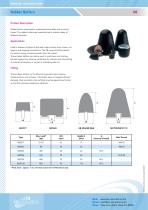
Rubber Buffers Product Description Rubber blocks vulcanised to a galvanised steel plate with a central thread. The rubber buffers are manufactured in natural rubber of different densities. Applications Used to dampen all types of drop and impact shocks from cranes, rail wagons and stopping mechanisms. The GB range of buffers absorb the kinetic energy, minimising shock from the impact. These rubber buffers can also be used in machinery as a limiting element against any extreme oscillations for instance with the shifting of resonance frequency or as part of a flexible guide rail. Fitting These rubber buffers can be fitted as required in either fixed or mobile sections of machinery. If the buffer does not supply sufficient damping, then two buffers can be fitted in series opposite each other so that the necessary damping is obtained. Bolt Thread Errors and Omissions Excepted (E&OE). * Peak load – approx. 1 sec. Normal load is half of Maximum load. Web: www.iac-acoustics.com Email: [email protected] Shop: View our online shop for AVMs
Open the catalog to page 1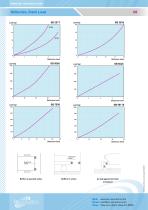
Deflection (mm) Deflection0(mm) Deflection (mm) 4 43 5 0 Deflection (mm) 5 White hollow on (mm) Deflection (mm) Load (kg) Load (kg) 250 800 White hollow Buffers in parallel setup 0 White hollow White hollow White hollow Deflection (mm) Deflection (mm) Load (kg) Load (kg) 250 800 IAC SD 4343 Load (kg) IAC SANDWICH 100 SD 4343 SANDWICH 100 White hollow Deflection (mm) Deflection (mm) Deflection (mm) Deflection (mm) White hollow 0 20 16 12 20 Deflection (mm) 16 Deflection (mm) Deflection (mm) Deflection (mm) Deflection (mm) Deflection (mm) Deflection (mm) Deflection (mm) Load (kg) Load (kg) 80 Load (kg) Deflection...
Open the catalog to page 2All Iac Acoustics catalogs and technical brochures
 Quiet-Duct® Silencers
8 Pages
 Round Cone Mounts - DRD
2 Pages
 Round Cone Mounts - DSD
2 Pages
 Rubber Metal Rails - GMS
3 Pages
 Rubber Pads - MF
1 Page
 Rubber Turret Mounts - FAV
2 Pages
 Sandwich Mount - VIKASH
1 Page
 Absorption Systems
3 Pages
 Radio 24-7
2 Pages
 Peregrines Pianos
2 Pages
 NBC Universal
2 Pages
 Kobalt Music Group
3 Pages
 IMG Studios
2 Pages
 Herning Hearing
2 Pages
 Financial Times
3 Pages
 Dolby
Dolby2 Pages
 Copenhagen University
2 Pages
 BBC Mailbox
4 Pages
 Trackwall Brochure
4 Pages
 Varitone Absorption Panels
3 Pages
 Security Rooms
3 Pages
 Police Interview Rooms
5 Pages
 Acoustic Barriers Brochure
7 Pages
 Audiology Facilities
25 Pages
 Audiometric Rooms
6 Pages
 Audiometric Booths
4 Pages


Archived catalogs
 Audiology Brochure
25 Pages
 350 Series Data Sheet
2 Pages
 250 Series Data Sheet
2 Pages