
- Catalogs
- IBI - Industrie Biomediche Insubri
- Surgical-procedures-SmartBone


Surgical-procedures-SmartBone

Surgical-procedures-SmartBone
- Evaluate the oral epithelium for keratinization.
- Make an incision above the muco-gingival junction and elevate the mucoperiosteal flap.
- Create an oval window in the canine fossa using chisels and mallet.
- Perform blunt dissection to access the bone and avoid perforating the Schneider membrane.
- Fill the bone cavity with SmartBone® Microchips, hydrated with patient's blood.
- Cover with a resorbable membrane and suture the flaps.
- Implants can be placed 6-7 months later after clinical evaluation.
- Ensure well-keratinized oral epithelium.
- Perform a surgical incision and elevate the muco-periodontal flap.
- Use SmartBone® for cellular colonization and osteogenic process.
- Shape SmartBone® carefully to avoid compromising its properties.
- Fix the block with osteo-synthesis screws and cover with a resorbable membrane.
- Suture the flaps without tension, using horizontal mattress sutures.
- Implant placement is possible after 7-9 months with clinical evaluation.
- Evaluate the gum's keratinization and perform a surgical incision.
- Use SmartBone® On Demand™ for bone defects, ensuring primary stability with screws.
- Cover with a resorbable membrane and suture the flaps without tension.
- Implant placement is possible after 7-9 months with clinical evaluation.
- Avoid using saline solution as it degrades the collagen fragments.
- Do not mix different bone substitutes.
- Ensure perfect contact between graft and native bone for stability.
- Use an atraumatic needle for suturing to avoid soft tissue dehiscence.
- SmartBone® is a composite bone substitute with high mechanical performance.
- It is designed to fit patient-specific defects and withstand surgical maneuvers.
Catalog excerpts
SURGICAL PROCEDURES swiss made
Open the catalog to page 1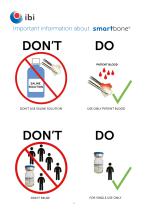
Important information about DON’T USE SALINE SOLUTION USE ONLY PATIENT BLOOD DON’T REUSE
Open the catalog to page 2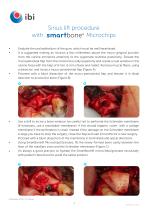
Sinus lift procedure with Microchips • • Evaluate the oral epithelium of the gum, which must be well keratinized. It is suggested making an incision a few millimeters above the muco-gingival junction from the canine eminence anteriorly to the zygomatic buttress posteriorly. Elevate the mucoperiosteal flap from the incision buccally/superiorly and create a oval window in the canine fossa with the help of 4 mm, 6 mm chisels and mallet. Remove muscle fibers, using a dissector, and incise a muco-periodontal flap (Figure A). Proceed with a blunt dissection of the muco-periodontal flap and elevate...
Open the catalog to page 3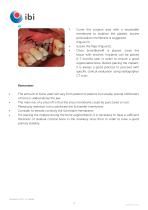
Cover the surgical area with a resorbable membrane to stabilize the platelet: bovine pericardium membrane is suggested (Figure D). Suture the flaps (Figure E). Once SmartBone® is placed, close the tissue with stitches. Implants can be placed 6-7 months later in order to ensure a good regenerated bone. Before placing the implant, it is always a good practice to proceed with specific clinical evaluation using radiography/ CT scan. The amount of bone used will vary from patient to patient, but usually several millimeters of bone is added above the jaw. The main risk of a sinus lift is that the sinus...
Open the catalog to page 4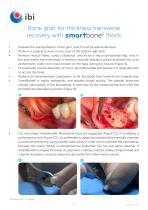
Bone graft for thickness transverse recovery with Block • • • Evaluate the oral epithelium of the gum, which must be well keratinized. Perform a surgical incision on the crest of the bottom right arch. Remove muscle fibers, using a dissector, and incise a muco-periodontal flap, only in the area where the bone block is inserted, because apically a partial thickness has to be performed in order not to have tension on the flaps during the closure (Figure A). Proceed with a blunt dissection of muco-periodontal flap and elevate it in distal direction to access the bone. Perform an intramedullary canalization...
Open the catalog to page 5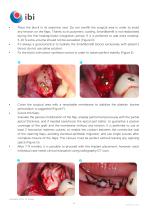
Place the block in its anatomic seat. Do not overfill the surgical area in order to avoid any tension on the flaps. Thanks to its polymeric coating, SmartBone® is not reabsorbed during the first healing/osteo-integration period. If it is preferred to add extra material, 5-10 % extra-volume should not be exceeded. (Figure D). It’s always a good practice to hydrate the SmartBone® blocks exclusively with patient’s blood, do not use saline solution. Fix the block with osteo-synthesis screws in order to obtain perfect stability (Figure E). D Cover the surgical area with a resorbable membrane to stabilize...
Open the catalog to page 6
Drill: it is preferable to maintain a cold environment by using a sterile water spray in order not to overheat the biomaterial, as this could modify its biomechanical properties. If SmartBone® is shaped/drilled intensely, its polymeric coating is widely compromised and a partial resorption could be observed during the first inflammation period. Avoid extensive modelling of the bone graft. For shaping the graft, the use of the bone cutter is preferred instead of drills. To perform an intramedullary canalization the Ø 1,1 mm drill or the round burr drill can be used. Be careful not to drill near...
Open the catalog to page 7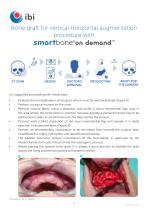
Bone graft for vertical-horizontal augmentation procedure with DOCTOR’S APPROVAL It is suggested proceeding with these steps: • • • Evaluate the oral epithelium of the gum, which must be well keratinized (Figure A). Perform a surgical incision on the crest. Remove muscle fibers, using a dissector, and incise a muco-periodontal flap, only in the area where the bone block is inserted, because apically a partial thickness has to be performed in order to avoid tension on the flaps during the closure. Proceed with a blunt dissection of the muco-periodontal flap and elevate it in distal direction to...
Open the catalog to page 8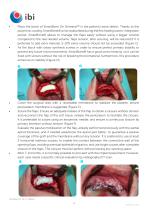
Place the block of SmartBone On Demand™ in the patient’s bone defect. Thanks to the polymeric coating, SmartBone® is not reabsorbed during the first healing/osteo-integration period. SmartBone® allows to manage the flaps easily without using a bigger volume compared to the real needed volume: flaps tension, after suturing, will be reduced.If it is preferred to add extra material, 5-10% extra-volume should not be exceeded (Figure C). Fix the block with osteo-synthesis screws in order to ensure perfect primary stability to prevent any future micromovements. SmartBone® has a good screw tenacity,...
Open the catalog to page 9
SmartBone® is a new composite bone substitute based on a novel concept of biomaterials assembly: it is obtained combining natural mineral structures with bioactive agents. SmartBone has extremely high mechanical performances, it can easily withstand heavy surgical manoeuvres and fixation devices, it can be precisely shaped and adapted to match the target defect, and it offers a very high tenacity to screws. Remember: • Drill: it is preferable to maintain a cold environment by using a water spray in order not to overheat the biomaterial, because this could modify its biomechanical properties....
Open the catalog to page 10
Industrie Biomediche Insubri SA Via Cantonale, 67 Mezzovico-Vira CH-6805 Switzerland Ph. +41 91 93 06 640 www.ibi-sa.com [email protected] These instructions are for educational purposes only. Surgical techniques may vary depending on the clinical operator.
Open the catalog to page 11All IBI - Industrie Biomediche Insubri catalogs and technical brochures
 SwissBone-Catalogue
4 Pages
 Brochure-SmartBone-Ortho.
12 Pages
 SmartBone-Ortho
8 Pages
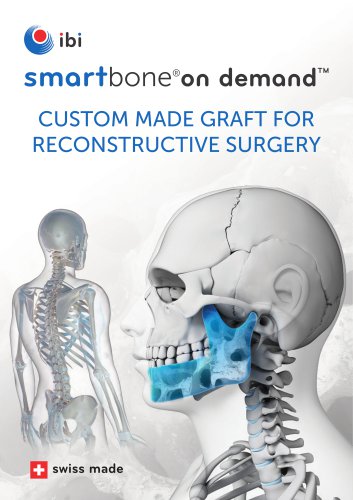 smartbone®on demand™
12 Pages
 Catalogue-SMARTBONE
4 Pages
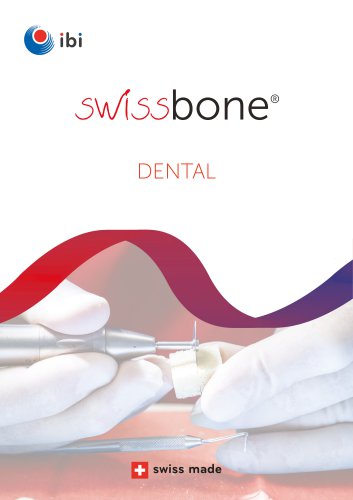 swiss bone
12 Pages
 SmartBone technology
8 Pages