- Catalogs
- IDE Vision
- MPS II Brochure

MPS II Brochure

MPS II Brochure
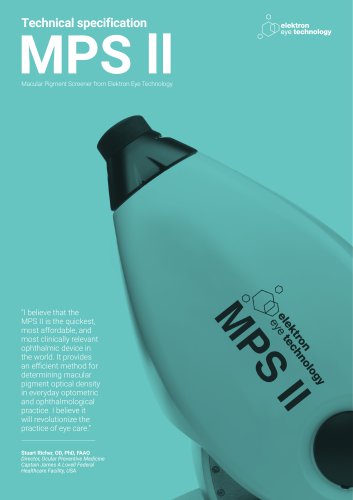
The document discusses the MPS II, a device designed to measure Macular Pigment Optical Density (MPOD) for early detection of Age-related Macular Degeneration (AMD). It highlights the device's potential to revolutionize eye care by providing a quick, affordable, and clinically relevant method for assessing AMD risk.
Global AMD Problem
AMD is a leading cause of vision loss, affecting millions globally. The document emphasizes the need for proactive solutions to manage AMD risk, particularly due to daily exposure to harmful blue light.
MPS II as a Solution
The MPS II is presented as a reliable, repeatable, intuitive, and fast device for measuring MPOD. It supports a proactive approach to AMD by enabling early detection and monitoring of risk factors.
Benefits of MPOD Screening
- Diversify Services: Offers MPOD screenings to detect AMD risk and educate patients.
- Business Growth: Generates new revenue through protective lens and supplement sales.
- Patient Protection: Regular screenings help monitor and manage preventative steps.
Clinical Evidence and Research
The document references several studies validating the effectiveness of MPOD measurement and the benefits of lutein and zeaxanthin supplementation in increasing MPOD.
Implementation Strategy
The MPS II can be integrated into practice through a three-step process: screening for MPOD, recommending lifestyle changes, and regular re-screening to assess preventative measures.
Technical Specifications
The MPS II is a computerized device with specific technical features, including a central and peripheral test mode, USB connectivity, and compatibility with MS Windows.
Conclusion
The MPS II is positioned as a cost-effective tool that adds value to both patients and practices by enabling early detection and management of AMD risk, ultimately contributing to better eye health outcomes.
Catalog excerpts

Early detection of AMD risk "I believe that the MPS II is the quickest, most affordable, and most clinically relevant ophthalmic device in the world. It provides an efficient method for determining macular pigment optical density in everyday optometric and ophthalmological practice. I believe it will revolutionize the practice of eye care.” Stuart Richer, OD, PhD, FAAO Director, Ocular Preventive Medicine Captain James A Lovell Federal Healthcare Facility, USA
Open the catalog to page 1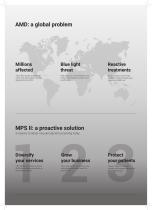
Millions affected 196 million people projected to suffer from age-related macular degeneration by 2020 Blue light threat Daily exposure to harmful blue light means even greater numbers could be affected Reactive treatments No attempts to reduce high healthcare costs through early detection of AMD risk 3 reasons to adopt macular pigment screening today: Diversify your services Offer MPOD screenings to detect AMD risk and educate patients on preventative choices Grow your business New revenues from protective lens and supplement sales boost the bottom line Protect your patients Regular repeat screenings...
Open the catalog to page 2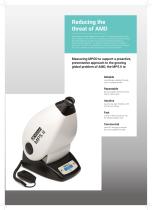
Reducing the threat of AMD Age-related macular degeneration (AMD) is a leading cause of vision loss worldwide. The MPS II is a portable screening device that enables early identification of AMD risk by measuring Macular Pigment Optical Density (MPOD). Low MPOD is a significant but modifiable risk factor for AMD. Once identified it can be monitored and corrected over time, enabling a proactive approach to a global problem. Measuring MPOD to support a proactive, preventative approach to the growing global problem of AMD, the MPS II is: Reliable scientifically validated through use in multiple studies...
Open the catalog to page 3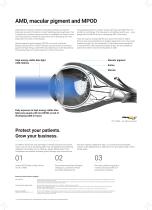
AMD, macular pigment and MPOD AMD affects hundreds of millions of people worldwide and reactive treatment accounts for billions in direct healthcare spend each year. This is despite the condition having a number of modifiable risk factors which can be proactively controlled to reduce the risk of developing the most advanced (‘wet’) form of the disease. Macular pigment optical density (MPOD) is one such risk factor. Measured by the MPS II, MPOD indicates a person’s level of protection against the high-energy visible (HEV) blue light known to be absorbed by the protective layer of macular pigment...
Open the catalog to page 4
The MPS II in practice Prevention beats intervention Prevent Stage 1. No AMD • Strategy: Assess children of AMD patients, as well as 'worried well' to detect risk of developing AMD • Tactics: MPS II screening along with analysis of other risk factors • Results: Delay early onset of AMD through preventative management strategy Mitigate Stage 2. Dry AMD • Strategy: Manage, monitor and mitigate likelihood of disease progression • Tactics: Lifestyle changes; supplementation to increase MPOD; monitor six monthly • Results: Reduce disease progression and improve visual acuity Intervene Stage 3. Wet...
Open the catalog to page 5
Device type Computerised device capable of assessing macular pigment optical density (MPOD) Target viewing distance set to infinity Background luminance set at 250 cd/m2) Central stimulus Integrated output from blue, green and white LEDs Stimulus target angular subtense 1° Peripheral fixation Integrated output from red LEDs Angular subtense ~2° Peripheral target offsets minimum +/- 6° Test modes Standard A central only test estimating MPOD value by comparing result with age normative data Detailed A central test plus a peripheral test, during which the patient fixates on an offset target. The...
Open the catalog to page 6